4,068 posters, 219 videos, 101 topics, 69 sessions, 14,365 authors, 6,128 institutions
ePostersLive by SciGen Technologies S.A. All rights reserved.
Alzheimer's Association International Conference 2026
July 12-15, 2026 | London, United Kingdom, and Online

2252
Hunting For The Aggregation Culprits - Individual And Combined Effects Of Post-translational Modifications On Tau Pathology
Poster Presenter
Authors
Affiliations
Part of Topic
Video
As global longevity rises, Alzheimer’s disease (AD) is poised to become a defining challenge for medicine and society with up to 140 million people affected by 2050. AD profoundly impacts patients and caregivers while driving escalating healthcare costs. Despite extensive research, its exact molecular etiology remains unclear, and current treatments largely slow progression rather than modify disease. Improving treatment outcome requires earlier, more accurate diagnostics and the identification of actionable biomarkers and drug targets.
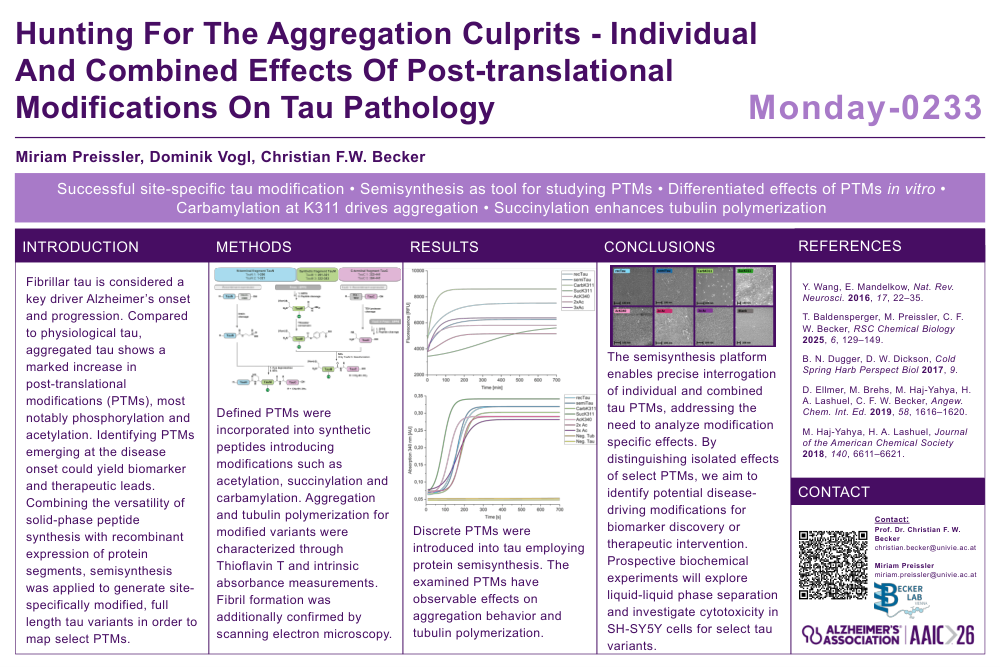
A pathological hallmark of AD are amyloidogenic protein aggregates of amyloid β and tau. Physiological, monomeric tau promotes tubulin polymerization and stabilizes microtubules, whereas oligomeric and aggregated tau disrupts neuronal structure and plasticity. Tau from AD brains exhibits distinct post-translational modification (PTM) patterns, offering promising avenues for biomarker discovery and therapeutic development.
Protein semisynthesis enables generation of site-specifically modified tau variants by ligating synthetic peptides or recombinant fragments. Herein, solid-phase peptide synthesis facilitates precise installation of defined PTMs including phosphorylation, acetylation and succinylation at target residues. Using this platform, we produced tau variants bearing discrete PTMs within the microtubule binding domain and assessed effects on aggregation highlighting the importance of semisynthesis in addressing our current knowledge gap regarding modification-specific effects. Further work will expand upon the biochemical characterization by assessing tubulin polymerization, liquid–liquid phase separation, cellular uptake, and cytotoxicity in SH-SY5Y cells.
Comments
Email is required but is not shown publicly.
Loading comments...