4,068 posters, 219 videos, 101 topics, 69 sessions, 14,365 authors, 6,128 institutions
ePostersLive by SciGen Technologies S.A. All rights reserved.
Alzheimer's Association International Conference 2026
July 12-15, 2026 | London, United Kingdom, and Online

9016
Perceived Neighborhood Context And Memory Performance Among Older Black Women At Risk For Cognitive Decline
Poster Presenter
Authors
Linisa Williams, Breanna Holloway, Joy Stradford, Michelle Jackson, Julia Talavera, Savannah Behboudi, Nadine Heyworth, Marc Norman, April Thames, Sarah Banks, Erin Sundermann
Affiliations
Department of Psychiatry, University of California, San Diego, Department of Neurosciences, University of California, San Diego, Department of Psychiatry, University of California, Los Angeles
Part of Topic
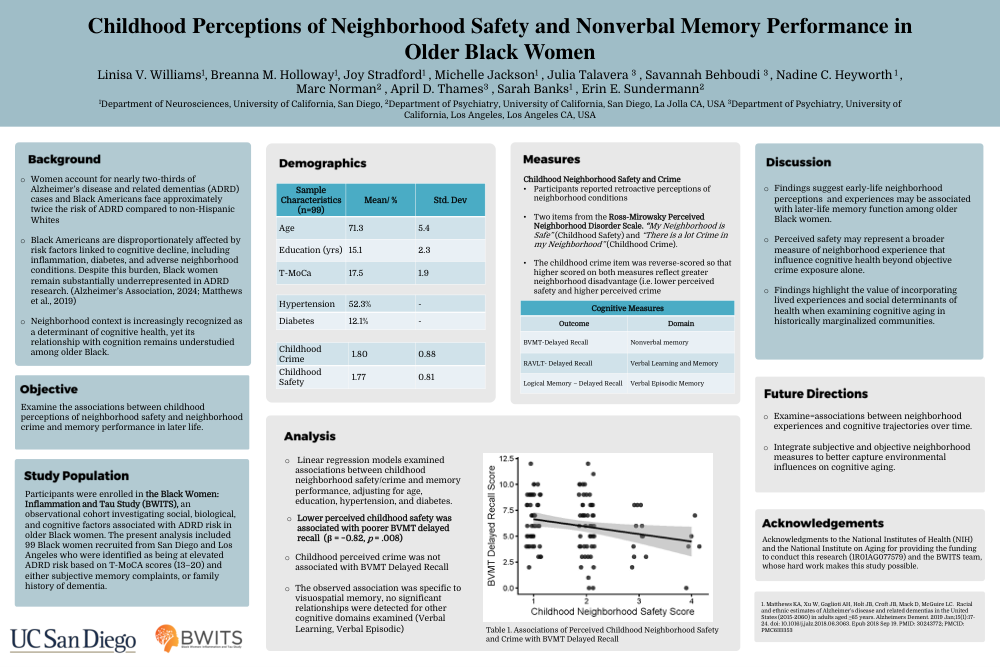
Background: Black women have the highest risk for Alzheimer’s disease and related dementias and are disproportionately exposed to adverse neighborhood conditions that may shape cognitive health. Neighborhood context is increasingly recognized as an important determinant of cognitive health. However, these associations are not well characterized among older Black women at elevated risk for cognitive decline. This study examined perceived neighborhood safety and crime in relation to memory performance among older Black women. We hypothesized that worse perceived neighborhood safety and crime would be associated with worse memory performance.
Methods: Participants were 72 older Black women (mean age=71 ± 5.5 years; mean education=15 ± 2.4 years) at elevated AD risk based on mild deficits on the Montreal Cognitive Assessment score and family history of dementia. Memory outcomes were nonverbal memory (Brief Visuospatial Memory Test-Delayed Recall), verbal list learning (Rey Auditory Verbal Learning Test-Delayed), and verbal episodic memory (Logical Memory-Delayed Recall). Current perceived neighborhood safety and crime were assessed using separate items from the Ross-Mirowsky Perceived Neighborhood Disorder Scale, with higher scores indicating lower safety and higher crime. Separate standard multiple linear regression models examined associations between perceived neighborhood safety and perceived neighborhood crime with each memory outcome, adjusting for age, education, hypertension, and diabetes. Sensitivity analyses were performed adjusting for neighborhood socioeconomic disadvantage using the Area Deprivation Index (ADI).
Results: Worse perceived neighborhood safety was significantly associated with poorer nonverbal, but not verbal, memory (R² = .18, F(5,67)=2.85, p=.021; β=−.23, p=.048). In sensitivity analyses adjusting for ADI, the overall model predicting nonverbal memory remained significant (R² = .18, F(6,66)=2.35, p=.041), although the association between perceived neighborhood safety and nonverbal memory was attenuated to trend level (β=−.23, p=.053). Perceived neighborhood crime was not significantly associated with any memory outcome, with or without ADI adjustment.
Conclusion: Results suggest an association between perceived neighborhood safety and nonverbal memory that is distinct from perceived crime exposure. The specificity to nonverbal memory suggests potential domain-specific sensitivity to environmental context, while attenuation after ADI adjustment suggests overlap with broader neighborhood disadvantage. These findings support further longitudinal investigation into whether neighborhood perceptions contribute to cognitive trajectories over time.
Comments
Email is required but is not shown publicly.
Loading comments...