4,068 posters, 219 videos, 101 topics, 69 sessions, 14,365 authors, 6,128 institutions
ePostersLive by SciGen Technologies S.A. All rights reserved.
Alzheimer's Association International Conference 2026
July 12-15, 2026 | London, United Kingdom, and Online

10868
Association Between Bmi Transition Patterns And Dementia Risk In Older Adults Evidence From Health And Retirement Survey hrs
Poster Presenter
Authors
Affiliations
Part of Topic
Association of Body Mass Index Variability With Risk of Dementia and Mild Cognitive Impairment in Older Adults
Liang Lai, Eunhae Shin, Janani Rajbhandari Thapa, Suhang Song
Department of Health Policy and Management, University of Georgia College of Public Health
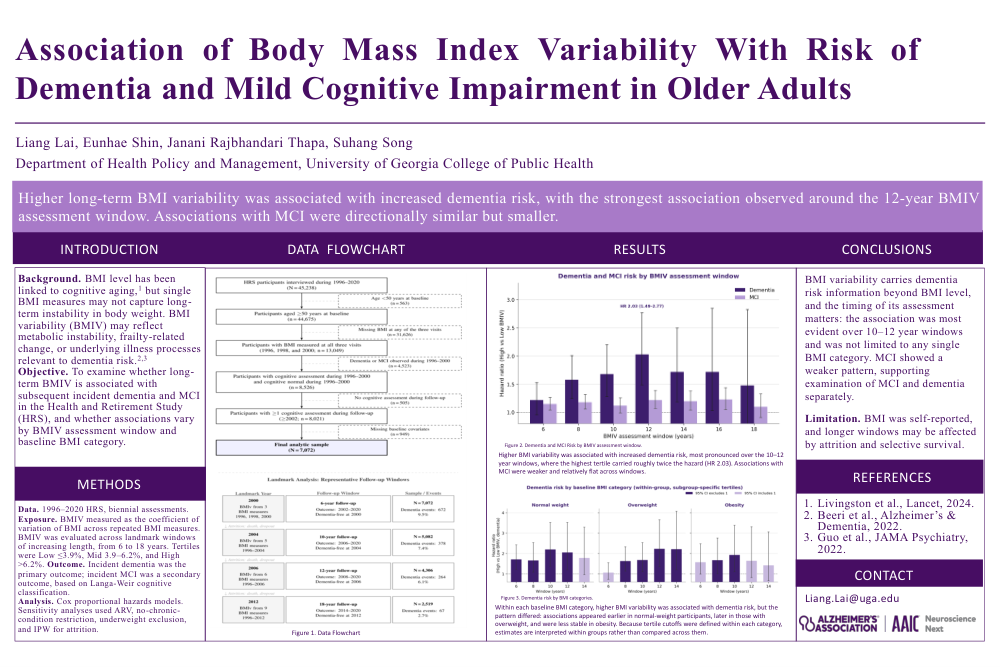
Higher long-term BMI variability was associated with increased dementia risk, with the strongest association observed around the 12-year BMIV assessment window. Associations with MCI were directionally similar but smaller.
Background. BMI level has been linked to cognitive aging,1 but single BMI measures may not capture long-term instability in body weight. BMI variability (BMIV) may reflect metabolic instability, frailty-related change, or underlying illness processes relevant to dementia risk.2,3
Objective. To examine whether long-term BMIV is associated with subsequent incident dementia and MCI in the Health and Retirement Study (HRS), and whether associations vary by BMIV assessment window and baseline BMI category.
Data. 1996–2020 HRS, biennial assessments.
Exposure. BMIV measured as the coefficient of variation of BMI across repeated BMI measures. BMIV was evaluated across landmark windows of increasing length, from 6 to 18 years. Tertiles were Low ≤3.9%, Mid 3.9–6.2%, and High >6.2%. Outcome. Incident dementia was the primary outcome; incident MCI was a secondary outcome, based on Langa-Weir cognitive classification.
Analysis. Cox proportional hazards models. Sensitivity analyses used ARV, no-chronic-condition restriction, underweight exclusion, and IPW for attrition.
Results. Higher BMI variability was associated with increased dementia risk, most pronounced over the 10-12 year windows, where the highest tertile carried roughly twice the hazard. Associations with MCI were weaker and relatively flat across windows. Within each baseline BMI category, higher BMI variability was associated with dementia risk, but the pattern differed across normal weight, overweight, and obesity groups.
Conclusions. BMI variability carries dementia risk information beyond BMI level, and the timing of its assessment matters: the association was most evident over 10–12 year windows and was not limited to any single BMI category. MCI showed a weaker pattern, supporting examination of MCI and dementia separately.
Limitation. BMI was self-reported, and longer windows may be affected by attrition and selective survival.
Contact: Liang.Lai@uga.edu
Comments
Email is required but is not shown publicly.
Loading comments...