4,068 posters, 219 videos, 101 topics, 69 sessions, 14,365 authors, 6,128 institutions
ePostersLive by SciGen Technologies S.A. All rights reserved.
Alzheimer's Association International Conference 2026
July 12-15, 2026 | London, United Kingdom, and Online

1400
The Clinical Presentation Of Amygdala Predominant Lewy Body Pathology
Poster Presenter
Authors
Affiliations
Part of Topic
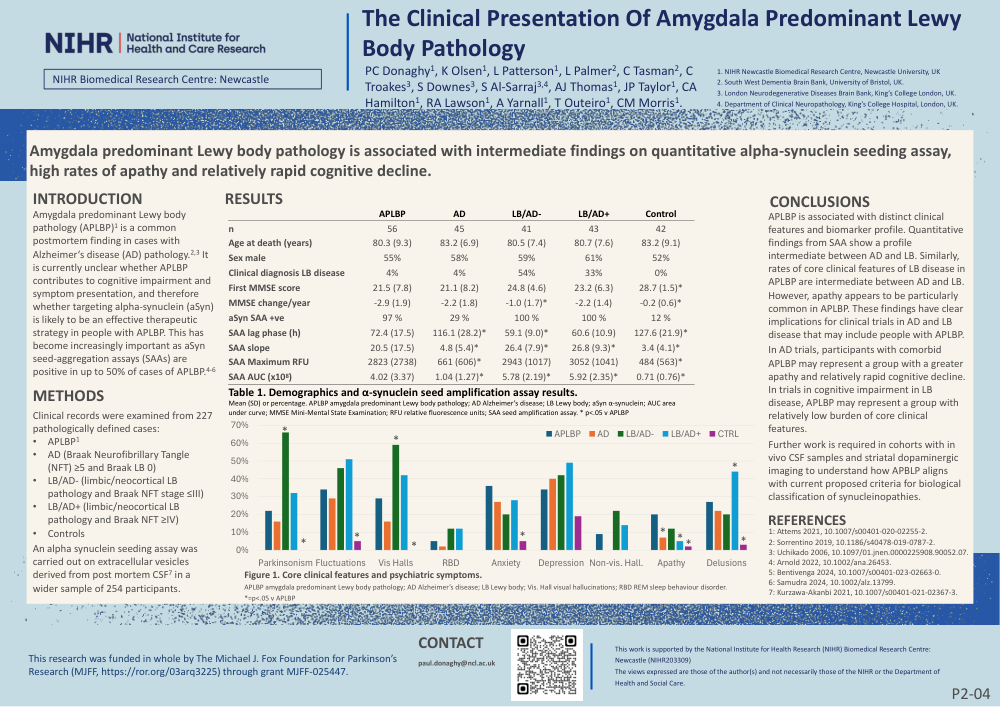
Amygdala predominant Lewy body pathology is associated with intermediate findings on quantitative alpha-synuclein seeding assay, high rates of apathy and relatively rapid cognitive decline.
Amygdala predominant Lewy body pathology (APLBP)1 is a common postmortem finding in cases with Alzheimer‘s disease (AD) pathology.2,3 It is currently unclear whether APLBP contributes to cognitive impairment and symptom presentation, and therefore whether targeting alpha-synuclein (aSyn) is likely to be an effective therapeutic strategy in people with APLBP. This has become increasingly important as aSyn seed-aggregation assays (SAAs) are positive in up to 50% of cases of APLBP.4-6
Clinical records were examined from 227 pathologically defined cases:
An alpha synuclein seeding assay was carried out on extracellular vesicles derived from post mortem CSF7 in a wider sample of 254 participants.
APLBP is associated with distinct clinical features and biomarker profile. Quantitative findings from SAA show a profile intermediate between AD and LB. Similarly, rates of core clinical features of LB disease in APLBP are intermediate between AD and LB. However, apathy appears to be particularly common in APLBP. These findings have clear implications for clinical trials in AD and LB disease that may include people with APLBP.
In AD trials, participants with comorbid APLBP may represent a group with a greater apathy and relatively rapid cognitive decline. In trials in cognitive impairment in LB disease, APLBP may represent a group with relatively low burden of core clinical features.
Further work is required in cohorts with in vivo CSF samples and striatal dopaminergic imaging to understand how APBLP aligns with current proposed criteria for biological classification of synucleinopathies.
Comments
Email is required but is not shown publicly.
Loading comments...