4,068 posters, 219 videos, 101 topics, 69 sessions, 14,365 authors, 6,128 institutions
ePostersLive by SciGen Technologies S.A. All rights reserved.
Alzheimer's Association International Conference 2026
July 12-15, 2026 | London, United Kingdom, and Online

7220
Biological Sex Differences In Clinical Parkinsonian Signs And Parkinson’S Disease Pathology In Community-dwelling Older Adults
Poster Presenter
Part of Topic
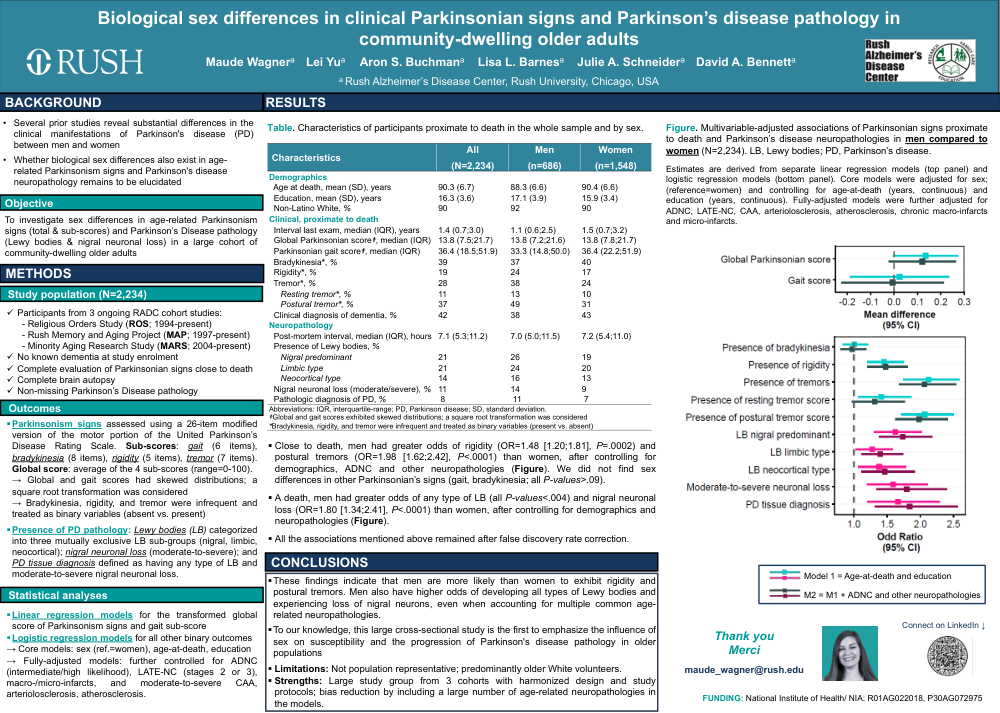
Background: Several prior studies reveal substantial differences in the clinical manifestations of Parkinson's disease (PD) between women and men. In this study, we expanded on those findings by investigating sex differences in age-related Parkinsonism signs and PD pathology.
Methods: We analyzed 2,121 autopsied participants (mean age-at-death=90 years; 69% female; Table) from three ongoing cohort studies at the Rush Alzheimer's Disease Center. Participants underwent a complete evaluation of Parkinsonian signs proximate to death (median antemortem interval=1.4y) and had non-missing data on PD neuropathology systematically examined at brain autopsy, including Lewy bodies and loss of nigral neurons. A 26-item modified version of the motor portion of the United Parkinson's Disease Rating Scale was used to calculate scores for four parkinsonian signs: gait, rigidity, bradykinesia, and tremor, as well as a summary global score; higher scores indicating more severe signs. The global Parkinsonian and gait scores displayed positively skewed distributions and were transformed using a square root. Rigidity, bradykinesia, and tremors were infrequent and were categorized as either present or absent. Pathologic PD diagnosis was defined by the presence of Lewy bodies (any type: nigral, limbic, or neocortical) and moderate-to-severe nigral neuronal loss. A series of regression models, adjusted for demographics, were employed to assess sex differences in the severity of global parkinsonism and gait, along with the odds of rigidity, bradykinesia, tremors, and PD pathology.
Results: Proximate to death, there were no apparent sex differences in global parkinsonism signs or gait (all P>.50; Figure). However, men exhibited substantially higher odds than women of showing tremors (Odd Ratio [OR]=1.93; 95%CI=1.57-2.36; P<.0001) and rigidity (OR=1.58; 95%CI=1.26-1.99; P<.0001) (Figure). At the time of death, men also had higher odds of presenting any type of Lewy bodies: nigral (OR=1.62; 95%CI=1.30-2.03; P<.0001), limbic (OR=1.42; 95%CI=1.13-1.7; P=.003), neocortical (OR=1.39; 95%CI=1.07-1.81; P=.01) (Figure). Additionally, men were more likely than women to present moderate-to-severe loss of nigral neurons (OR=1.64; 95%CI=1.22-2.18; P=.001) (Figure).
Conclusions: These findings indicates that older men are more likely to show specific age-related Parkinsonian signs and develop Parkinson's disease pathology compared to women, highlighting the role of sex in the disease's susceptibility and progression of PD pathology.
Comments
Email is required but is not shown publicly.
Loading comments...