4,068 posters, 219 videos, 101 topics, 69 sessions, 14,365 authors, 6,128 institutions
ePostersLive by SciGen Technologies S.A. All rights reserved.
Alzheimer's Association International Conference 2026
July 12-15, 2026 | London, United Kingdom, and Online

5117
Robust Integrative Genomic Association (RIGA) Framework To Uncover Complex Genetic Architecture From Diverse Multicohort Studies
Poster Presenter
Authors
Xiaoqi Li, Xihao Li, Borui Tang, Tengfei Li, Weili Lin, Hongtu Zhu
Affiliations
Part of Topic
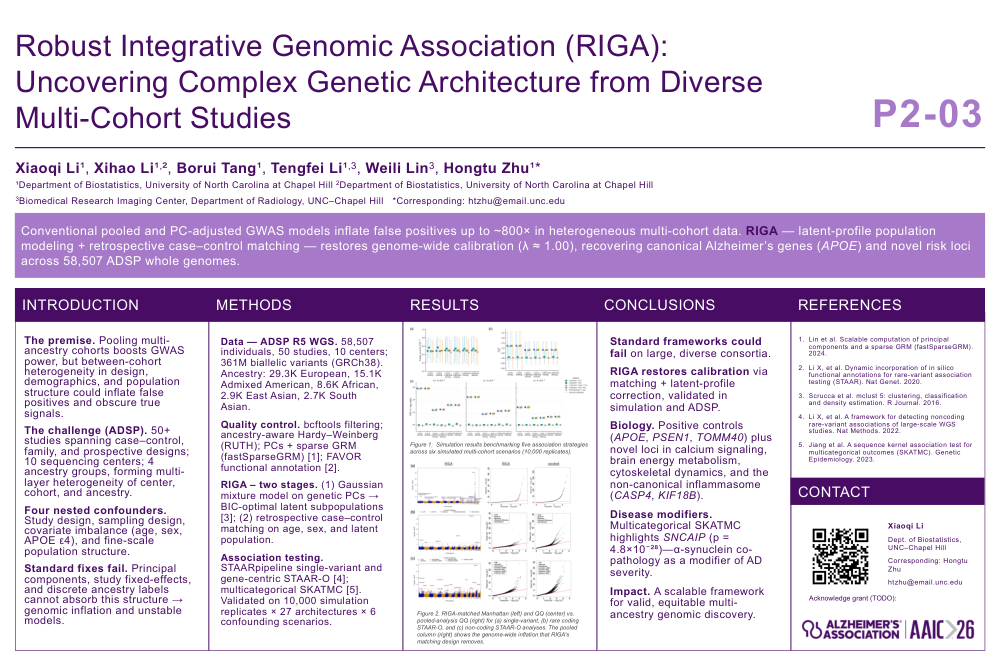
onventional pooled and PC-adjusted GWAS models inflate false positives up to ~800× in heterogeneous multi-cohort data. RIGA — latent-profile population modeling plus retrospective case-control matching — restores genome-wide calibration, recovering canonical Alzheimer’s genes such as APOE and novel risk loci across 58,507 ADSP whole genomes.
Introduction:
Pooling multi-ancestry cohorts boosts GWAS power, but between-cohort heterogeneity in design, demographics, and population structure can inflate false positives and obscure true signals. The ADSP dataset includes more than 50 sequencing case-control studies spanning case-control, family, and prospective designs; 10 sequencing centers; and four ancestry groups, forming multi-layer heterogeneity of center, cohort, and ancestry. Four nested confounders include study design, sampling design, covariate imbalance in age, sex, and APOE ε4, and fine-scale population structure. Standard fixes such as principal components, study fixed effects, and discrete ancestry labels cannot fully absorb this structure, leading to genomic inflation and unstable models.
Methods:
We analyzed ADSP R5 whole-genome sequencing data from 58,507 individuals, 50 studies, and 10 centers, including 361 million biallelic variants on GRCh38. The ancestry composition included approximately 29.3K European, 15.1K Admixed American, 8.6K African, 2.9K East Asian, and 2.7K South Asian individuals. Quality control included bcftools filtering, ancestry-aware Hardy-Weinberg testing using RUTH, principal components and sparse genetic relatedness matrix estimation using fastSparseGRM, and FAVOR functional annotation. RIGA uses two stages: first, Gaussian mixture modeling on genetic principal components to identify BIC-optimal latent subpopulations; second, retrospective case-control matching on age, sex, and latent population. Association testing was performed using STAARpipeline single-variant and gene-centric STAAR-O tests and multicategorical SKATMC. The approach was validated using 10,000 simulation replicates across 27 architectures and six confounding scenarios.
Results:
Simulation benchmarking showed that conventional pooled and PC-adjusted GWAS models can produce severe genomic inflation and false-positive signals in heterogeneous multi-cohort data. RIGA-match restored genome-wide calibration while maintaining power to identify true Alzheimer’s disease risk signals. In ADSP whole-genome sequencing analysis, RIGA recovered known Alzheimer’s disease genes including APOE, PSEN1, and TOMM40 and identified novel risk loci related to calcium signaling, brain energy metabolism, cytoskeletal dynamics, and non-canonical inflammasome pathways. Multicategorical SKATMC highlighted SNCAIP as associated with Alzheimer’s disease severity, suggesting alpha-synuclein co-pathology as a potential disease modifier.
Conclusions:
Standard GWAS frameworks may fail in large, diverse consortia with multi-layer population and study heterogeneity. RIGA restores calibration through latent-profile population correction and retrospective case-control matching, validated in both simulation and ADSP data. This framework provides a scalable approach for valid and equitable multi-ancestry genomic discovery.
Contact:
Xiaoqi Li, Department of Biostatistics, UNC-Chapel Hill. Corresponding author: Hongtu Zhu.
Comments
Email is required but is not shown publicly.
Loading comments...