4,068 posters, 219 videos, 101 topics, 69 sessions, 14,365 authors, 6,128 institutions
ePostersLive by SciGen Technologies S.A. All rights reserved.
Alzheimer's Association International Conference 2026
July 12-15, 2026 | London, United Kingdom, and Online

3684
Inflammation-associated Transcriptional Changes In Memory Circuits Of Alzheimer's Disease Mice
Poster Presenter
Authors
Paula Sotillo Sotillo, Maria D. Capilla-López, Ángel Deprada, Erika Rangel, Alejandra Delprat, José Rodríguez-Alvarez, Arnaldo Parra-Damas, Carlos A. Saura
Affiliations
1. Institut de Neurociències, Departament de Bioquímica i Biologia Molecular, Universitat Autònoma de Barcelona, Bellaterra, Barcelona 08193, Spain 2. Centro de Investigación Biomédica en Red Enfermedades Neurodegenerativas (CIBERNED), Instituto de Salud Carlos III, Madrid 28031, Spain, 1. Institut de Neurociències, Departament de Bioquímica i Biologia Molecular, Universitat Autònoma de Barcelona, Bellaterra, Barcelona 08193, Spain 2. Centro de Investigación Biomédica en Red Enfermedades Neurodegenerativas (CIBERNED), Instituto de Salud Carlos III, Madrid 28031, Spain 3.Hospital Universitari Parc Taulí, Institut d’Investigació i Innovació Parc Taulí (I3PT-CERCA), Universitat Autònoma de Barcelona, Sabadell 08208, Spain, 1. Institut de Neurociències, Departament de Bioquímica i Biologia Molecular, Universitat Autònoma de Barcelona, Bellaterra, Barcelona 08193, Spain
Part of Topic
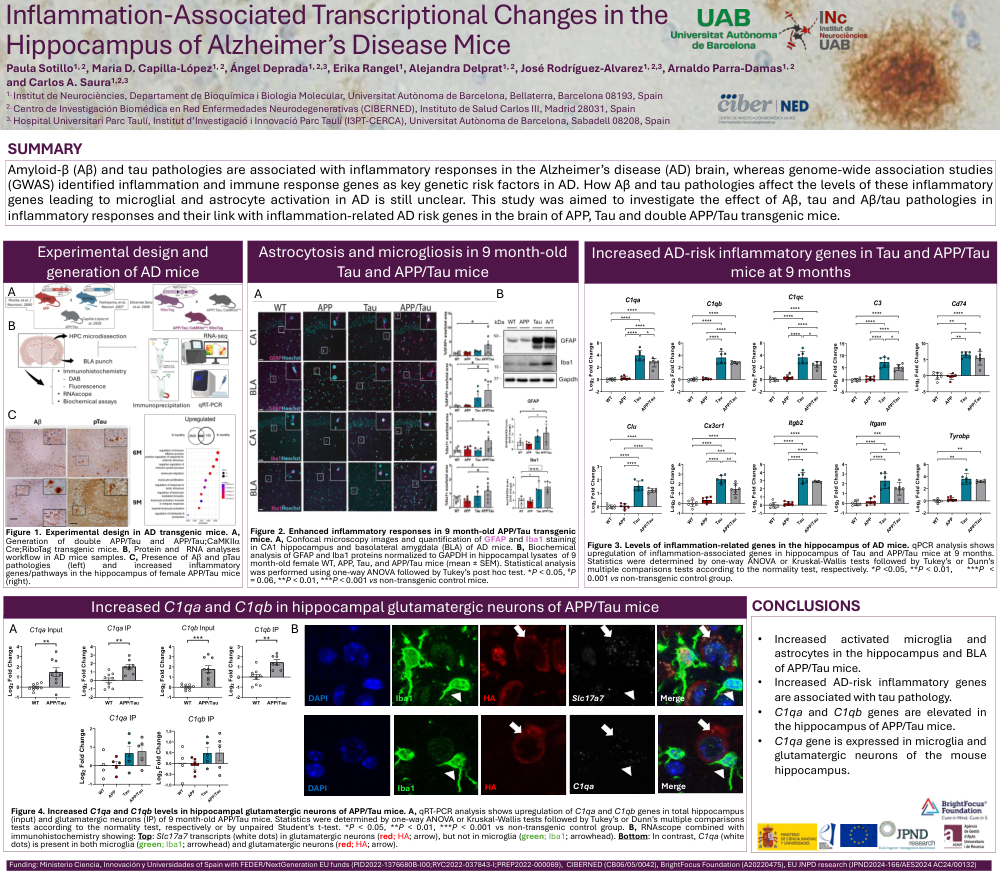
Background: Accumulation of amyloid-β (Aβ) and tau-containing neurofibrillary tangles is closely associated with inflammatory responses in the Alzheimer’s disease (AD) brain. Interestingly, recent genome-wide association studies (GWAS) identified inflammation and immune response-related genes as key genetic risk factors in sporadic AD, but how Aβ and/or tau pathologies affect the expression of these inflammatory genes leading to microglial and astrocyte activation in AD brain is unclear. To study the relationship between these AD pathological hallmarks, we recently generated novel double APP/Tau transgenic mice that develop age-dependent Aβ and phosphorylated tau pathologies and inflammatory responses in memory-related neural circuits (Capilla-López et al., Mol Psyc 2025). In this study, we aimed to investigate the effect of Aβ and tau pathologies in inflammatory responses (microgliosis and astrocytosis) and their link with inflammation-related AD risk genes in the brain of single APP and Tau, and double APP/Tau transgenic mice.
Methods: We have performed bulk and cell-specific transcriptomics analysis (bulk and RiboTag RNA-Seq) in the hippocampus of APP, Tau and APP/Tau transgenic mice at ages characterized by accumulation of Aβ plaques and/or Tau pathologies in the hippocampus. Moreover, we performed gene (qRT-PCR, RNAscope) and protein analyses (Western blot) for immune response- and complement-related molecules.
Results: We found 63 differentially expressed AD risk genes, including astrocytic and microglial expressed genes (Apoe, Gfap, Stat3, Aif1, Cx3cr1, Itgax), associated with activated microglia and reactive astrocytes in the bulk hippocampus and/or amygdala of 9 month-old double APP/Tau transgenic mice. Furthermore, cell-specific RiboTag profiling of hippocampal excitatory neurons showed upregulation of inflammatory genes related to the complement pathway (C1qa, C1qb, C1qc, C3, Itgb2). Moreover, we found an age-dependent increase of transcript and/or protein levels of complement-related genes in the hippocampus of Tau and/or APP/Tau transgenic mice.
Conclusions: This study provides evidence of inflammatory responses associated with transcriptional changes of AD risk inflammatory genes differentially associated with Aβ and tau pathologies in memory circuits of AD mice. Study supported by grants from Agencia Estatal de Investigación, Ministerio de Ciencia e Innovación of Spain (FEDER and “NextGenerationEU”/PRTR” funds: PID2022-137668OB-I00), CIBERNED (CB06/05/0042), BrightFocus Foundation (A2022047S), AGAUR/Generalitat de Catalunya (2021 SGR00142) and FPI Fellowship PREP2022-000069).
Comments
Email is required but is not shown publicly.
Loading comments...