4,068 posters, 219 videos, 101 topics, 69 sessions, 14,365 authors, 6,128 institutions
ePostersLive by SciGen Technologies S.A. All rights reserved.
Alzheimer's Association International Conference 2026
July 12-15, 2026 | London, United Kingdom, and Online

1597
How consciousness science can make sense of what it is like to have severe dementia
Poster Presenter
Authors
Affiliations
Part of Topic
INTRODUCTION
•Understanding how awareness changes with the progression of AD is essential for person-centred care.
•Assessment of awareness is especially challenging in severe AD due to impairments in communication.
•EEG and fMRI markers established in healthy older adults may reveal preserved awareness in Alzheimer’s disease (AD).
AIMS: To determine whether established neural signatures of visual awareness remain detectable across mild–moderate and severe Alzheimer's disease.
METHODS
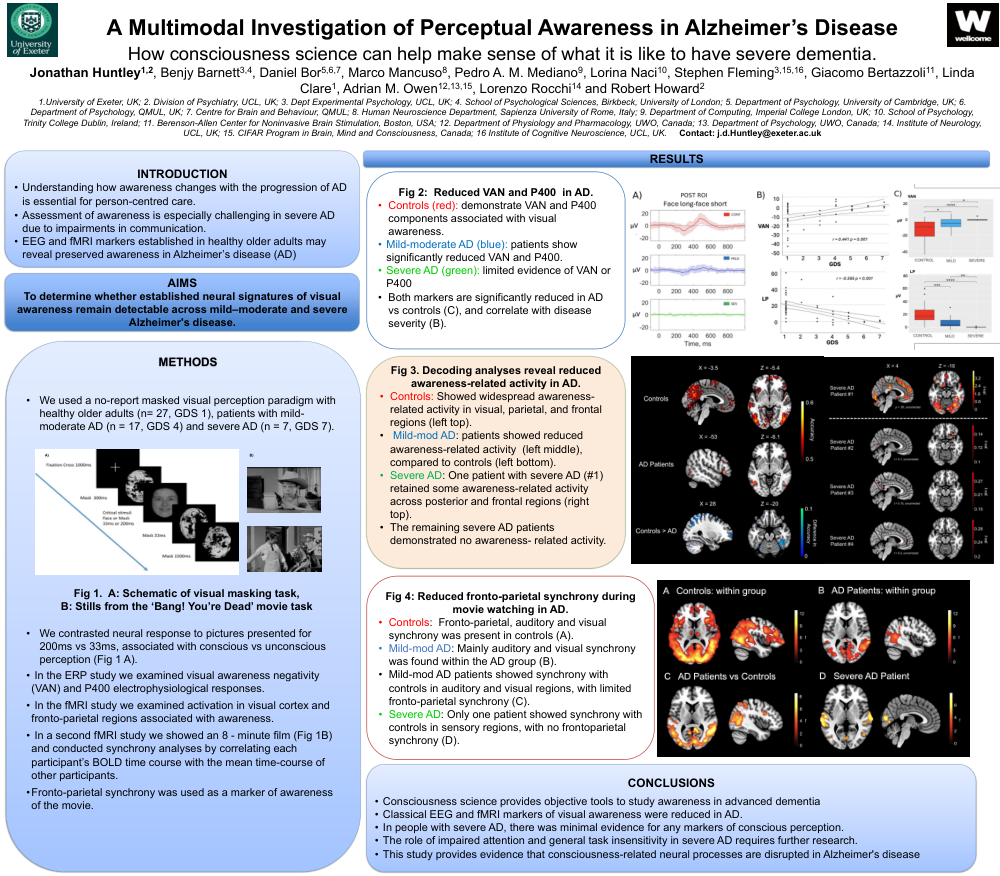
•We used a no-report masked visual perception paradigm with healthy older adults (n= 27, GDS 1), patients with mild-moderate AD (n = 17, GDS 4) and severe AD (n = 7, GDS 7). •
•We contrasted neural response to pictures presented for 200ms vs 33ms, associated with conscious vs unconscious perception (Fig 1 A).
• In the ERP study we examined visual awareness negativity (VAN) and P400 electrophysiological responses.
• In the fMRI study we examined activation in visual cortex and fronto-parietal regions associated with awareness.
• In a second fMRI study we showed an 8 - minute film (Fig 1B) and conducted synchrony analyses by correlating each participant’s BOLD time course with the mean time-course of other participants.
•Fronto-parietal synchrony was used as a marker of awareness of the movie.
RESULTS
Reduced VAN and P400 in AD.
•Controls (red): demonstrate VAN and P400 components associated with visual awareness.
•Mild-moderate AD (blue): patients show significantly reduced VAN and P400.
•Severe AD (green): limited evidence of VAN or P400
•Both markers are significantly reduced in AD vs controls (C), and correlate with disease severity (B).
Decoding analyses reveal reduced awareness-related activity in AD.
•Controls: Showed widespread awareness-related activity in visual, parietal, and frontal regions (left top).
• Mild-mod AD: patients showed reduced awareness-related activity (left middle), compared to controls (left bottom).
•Severe AD: One patient with severe AD (#1) retained some awareness-related activity across posterior and frontal regions (right top).
The remaining severe AD patients demonstrated no awareness- related activity
Reduced fronto-parietal synchrony during movie watching in AD.
•Controls: Fronto-parietal, auditory and visual synchrony was present in controls (A).
•Mild-mod AD: Mainly auditory and visual synchrony was found within the AD group (B).
•Mild-mod AD patients showed synchrony with controls in auditory and visual regions, with limited fronto-parietal synchrony (C).
•Severe AD: Only one patient showed synchrony with controls in sensory regions, with no frontoparietal synchrony (D).
CONCLUSIONS
•Consciousness science provides objective tools to study awareness in advanced dementia
•Classical EEG and fMRI markers of visual awareness were reduced in AD.
•In people with severe AD, there was minimal evidence for any markers of conscious perception.
•The role of impaired attention and general task insensitivity in severe AD requires further research.
•This study provides evidence that consciousness-related neural processes are disrupted in Alzheimer's disease
Comments
Email is required but is not shown publicly.
Loading comments...