4,068 posters, 219 videos, 101 topics, 69 sessions, 14,365 authors, 6,128 institutions
ePostersLive by SciGen Technologies S.A. All rights reserved.
Alzheimer's Association International Conference 2026
July 12-15, 2026 | London, United Kingdom, and Online

4692
Multi Network-based Analysis Reveal Sex-dependent Plasma Protein Co-expression Linked To Alzheimer’s Genetic Risk
Poster Presenter
Part of Topic
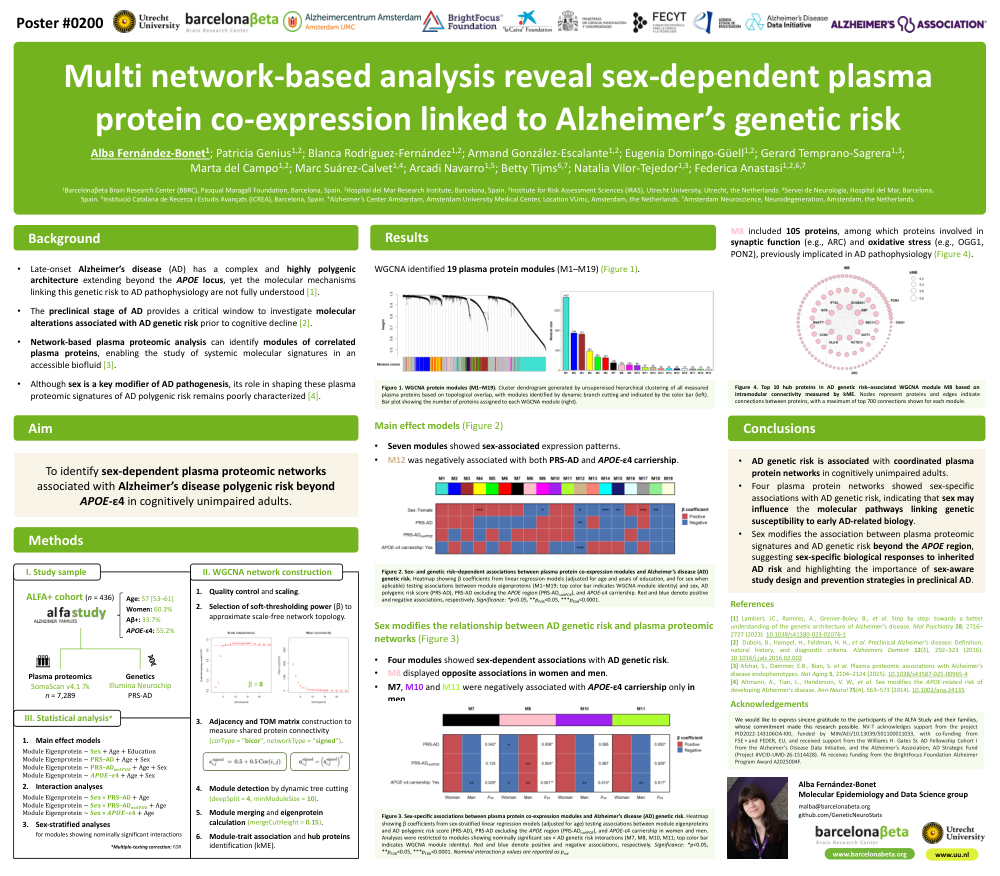
Background: Alzheimer’s disease (AD) is highly polygenic, yet the molecular mechanisms linking AD polygenic risk to disease biology remain understudied. Although sex and APOE-ε4 carriership substantially modify AD pathogenesis, how they shape the proteomic signatures of genetic risk remains unclear. We characterized plasma proteomic networks associated with AD polygenic risk, focusing on sex-dependent and APOE-ε4-independent components.
Methods: We analyzed SomaScan 7k plasma proteome from 436 cognitively unimpaired participants of the ALFA+ cohort (60.3% women) with genotype available (Fig.1). Protein co-expression modules (M) were identified using weighted gene co-expression network analysis (WGCNA) with the following parameters: biweight midcorrelation, power=8, minimum module size of 10 and deepSplit=4. We first tested associations of module eigenproteins with sex and AD genetic risk (PRS-AD, PRS-AD excluding the APOE region, and APOE-ε4 carriership). We then tested sex × AD genetic risk interactions and, where significant, performed sex-stratified models. Models were adjusted for age and years of education, and for sex when applicable, and were FDR-corrected for multiple testing.
Results: WGCNA identified 19 plasma protein modules. In the main effect models, seven modules showed significant associations with sex, and only M12 was associated with AD genetic risk (both PRS-AD and APOE-ε4 carriership) (Fig.2). Sex interaction models identified multiple sex-dependent associations with AD genetic risk for 4 modules (M8: FDR-pint<0.05, M7-M10-M11: pint<0.05, Fig.3), all showing opposite effect direction. When these models were stratified, M8 was significantly associated with APOE-ε4 carriership in both sexes, with PRS-AD in women, and with PRS-AD excluding the APOE region in men. M8 included 105 proteins, including proteins related to synaptic function (e.g., ARC) and oxidative stress (e.g., OGG1, PON2), processes associated with AD. In addition, M7-M10-M11 showed significant associations only in men and with APOE-ε4 carriership.
Conclusion: We highlight sex as a modifier that links AD polygenic risk to plasma proteomic networks, considering both APOE-dependent and APOE-independent molecular signatures.
Comments
Email is required but is not shown publicly.
Loading comments...