4,068 posters, 219 videos, 101 topics, 69 sessions, 14,365 authors, 6,128 institutions
ePostersLive by SciGen Technologies S.A. All rights reserved.
Alzheimer's Association International Conference 2026
July 12-15, 2026 | London, United Kingdom, and Online

1700
A Joint Single-cell Transcriptomic Analysis Of Alzheimer’s And Parkinson’s Disease
Poster Presenter
Part of Topic
Title:A Joint Single-Cell Transcriptomic Analysis of Alzheimer's and Parkinson's Disease | P-0199
Authors: Adithya V. Madduri | Chirag J. Patel | Department of Biomedical Informatics, Harvard Medical School
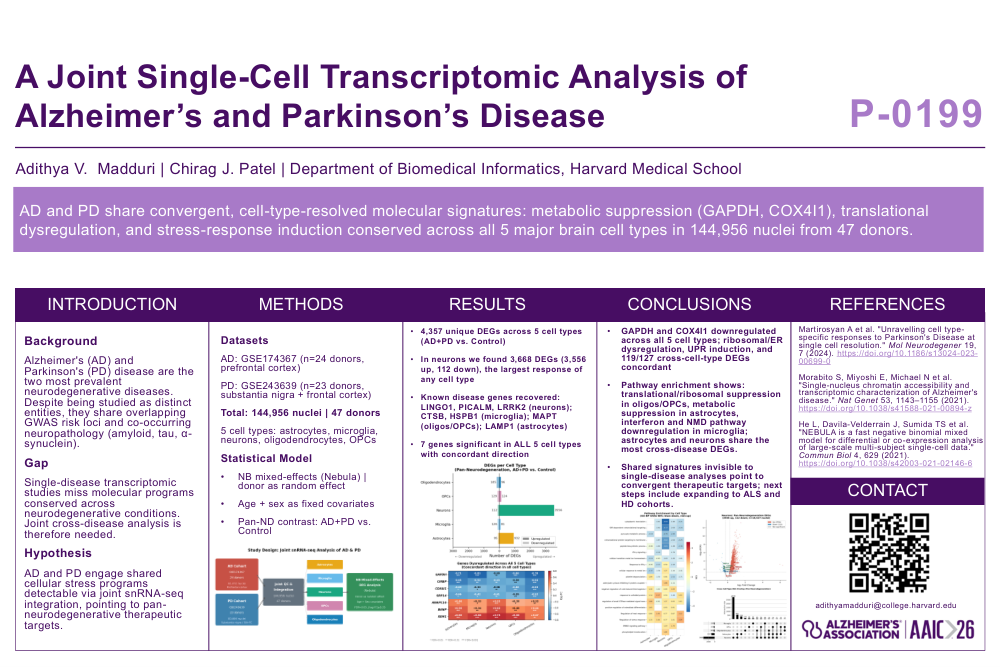
Abstract bar: AD and PD share convergent, cell-type-resolved molecular signatures: metabolic suppression (GAPDH, COX4I1), translational dysregulation, and stress-response induction conserved across all 5 major brain cell types in 144,956 nuclei from 47 donors.
INTRODUCTION
Background
Alzheimer's (AD) and Parkinson's (PD) disease are the two most prevalent neurodegenerative diseases. Despite being studied as distinct entities, they share overlapping GWAS risk loci and co-occurring neuropathology (amyloid, tau, α-synuclein).
Gap
Single-disease transcriptomic studies miss molecular programs conserved across neurodegenerative conditions. Joint cross-disease analysis is therefore needed.
Hypothesis
AD and PD engage shared cellular stress programs detectable via joint snRNA-seq integration, pointing to pan-neurodegenerative therapeutic targets.
METHODS
Datasets
AD: GSE174367 (n=24 donors, prefrontal cortex)
PD: GSE243639 (n=23 donors, substantia nigra + frontal cortex)
Total: 144,956 nuclei | 47 donors
5 cell types: astrocytes, microglia, neurons, oligodendrocytes, OPCs
Statistical Model
- NB mixed-effects (Nebula) | donor as random effect
- Age + sex as fixed covariates
- Pan-ND contrast: AD+PD vs. Control
RESULTS
- 4,357 unique DEGs across 5 cell types (AD+PD vs. Control)
- In neurons we found 3,668 DEGs (3,556 up, 112 down), the largest response of any cell type
- Known disease genes recovered: LINGO1, PICALM, LRRK2 (neurons); CTSB, HSPB1 (microglia); MAPT (oligos/OPCs); LAMP1 (astrocytes)
- 7 genes significant in ALL 5 cell types with concordant direction
CONCLUSIONS
- GAPDH and COX4I1 downregulated across all 5 cell types; ribosomal/ER dysregulation, UPR induction, and 119/127 cross-cell-type DEGs concordant
- Pathway enrichment reveals cell-type-specific programs: translational/ribosomal suppression in oligos/OPCs, metabolic suppression in astrocytes, interferon and NMD pathway downregulation in microglia; astrocytes and neurons share the most cross-disease DEGs.
- Shared signatures invisible to single-disease analyses point to convergent therapeutic targets; next steps include expanding to ALS and HD cohorts.
REFERENCES
Martirosyan A et al. "Unravelling cell type-specific responses to Parkinson's Disease at single cell resolution." Mol Neurodegener 19, 7 (2024). https://doi.org/10.1186/s13024-023-00699-0
Morabito S, Miyoshi E, Michael N et al. "Single-nucleus chromatin accessibility and transcriptomic characterization of Alzheimer's disease." Nat Genet 53, 1143–1155 (2021). https://doi.org/10.1038/s41588-021-00894-z
He L, Davila-Velderrain J, Sumida TS et al. "NEBULA is a fast negative binomial mixed model for differential or co-expression analysis of large-scale multi-subject single-cell data." Commun Biol 4, 629 (2021). https://doi.org/10.1038/s42003-021-02146-6
Comments
Email is required but is not shown publicly.
Loading comments...