Loading...

4,068 posters, 219 videos, 101 topics, 69 sessions, 14,365 authors, 6,128 institutions

ePostersLive by SciGen Technologies S.A. All rights reserved.

Alzheimer's Association International Conference 2026

July 12-15, 2026 | London, United Kingdom, and Online

Alzheimer's Association International Conference 2026 banner

5876

Relationship Between Cataract And Alzheimer’S Disease: A Two-sample Mendelian Randomization Study
Part of Topic

Relationship between cataract and Alzheimer’s disease: a two-sample Mendelian Randomization study

Background

•Alzheimer's Disease (AD), the leading cause of dementia worldwide, has a strong genetic basis, with twin and family studies estimating heritability between 60% and 80%. To date, over 75 AD-associated loci through genome-wide association (GWA) studies have been identified1.
•Cataract is a vision disorder, characterized by the opacification of the crystalline lens, with heritability estimates between 35% and 58%. To date, over 100 cataract-associated loci through GWA studies have been identified2,3.
•Observational studies have linked cataracts with increased risk of AD through shared neural and vascular pathways; however, it is not clear if these observational associations are causal.

Objective

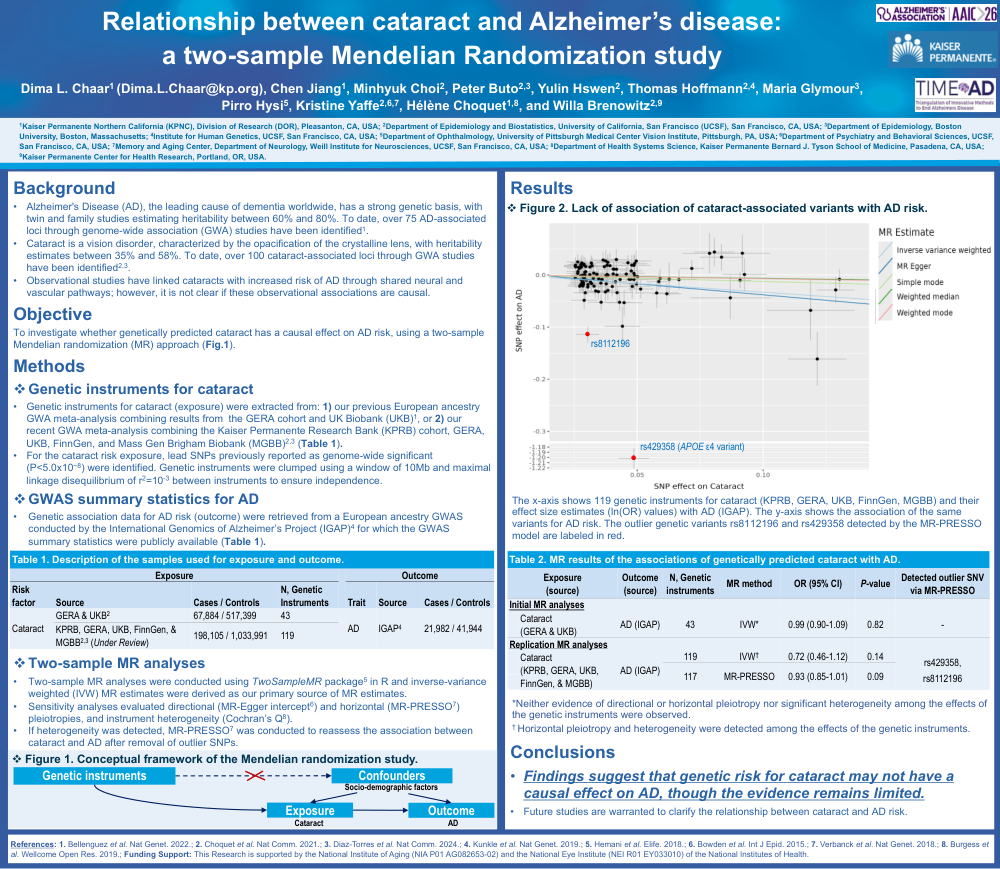
To investigate whether genetically predicted cataract has a causal effect on AD risk, using a two-sample Mendelian randomization (MR) approach (Fig.1).

Methods

--Genetic instruments for cataract
•Genetic instruments for cataract (exposure) were extracted from: 1) our previous European ancestry GWA meta-analysis combining results from  the GERA cohort and UK Biobank (UKB)1, or 2) our recent GWA meta-analysis combining the Kaiser Permanente Research Bank (KPRB) cohort, GERA, UKB, FinnGen, and Mass Gen Brigham Biobank (MGBB)2,3 (Table 1).
•For the cataract risk exposure, lead SNPs previously reported as genome-wide significant (P<5.0x10⁻⁸) were identified. Genetic instruments were clumped using a window of 10Mb and maximal linkage disequilibrium of r2=10-3 between instruments to ensure independence.
--GWAS summary statistics for AD
•Genetic association data for AD risk (outcome) were retrieved from a European ancestry GWAS conducted by the International Genomics of Alzheimer’s Project (IGAP)4 for which the GWAS summary statistics were publicly available (Table 1).
--Two-sample MR analyses
•Two-sample MR analyses were conducted using TwoSampleMR package5 in R and inverse-variance weighted (IVW) MR estimates were derived as our primary source of MR estimates.
•Sensitivity analyses evaluated directional (MR-Egger intercept6) and horizontal (MR-PRESSO7) pleiotropies, and instrument heterogeneity (Cochran’s Q8).
•If heterogeneity was detected, MR-PRESSO7 was conducted to reassess the association between cataract and AD after removal of outlier SNPs.

Conclusions

•Findings suggest that genetic risk for cataract may not have a causal effect on AD, though the evidence remains limited.
•Future studies are warranted to clarify the relationship between cataract and AD risk.

Comments

Email is required but is not shown publicly.

Loading comments...

aaic2026 banner
Copyright © 2015-2026, ePostersLive® SciGen is a registered trademark of SciGen Technologies S.A. Patent pending.

This website and third-party tools we use rely on cookies for the best user experience. By selecting "I agree", you agree to cookie usage as described in our Privacy Policy.