4,068 posters, 219 videos, 101 topics, 69 sessions, 14,365 authors, 6,128 institutions
ePostersLive by SciGen Technologies S.A. All rights reserved.
Alzheimer's Association International Conference 2026
July 12-15, 2026 | London, United Kingdom, and Online

9072
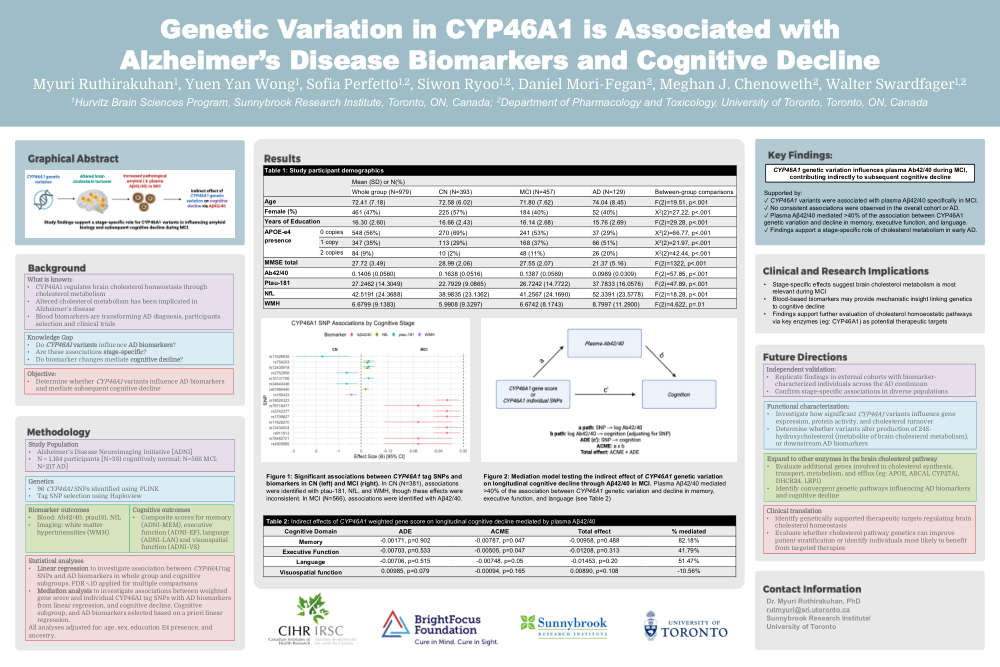
Genetic Variation In Cyp46a1 Is Associated With Alzheimer’S Disease Biomarkers And Cognitive Decline
Poster Presenter
Authors
Myuri Ruthirakuhan, Yuen Yan Wong, Sofia Perfetto, Siwon Ryoo, Daniel Mori-Fegan, Meghan J. Chenoweth, Walter Swardfager
Affiliations
Hurvitz Brain Sciences Program, Sunnybrook Research Institute, Toronto, ON, Canada, Department of Pharmacology and Toxicology, University of Toronto, Toronto, ON, Canada, Hurvitz Brain Sciences Program, Sunnybrook Research Institute, Toronto, ON, Canada; Department of Pharmacology and Toxicology, University of Toronto, Toronto, ON, Canada
Part of Topic
BACKGROUND:
Brain cholesterol metabolism is critical for neuronal integrity and synaptic function. The CYP46A1 gene encodes cholesterol 24-hydroxylase, the primary enzyme responsible for converting brain cholesterol to 24S-hydroxycholesterol, a metabolite that can cross the blood–brain barrier for excretion. Dysregulation of this pathway may contribute to amyloid pathology and cognitive decline in Alzheimer’s disease (AD). We investigated whether genetic variation in CYP46A1 is associated with AD biomarkers and whether these associations influence cognitive decline.
METHODS:
Using ADNI data, 96 SNPs in CYP46A1 were identified via PLINK. Tag SNPs were extracted using Haploview based on linkage disequilibrium block structure. Associations with AD biomarkers (amyloid-β42/40 [Aβ42/40], phosphorylated tau-181 [ptau-181], neurofilament light [NfL], glial fibrillary acidic protein [GFAP], and white matter hyperintensities [WMH]] were tested overall and by cognitive status (cognitively normal [CN], mild cognitive impairment [MCI], AD). Covariates included age, sex, education, MMSE, and APOE-ε4 status. False discovery rate correction (FDR<0.1) was applied. Mediation analyses in MCI evaluated whether weighted CYP46A1 gene scores and individual tag SNPs exerted indirect effects on subsequent cognitive decline through baseline Aβ42/40, with decline estimated as slopes using ≥2 post-biomarker visits across memory, executive function, language, and visuospatial composite scores.
RESULTS:
CYP46A1 variants were not associated with AD markers in the whole group (N=1164) or AD (N=217). In CN (N=381), associations were identified with ptau-181, NfL, and WMH, though these effects were inconsistent. In MCI (N=566), associations were identified with Aβ42/40 (Fig1). In MCI (N=332) a weighted CYP46A1 gene score influenced memory (Average Causal Mediation Effect [ACME]:-.008[-.017, -6.911]), executive function (ACME:-.007[-.016, -5.224]), and language composite scores (ACME:-.005[-.011, -.0001]) indirectly through Aβ42/40, with substantial proportions of the total effect mediated (>42%). Indirect effects were also seen for executive function with individual tag SNPs (FDR corrected ACME: all<.1; proportion mediated: 35-48%).
CONCLUSIONS:
CYP46A1 variation was associated with amyloid markers in MCI, with evidence of an indirect effect on cognitive decline mediated by Aβ42/40. These findings support a stage-specific role of CYP46A1 regulatory variants in AD pathophysiology, highlighting the role of cholesterol metabolism in early cognitive vulnerability.
Comments
Email is required but is not shown publicly.
Loading comments...