4,068 posters, 219 videos, 101 topics, 69 sessions, 14,365 authors, 6,128 institutions
ePostersLive by SciGen Technologies S.A. All rights reserved.
Alzheimer's Association International Conference 2026
July 12-15, 2026 | London, United Kingdom, and Online

9748
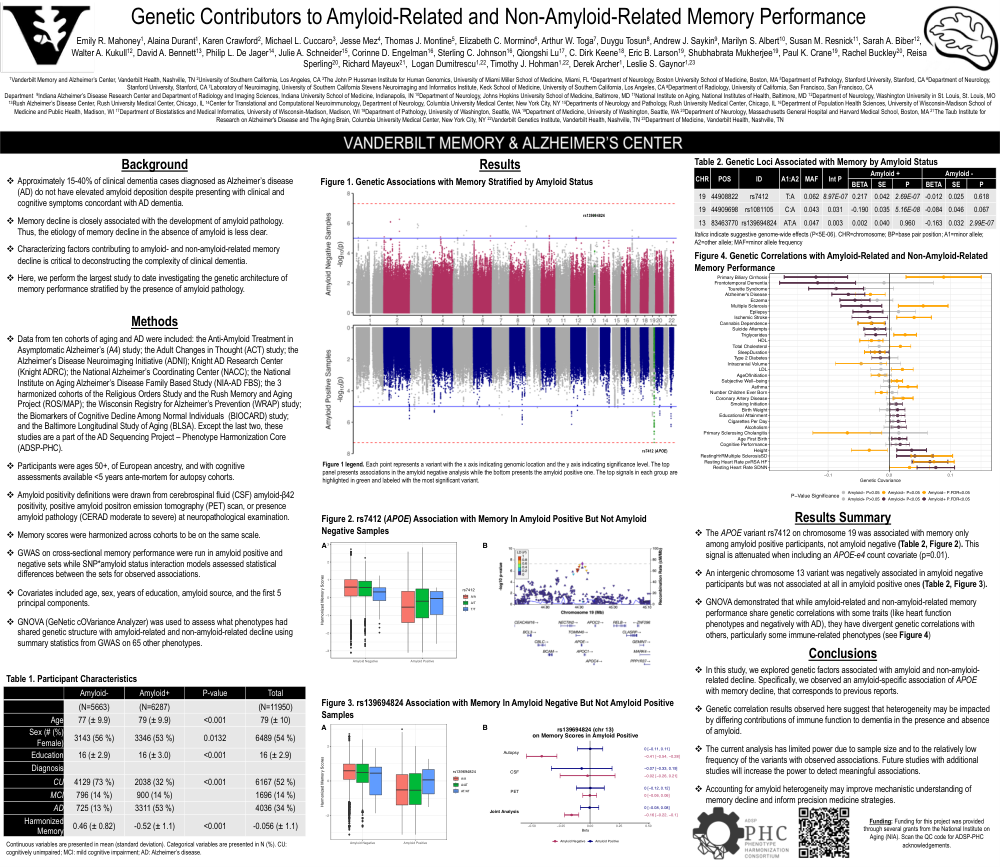
Genetic Contributors To Amyloid-related And Non-amyloid Related Memory Performance
Poster Presenter
Authors
Emily R. Mahoney, Alaina Durant, Karen Crawford, Michael L. Cuccaro, Jesse Mez, Thomas J. Montine, Elizabeth C. Mormino, Arthur W. Toga, Duygu Tosun, Andrew J Saykin, Marilyn S. Albert, Susan M Resnick, Sarah A. Biber, Walter A. Kukull, David A. Bennett, Philip L. De Jager, Julie A. Schneider, Corinne D. Engelman, Sterling C. Johnson, Qiongshi Lu, C. Dirk Keene, Eric B. Larson, Shubhabrata Mukherjee, Paul K. Crane, Rachel Buckley, Reisa Sperling, Richard Mayeux, Logan Dumitrescu, Timothy J. Hohman, Derek Archer, Leslie S. Gaynor
Affiliations
Department of Neurology, Washington University in St. Louis, St. Louis, MO, Department of Medicine, University of Washington, Seattle, WA, Vanderbilt Memory and Alzheimer’s Center, Vanderbilt Health, Nashville, TN, University of Southern California, Los Angeles, CA, The John P Hussman Institute for Human Genomics, University of Miami Miller School of Medicine, Miami, FL, Department of Neurology, Boston University School of Medicine, Boston, MA, Department of Pathology, Stanford University, Stanford, CA, Department of Neurology, Stanford University, Stanford, CA, Laboratory of Neuroimaging, University of Southern California Stevens Neuroimaging and Informatics Institute, Keck School of Medicine, University of Southern California, Los Angeles, CA, Department of Radiology, University of California, San Francisco, San Francisco, CA, Indiana Alzheimer’s Disease Research Center and Department of Radiology and Imaging Sciences, Indiana University School of Medicine, Indianapolis, IN, Department of Neurology, Johns Hopkins University School of Medicine, Baltimore, MD, National Institute on Aging, National Institutes of Health, Baltimore, MD, Rush Alzheimer’s Disease Center, Rush University Medical Center, Chicago, IL, Center for Translational and Computational Neuroimmunology, Department of Neurology, Columbia University Medical Center, New York City, NY, Departments of Neurology and Pathology, Rush University Medical Center, Chicago, IL, Department of Population Health Sciences, University of Wisconsin-Madison School of Medicine and Public Health, Madison, WI, Department of Biostatistics and Medical Informatics, University of Wisconsin-Madison, Madison, WI, Department of Pathology, University of Washington, Seattle, WA, Department of Neurology, Massachusetts General Hospital and Harvard Medical School, Boston, MA, The Taub Institute for Research on Alzheimer's Disease and The Aging Brain, Columbia University Medical Center, New York City, NY
Part of Topic
Background:
Participants were ages 50+, of European ancestry, and with cognitive assessments available <5 years ante-mortem for autopsy cohorts. Amyloid positivity definitions were drawn from cerebrospinal fluid (CSF) amyloid-β42 positivity, positive amyloid positron emission tomography (PET) scan, or presence amyloid pathology (CERAD moderate to severe) at neuropathological examination. Memory scores were harmonized across cohorts to be on the same scale.
GWAS on cross-sectional memory performance were run in amyloid positive and negative sets while SNP*amyloid status interaction models assessed statistical differences between the sets for observed associations. Covariates included age, sex, years of education, amyloid source, and the first 5 principal components. GNOVA (GeNetic cOVariance Analyzer) was used to assess what phenotypes had shared genetic structure with amyloid-related and non-amyloid-related decline using summary statistics from GWAS on 65 other phenotypes.
Results Summary:
Comments
Email is required but is not shown publicly.
Loading comments...