4,068 posters, 219 videos, 101 topics, 69 sessions, 14,365 authors, 6,128 institutions
ePostersLive by SciGen Technologies S.A. All rights reserved.
Alzheimer's Association International Conference 2026
July 12-15, 2026 | London, United Kingdom, and Online

4729
Multimodal Epigenetic Profiling Of Cfdna In Alzheimer’S Disease Reveals Methylation, Fragmentomic And Tissue Of Origin Alterations
Poster Presenter
Authors
Part of Topic
Introduction:
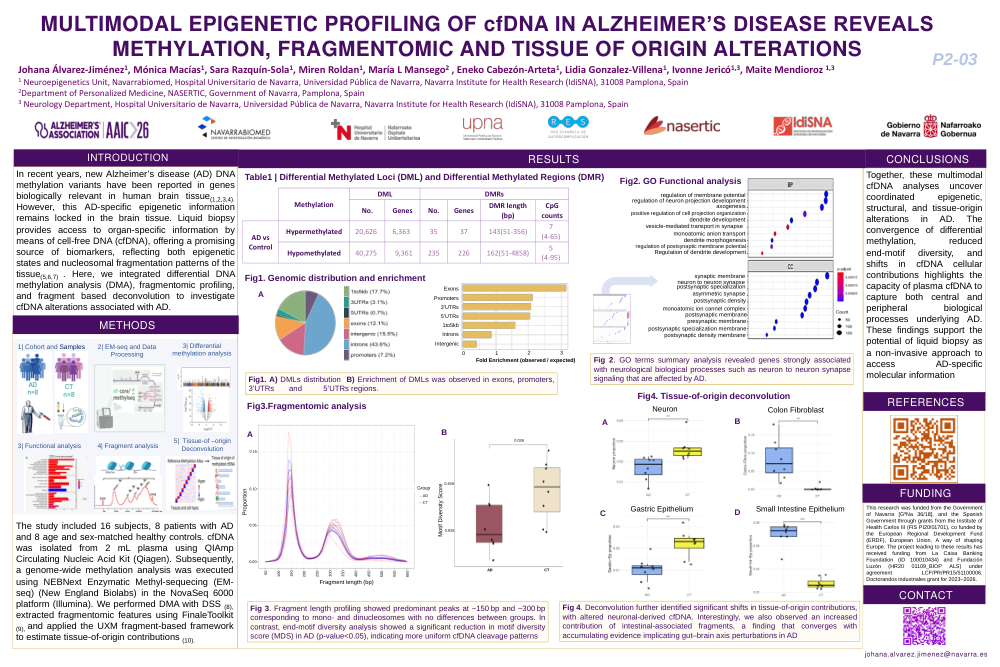
In recent years, new Alzheimer’s disease (AD) DNA methylation variants have been reported in genes biologically relevant in human brain tissue(1,2,3,4). However, this AD-specific epigenetic information remains locked in the brain tissue. Liquid biopsy provides access to organ-specific information by means of cell-free DNA (cfDNA), offering a promising source of biomarkers, reflecting both epigenetic states and nucleosomal fragmentation patterns of the tissue(5,6,7) . Here, we integrated differential DNA methylation analysis (DMA), fragmentomic profiling, and fragment based deconvolution to investigate cfDNA alterations associated with AD.
Methods:
The study included 16 subjects, 8 patients with AD and 8 age and sex-matched healthy controls. cfDNA was isolated from 2 mL plasma using QIAmp Circulating Nucleic Acid Kit (Qiagen). Subsequently, a genome-wide methylation analysis was executed using NEBNext Enzymatic Methyl-sequecing (EM-seq) (New England Biolabs) in the NovaSeq 6000 platform (Illumina). We performed DMA with DSS (8), extracted fragmentomic features using FinaleToolkit (9), and applied the UXM fragment‑based framework to estimate tissue‑of‑origin contributions (10).
Conclusions:
Together, these multimodal cfDNA analyses uncover coordinated epigenetic, structural, and tissue‑origin alterations in AD. The convergence of differential methylation, reduced end‑motif diversity, and shifts in cfDNA cellular contributions highlights the capacity of plasma cfDNA to capture both central and peripheral biological processes underlying AD. These findings support the potential of liquid biopsy as a non-invasive approach to access AD-specific molecular information
Funding:
This research was funded from the Government of Navarra [GºNa 36/18], and the Spanish Government through grants from the Institute of Health Carlos III (FIS PI20/01701), co funded by the European Regional Development Fund (ERDF), European Union, A way of shaping Europe. The project leading to these results has received funding from La Caixa Banking Foundation (ID 100010434) and Fundación Luzón (HR20 01109_BIOP ALS) under agreement LCF/PR/PR15/51100006. Doctorandos industriales grant for 2023–2026.
Contact: johana.alvarez.jimenez@navarra.es
Comments
Email is required but is not shown publicly.
Loading comments...