4,068 posters, 219 videos, 101 topics, 69 sessions, 14,365 authors, 6,128 institutions
ePostersLive by SciGen Technologies S.A. All rights reserved.
Alzheimer's Association International Conference 2026
July 12-15, 2026 | London, United Kingdom, and Online

1002
Causal Inference Analysis Of The Effect Of Beta-amyloid And Tau Proteins On Dementia Risk: A Mendelian Randomization Analysis
Poster Presenter
Authors
Jacob Apibilla Ayembilla, Rachael Osemudiamen Osagie, Adeyemi Timothy Akinade, Oumar Sako, Oluwafunmbi Ebenezer Ogunmiluyi, Olaitan I. Awe
Affiliations
Department of Science Laboratory Technology, Accra Technical University, Accra, Ghana., Faculty of Dental Medicine and Oral Health Sciences, McGill University, Montreal, QC, Canada., Department of Genetics and Biochemistry, Clemson University, South Carolina, SC, USA., African Centre of Excellence in Bioinformatics and Data Intensive Science (ACE-B), University of Sciences Techniques and Technologies of Bamako, Bamako, Mali., Department of Physiology, University of Medical Sciences, Ondo, Ondo State, Nigeria., Department of Computer Science, University of Ibadan,, Ibadan, Oyo State, Nigeria.
Part of Topic
Video
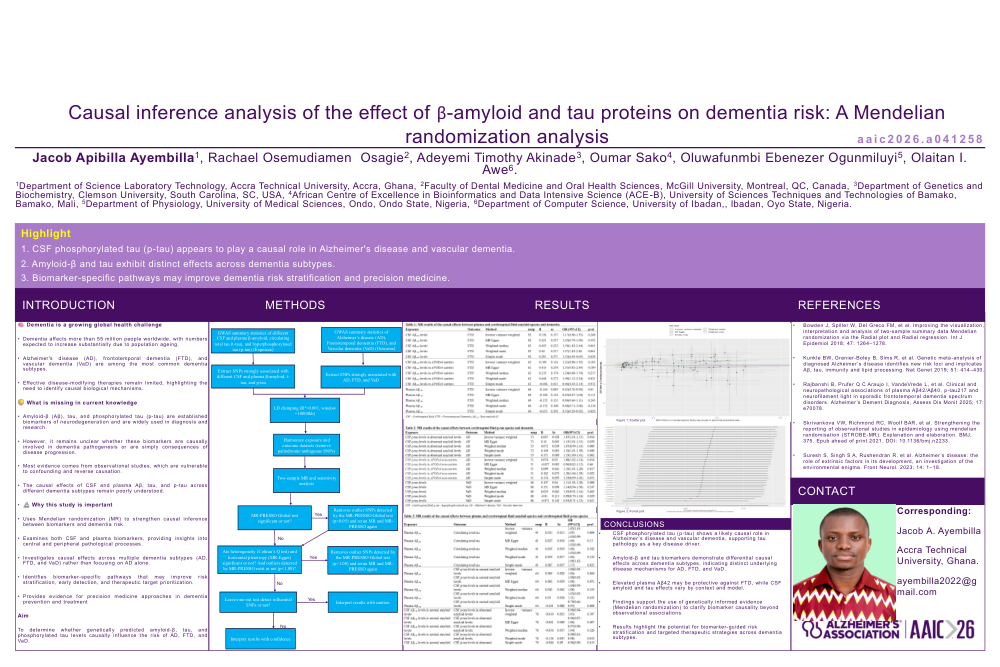
Causal inference analysis of the effect of β-amyloid and tau proteins on dementia risk: A Mendelian randomization analysis.
Jacob Apibilla Ayembilla1, Rachael Osemudiamen Osagie2, Adeyemi Timothy Akinade3, Oumar Sako4, Oluwafunmbi Ebenezer Ogunmiluyi5, Olaitan I. Awe6.
1Department of Science Laboratory Technology, Accra Technical University, Accra, Ghana, 2Faculty of Dental Medicine and Oral Health Sciences, McGill University, Montreal, QC, Canada, 3Department of Genetics and Biochemistry, Clemson University, South Carolina, SC, USA, 4African Centre of Excellence in Bioinformatics and Data Intensive Science (ACE-B), University of Sciences Techniques and Technologies of Bamako, Bamako, Mali, 5Department of Physiology, University of Medical Sciences, Ondo, Ondo State, Nigeria, 6Department of Computer Science, University of Ibadan,, Ibadan, Oyo State, Nigeria.
Study Highlights
1. CSF phosphorylated tau (p-tau) appears to play a causal role in Alzheimer's disease and vascular dementia.
2. Amyloid-β and tau exhibit distinct effects across dementia subtypes.
3. Biomarker-specific pathways may improve dementia risk stratification and precision medicine.
Introduction
�� Dementia is a growing global health challenge
�� What is missing in current knowledge
Aim
To determine whether genetically predicted amyloid-β, tau, and phosphorylated tau levels causally influence the risk of AD, FTD, and VaD.
Conclusion
Comments
Email is required but is not shown publicly.
Loading comments...