4,068 posters, 219 videos, 101 topics, 69 sessions, 14,365 authors, 6,128 institutions
ePostersLive by SciGen Technologies S.A. All rights reserved.
Alzheimer's Association International Conference 2026
July 12-15, 2026 | London, United Kingdom, and Online

3779
Alzheimer's Disease Sequencing Project Phenotype Harmonization Consortium
Poster Presenter
Authors
Shannon Turner, Alaina Durant, Aditi Sathe, Logan Dumitrescu, Derek Archer, Shannoon Risacher, Guray Erus, Christos Davatzikos, Mohamad Habes, Dugyu Tosun-Turgut, Paul Thompson, Elizabeth University, Carlos Cruchaga, Annie Lee, Adam Brickman, Richard Mayeux, Gary Beecham, Thomas Montine, Bennett Landman, Andrew Saykin, Arthur Toga, Michael Cuccaro, Timothy Hohman
Affiliations
Vanderbilt Memory and Alzheimer's Center, Vanderbilt Health, Nashville, TN, 37232, USA, Vanderbilt Memory and Alzheimer's Center, Vanderbilt Health, Nashville, TN, 37232, USA; Department of Neurology, Vanderbilt Health, Nashville, TN, 37232, USA; Vanderbilt Genetics Institute, Vanderbilt Health, Nashville, TN, 37232, USA; Vanderbilt Brain Institute, Vanderbilt Health, Nashville, TN, 37232, USA;, Vanderbilt HealthVanderbilt Memory and Alzheimer's Center, Vanderbilt Health, Nashville, TN, 37232, USA; Department of Neurology, Vanderbilt Health, Nashville, TN, 37232, USA; Vanderbilt Genetics Institute, Vanderbilt Health, Nashville, TN, 37232, USA; Vanderbilt Brain Institute, Vanderbilt Health, Nashville, TN, 37232, USA;, Department of Gerontology and Geriatrics, Wake Forest University School of Medicine, Winston-Salem, NC, 27106, USA; Department of Internal Medicine, Wake Forest University School of Medicine, Winston-Salem, NC, 27106, USA;, Department of Radiology, University of Pennsylvania, Philadelphia, PA, 19103, USA, Neuroimage Analytics Laboratory and Biggs Institute Neuroimaging Core,, Glenn Biggs Institute for Alzheimer’s and Neurodegenerative Diseases, University of Texas Health Science Center at San Antonio, San Antonio, TX, 78229, USA, Department of Radiology and Biomedical Imaging, University of California San Francisco, San Francisco, CA, 94143, USA, Imaging Genetics Center, Mark and Mary Stevens Institute for Neuroimaging and Informatics, Keck School of Medicine, University of Southern California, Marina del Rey, CA, 90033, USA, Department of Neurology and Neurological Sciences, Stanford University School of Medicine, Stanford, CA, 94304, USA, Department of Genetics, Washington University of St. Louis, St. Louis, MO, 63130, USA; Department of Neurology, Washington University of St. Louis, St. Louis, MO, 63130, USA, Department of Neurology, Columbia University Irving Medical Center, New York, NY, 10027, USA, Department of Internal Medicine, Wake Forest University School of Medicine, Winston-Salem, NC, 27106, USA; Department of Public Health Sciences, Wake Forest University School of Medicine, Winston-Salem, NC, 27106, USA, Department of Pathology, Stanford University, Stanford, CA 94305, Department of Electrical and Computer Engineering, Vanderbilt University, Nashville, TN, 37232, USA; Department of Radiology & Radiological Sciences, Vanderbilt Health, Nashville, TN, 37232, USA; Vanderbilt University Institute of Imaging Science, Vanderbilt Health, Nashville, TN, 37232, USA; Department of Biomedical Engineering, Vanderbilt University, Nashville, TN, 37232, USA, Department of Radiology and Imaging Sciences, Indiana University School of Medicine, Indianapolis, IN, 46202, USA; Indiana Alzheimer’s Disease Research Center, Indiana University School of Medicine, Indianapolis, IN, 46202, USA, Laboratory of Neuroimaging, USC Stevens Institute of Neuroimaging and Informatics, Keck School of Medicine, University of Southern California, Los Angeles, CA, 90033, USA;, The Dr. John T. Macdonald Foundation, Department of Human Genetics, University of Miami Miller School of Medicine, Miami, FL, 33136, USA
Part of Topic
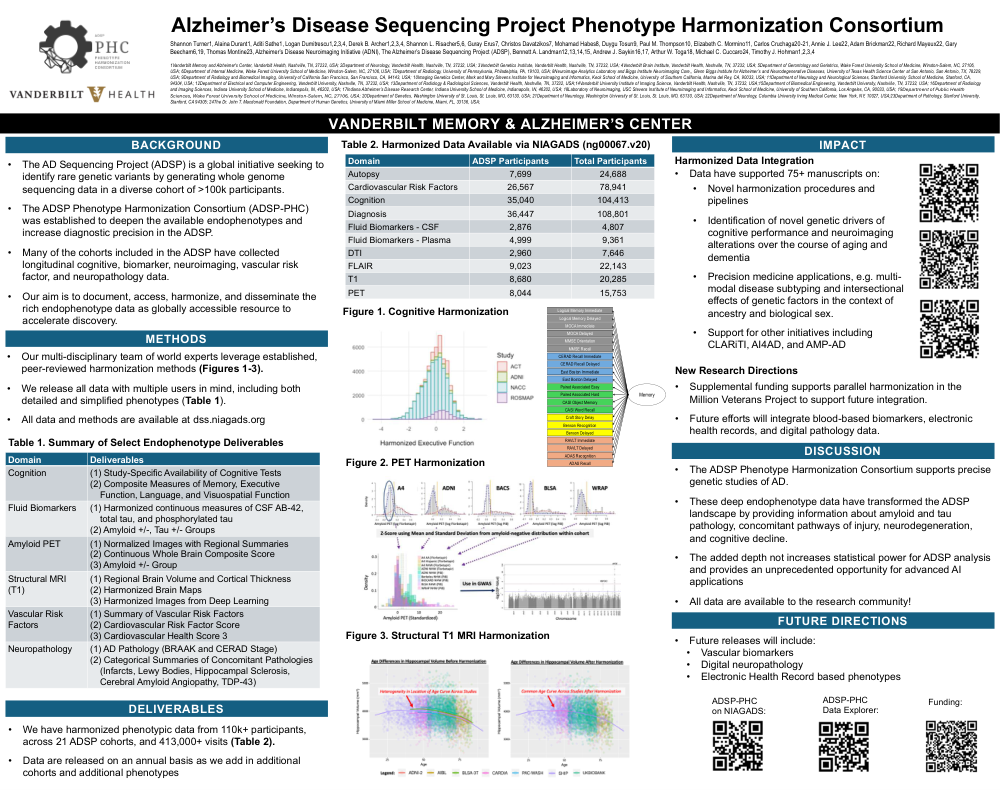
Background: The Alzheimer’s Disease Sequencing Project Phenotype Harmonization Consortium (ADSP-PHC) was established in 2020 in response to the pressing need to integrate rich endophenotypic data and characterize the genetic architecture of the complex biological cascades in Alzheimer’s disease and related dementias (ADRD).The ADSP-PHC’s ultimate goal is to generate harmonized data that will become a “legacy” dataset perpetually curated and shared with qualified researchers.
Methods: The ADSP-PHC’s multidisciplinary team includes experts in neuroimaging, neuropsychology, fluid biomarkers, neuropathology, and vascular contributions to ADRD.In coordination with ADSP workgroups and initiatives, the ADSP-PHC works closely with cohort studies to coordinate the (1) procurement, collation, and curation of endophenotype data, (2) harmonization of data leveraging advanced statistical approaches, (3) dissemination of harmonization protocols and harmonized outputs to the research community, and (4) education of available resources and best practices for leveraging harmonized data resources. All data are released with multiple users in mind to ensure accessibility at all levels of analysis (see Figure 1).
Results:To-date, the ADSP-PHC has harmonized more than 400,000 visits across 21 ADSP cohorts and eight domains (See Figure 2). These harmonized data resources have increased statistical power for all ADSP analyses, resulting in more than 100 peer-reviewed manuscripts, including publications laying out novel harmonization procedures, identifying novel genetic drivers of cognitive performance and neuroimaging alterations over the course of aging and dementia, and delving into precision medicine applications such as multi-modal disease subtyping and intersectional effects of genetic factors in the context of ancestry and biological sex. Importantly, these resources provide an unprecedented opportunity for application to AI/ML efforts to perform advanced subtyping from these unique data resources. Published results leveraging ADSP-PHC data include the demonstration of novel AD subtypes based on imaging and genetic signatures, and novel multi-modal signatures of concomitant pathways of injury such as TDP-43 pathology.
CONCLUSION: The ADSP-PHC's enabling contribution to ADRD research will grow with increasing sample sizes, additional understudied populations from new cohorts coming into the ADSP FUS 2.0, and as harmonization expands to emergingnew opportunities (e.g., blood-based biomarkers).
Comments
Email is required but is not shown publicly.
Loading comments...