4,068 posters, 219 videos, 101 topics, 69 sessions, 14,365 authors, 6,128 institutions
ePostersLive by SciGen Technologies S.A. All rights reserved.
Alzheimer's Association International Conference 2026
July 12-15, 2026 | London, United Kingdom, and Online

4791
Insights from DNA methylomics and transcriptomics into early oligodendrocyte dysfunction in Alzheimer’s disease
Poster Presenter
Authors
Katherine Fodder, Hannah M.G. Smith, Umran Yaman, Ignazio S. Piras, Megha Murthy, John Hardy, Tammaryn Lashley, Rohan de Silva, Dervis A. Salih, Conceicao Bettencourt
Affiliations
UCL Queen Square Institute of Neurology, London, UK, Neurogenomics Division, Translational Genomics Research Institute, Phoenix, AZ, USA
Part of Topic
ABSTRACT
Background:
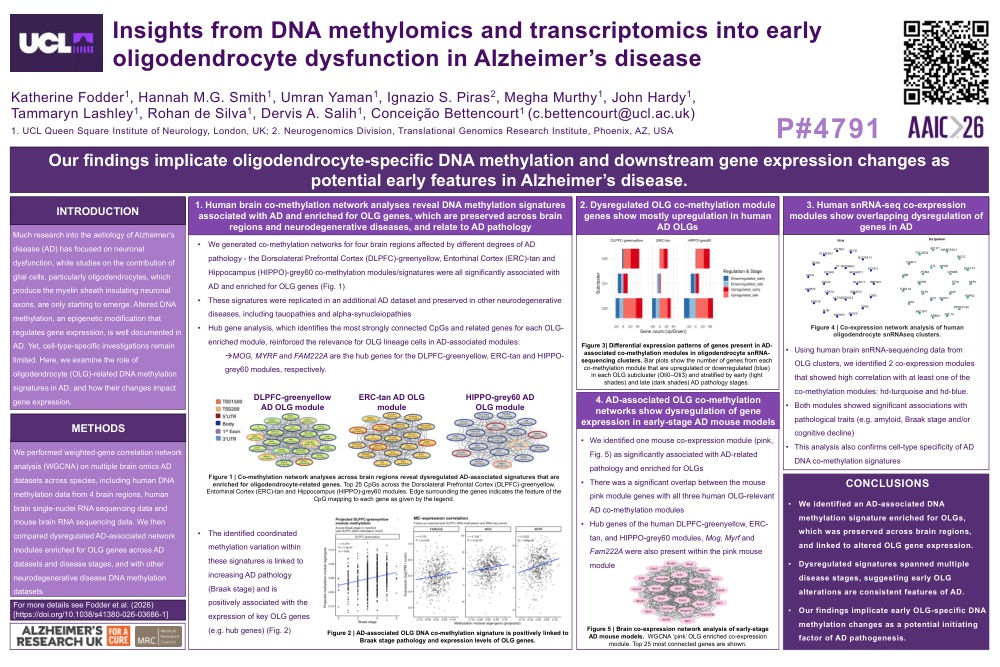
Much research into the aetiology of Alzheimer’s disease (AD) has focused on neuronal dysfunction, while studies on the contribution of glial cells, particularly oligodendrocytes, which produce the myelin sheath insulating neuronal axons, are only starting to emerge. Altered DNA methylation, an epigenetic modification that regulates gene expression, is well documented in AD. Yet, cell-type-specific investigations remain limited. Here, we examine the role of oligodendrocyte-related DNA methylation signatures in AD, and how their changes may impact gene expression.
Methods:
We performed weighted-gene correlation network analysis (WGCNA) on multiple brain omics AD datasets across species, including human DNA methylation data from 4 brain regions, human brain single-nuclei RNA sequencing data and mouse brain RNA sequencing data. We then compared dysregulated AD-associated network modules enriched for oligodendrocyte genes across AD datasets and disease stages, and with other neurodegenerative disease DNA methylation datasets.
Results:
We identified a DNA methylation signature associated with AD, enriched for oligodendrocytes, and preserved across brain regions representing early and late AD pathology stages. Genes within this signature showed altered expression, mostly upregulation, in AD oligodendrocyte nuclei, confirming cell-type specificity and disease relevance. This oligodendrocyte signature was also preserved in transgenic mice with early Aβ pathology and in other neurodegenerative diseases without Aβ pathology. We reveal a consistent pattern of oligodendrocyte dysfunction spanning early to late stages of AD, across DNA methylation and gene expression.
Conclusion:
Our findings highlight early oligodendrocyte-associated DNA methylation changes as a potential initiating factor in AD pathogenesis, and possibly in other neurodegenerative diseases, opening new avenues for therapeutic development.
Comments
Email is required but is not shown publicly.
Loading comments...