4,068 posters, 219 videos, 101 topics, 69 sessions, 14,365 authors, 6,128 institutions
ePostersLive by SciGen Technologies S.A. All rights reserved.
Alzheimer's Association International Conference 2026
July 12-15, 2026 | London, United Kingdom, and Online

10797
Development Of Human Neurovascular Unit Atlas For Alzheimer's Patients
Poster Presenter
Authors
Douglas A Nelson, Xiaojia Tang, Mikel Hernaez, Karunya K Kandimalla, Krishna R Kalari
Affiliations
Department of Pharmaceutics and Brain Barriers Research Center, University of 6 Minnesota, College of Pharmacy, Minneapolis, MN, USA, Department of Quantitative Health Sciences, Mayo Clinic, Rochester, MN, USA, Centro de Investigación Médica Aplicada (CIMA), Universidad de Navarra, Spain
Part of Topic
Development Of Human Neurovascular Unit
Atlas For Alzheimer's Patients
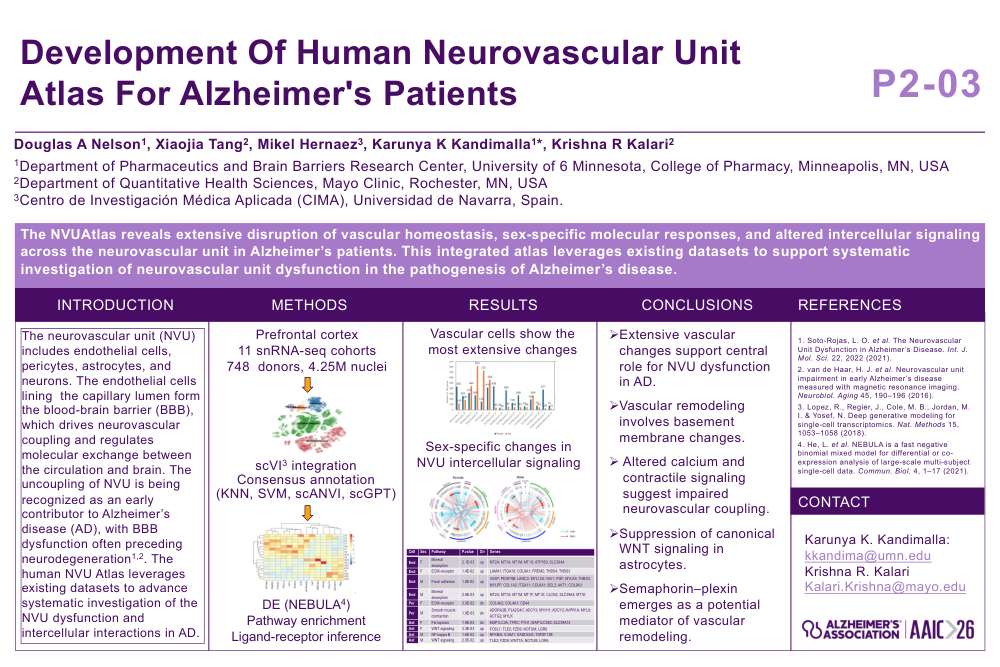
The NVUAtlas reveals extensive disruption of vascular homeostasis, sex-specific molecular responses, and altered intercellular signaling across the neurovascular unit in Alzheimer’s patients. This integrated atlas leverages existing datasets to support systematic investigation of neurovascular unit dysfunction in the pathogenesis of Alzheimer’s disease.
Introduction:
The neurovascular unit (NVU) includes endothelial cells, pericytes, astrocytes, and neurons. The endothelial cells lining the capillary lumen form the blood-brain barrier (BBB), which drives neurovascular coupling and regulates molecular exchange between the circulation and brain. The uncoupling of NVU is being recognized as an early contributor to Alzheimer’s disease (AD), with BBB dysfunction often preceding neurodegeneration1,2. The human NVU Atlas leverages existing datasets to advance systematic investigation of the NVU dysfunction and intercellular interactions in AD.
Methods:
Prefrontal cortex
11 snRNA-seq cohorts
748 donors, 4.25M nuclei
scVI3 integration
Consensus annotation
(KNN, SVM, scANVI, scGPT)
DE (NEBULA4)
Pathway enrichment
Ligand-receptor inference
Results:
Vascular cells show the most extensive changes
Sex-specific changes in NVU intercellular signaling
Conclusions:
Comments
Email is required but is not shown publicly.
Loading comments...