4,068 posters, 219 videos, 101 topics, 69 sessions, 14,365 authors, 6,128 institutions
ePostersLive by SciGen Technologies S.A. All rights reserved.
Alzheimer's Association International Conference 2026
July 12-15, 2026 | London, United Kingdom, and Online

10312
Polygenic Risk Score For Alzheimer's Disease In Hispanic Populations Using A Novel Machine Learning Approach
Poster Presenter
Authors
Affiliations
Part of Topic
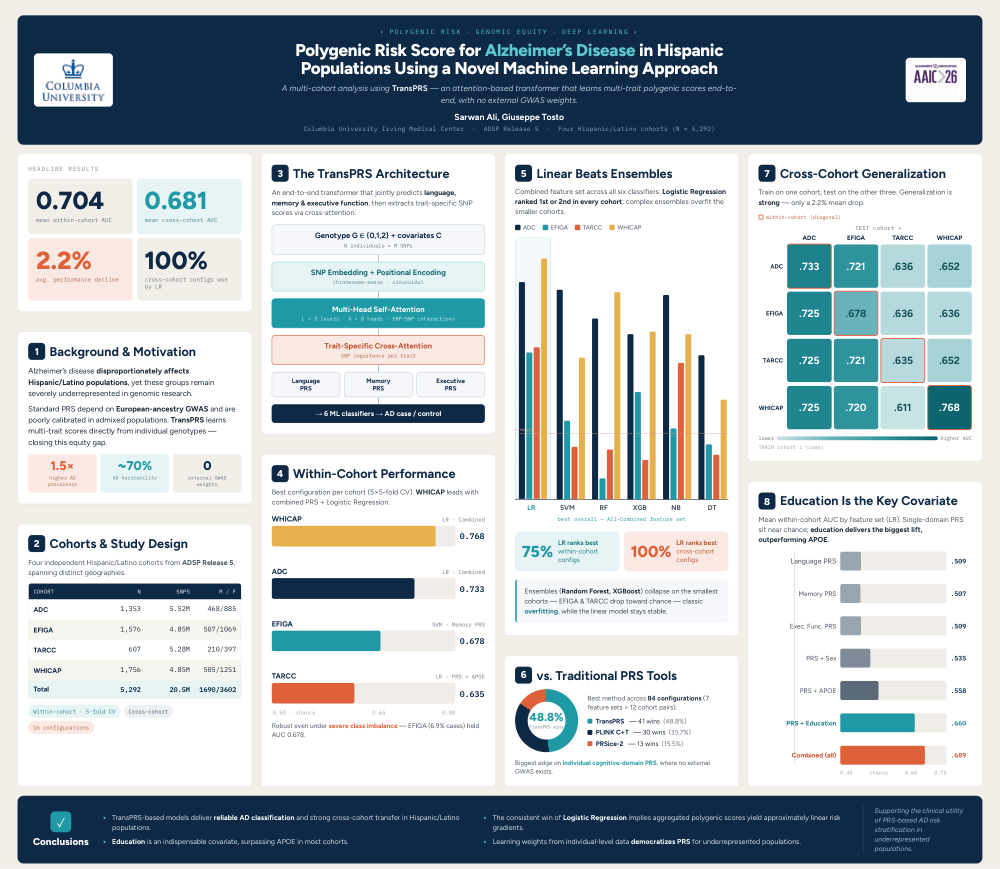
Background: Alzheimer's disease (AD) disproportionately affects Hispanic/Latino populations, yet these groups remain severely underrepresented in genomic research. Standard PRS methods depend on European-ancestry GWAS summary statistics, limiting validity in admixed populations. We introduce TransPRS, an attention-based transformer that learns multi-trait polygenic scores end-to-end from individual-level genotype data without requiring external GWAS weights, addressing this critical equity gap.
Methods: TransPRS jointly predicts three cognitive phenotypes, language, memory, and executive function — using multi-head self-attention over SNP embeddings augmented with chromosome-aware positional encodings, with trait-specific SNP importance extracted via a cross-attention mechanism. Predicted PRS were used as features for AD case-control classification across six machine learning algorithms (Logistic Regression, SVM, Random Forest, XGBoost, Naive Bayes, Decision Trees), evaluated across feature sets ranging from individual domain PRS to combined PRS plus demographic covariates (sex, education, APOE genotype). Four independent Hispanic/Latino cohorts from ADSP Release 5 were used: ADC (N=1,353), EFIGA (N=1,576), TARCC (N=607), and WHICAP (N=1,756; total N=5,292). Both within-cohort (5-fold cross-validation) and cross-cohort (train-on-one, test-on-others) evaluations were performed across 16 experimental configurations.
Results: Within-cohort AUC ranged from 0.635 to 0.768 (mean=0.704), with WHICAP achieving the highest performance using combined PRS features and Logistic Regression. Cross-cohort generalization was strong, with AUC of 0.611-0.725 (mean=0.681) representing only a 2.2% average decline from within-cohort performance. Logistic Regression outperformed all ensemble methods in 75% of within-cohort and 100% of cross-cohort configurations. The combined feature set (all PRS + sex + education + APOE) and PRS + Education were each selected as top performers in 50% of cross-cohort configurations. Models remained robust even under severe class imbalance (EFIGA: 6.9% cases, AUC=0.678). Education emerged as the strongest non-genetic predictor, outperforming APOE genotype in most cohorts.
Conclusions: TransPRS-based models demonstrate reliable AD classification and strong cross-cohort transferability in Hispanic/Latino populations. The consistent superiority of Logistic Regression over complex ensemble methods suggests that aggregated polygenic scores yield approximately linear risk gradients, with education serving as an indispensable covariate. These findings support the clinical utility of PRS-based AD risk stratification in underrepresented populations.
Comments
Email is required but is not shown publicly.
Loading comments...