4,068 posters, 219 videos, 101 topics, 69 sessions, 14,365 authors, 6,128 institutions
ePostersLive by SciGen Technologies S.A. All rights reserved.
Alzheimer's Association International Conference 2026
July 12-15, 2026 | London, United Kingdom, and Online

9394
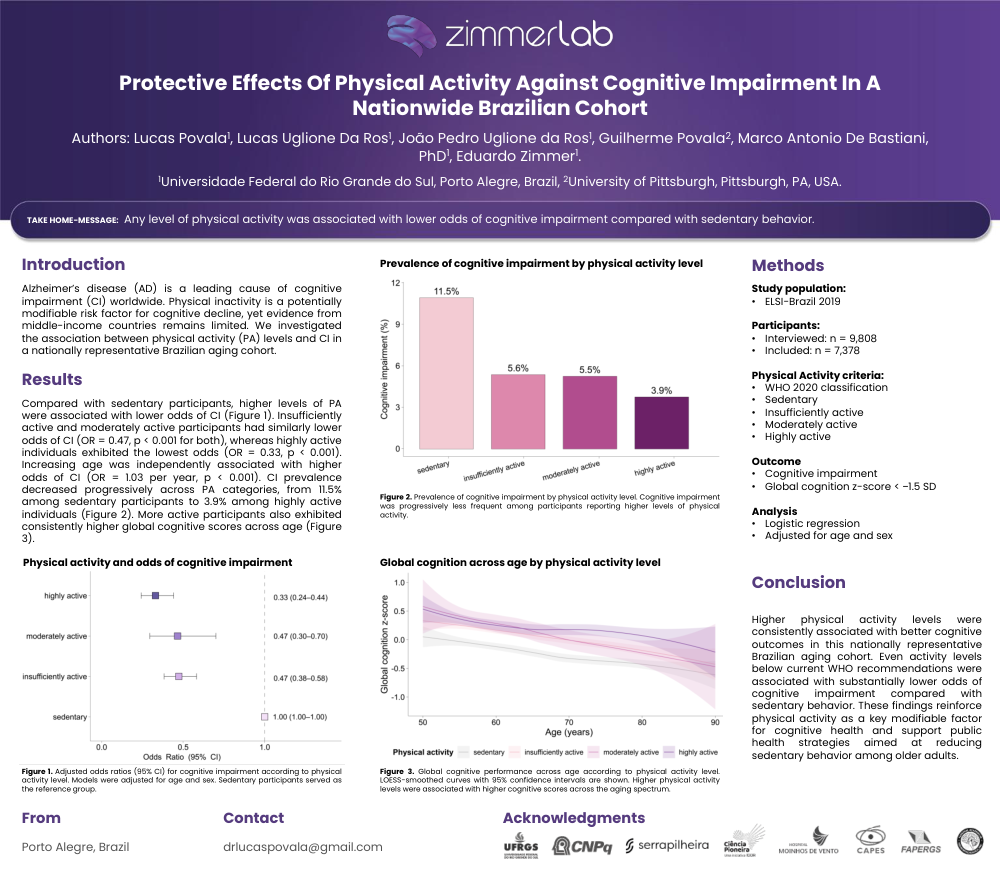
Protective Effects Of Physical Activity Against Cognitive Impairment In A Nationwide Brazilian Cohort
Part of Topic
Introduction: Alzheimer’s disease (AD) is a leading cause of cognitive impairment (CI) worldwide. Physical inactivity is a potentially modifiable risk factor for cognitive decline, yet evidence from middle-income countries remains limited. We investigated the association between physical activity (PA) levels and CI in a nationally representative Brazilian aging cohort.
Methods: Data were derived from the 2019 wave of the Brazilian Longitudinal Study of Aging (ELSI-Brazil). Of the 9,808 participants interviewed, 7,378 met the eligibility criteria and were included in the analyses. Physical activity was classified according to the WHO 2020 guidelines into four categories: sedentary, insufficiently active, moderately active, and highly active. Cognitive impairment was defined as a global cognition z-score below −1.5 standard deviations. Associations between physical activity level and cognitive impairment were assessed using multivariable logistic regression models adjusted for age and sex.
Results: Compared with sedentary participants, higher levels of PA were associated with lower odds of CI (Figure 1). Insufficiently active and moderately active participants had similarly lower odds of CI (OR = 0.47, p < 0.001 for both), whereas highly active individuals exhibited the lowest odds (OR = 0.33, p < 0.001). Increasing age was independently associated with higher odds of CI (OR = 1.03 per year, p < 0.001). CI prevalence decreased progressively across PA categories, from 11.5% among sedentary participants to 3.9% among highly active individuals (Figure 2). More active participants also exhibited consistently higher global cognitive scores across age (Figure 3).
Conclusion: Higher physical activity levels were consistently associated with better cognitive outcomes in this nationally representative Brazilian aging cohort. Even activity levels below current WHO recommendations were associated with substantially lower odds of cognitive impairment compared with sedentary behavior. These findings reinforce physical activity as a key modifiable factor for cognitive health and support public health strategies aimed at reducing sedentary behavior among older adults.
Comments
Email is required but is not shown publicly.
Loading comments...