4,068 posters, 219 videos, 101 topics, 69 sessions, 14,365 authors, 6,128 institutions
ePostersLive by SciGen Technologies S.A. All rights reserved.
Alzheimer's Association International Conference 2026
July 12-15, 2026 | London, United Kingdom, and Online

3328
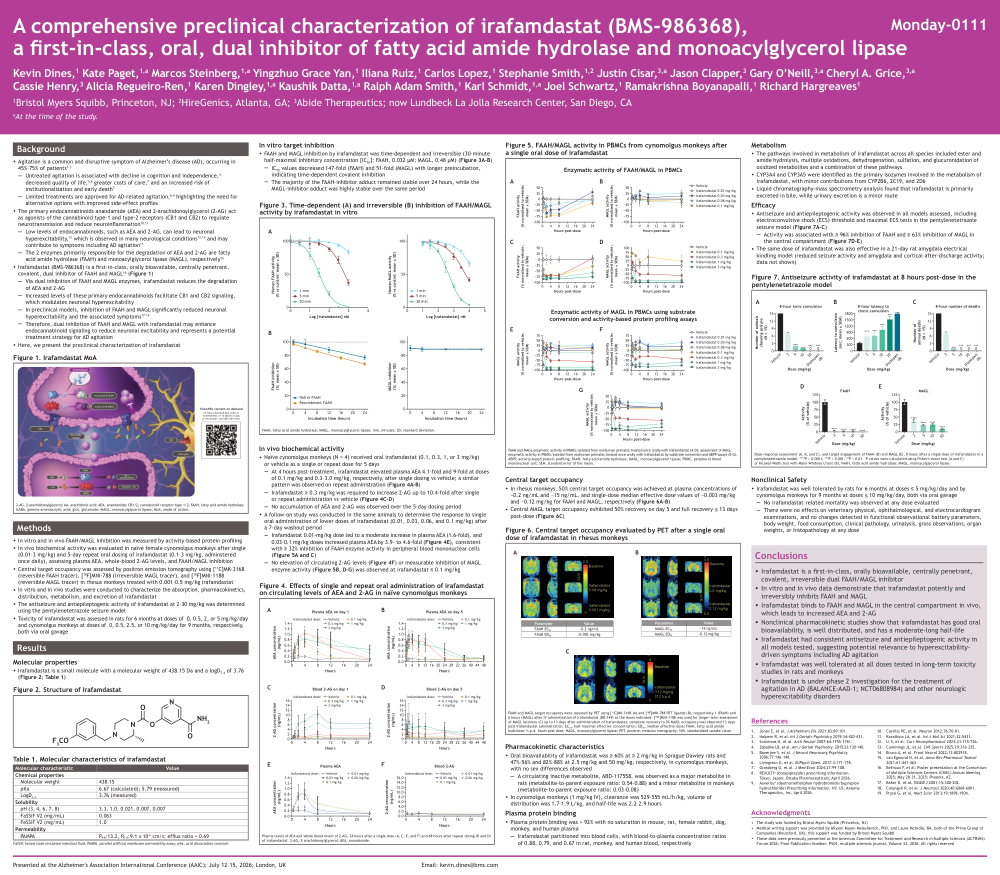
A Comprehensive Preclinical Characterization Of BMS-986368, A First-in-class, Oral, Dual Inhibitor Of FAAH/MAGL
Poster Presenter
Authors
Kevin Dines, Kate Paget, Marcos Steinberg, Yingzhuo Grace Yan, Iliana Ruiz, Carlos Lopez, Stephanie Smith, Justin Cisar, Jason Clapper, Gary O’Neill, Cheryl A. Grice, Cassie Henry, Alicia Regueiro-Ren, Karen Dingley, Kaushik Datta, Ralph Adam Smith, Karl Schmidt, Joel Schwartz, Ramakrishna Boyanapalli, Richard Hargreaves
Affiliations
Bristol Myers Squibb, Princeton, NJ, Bristol Myers Squibb, Princeton, NJ; HireGenics, Atlanta, GA, Abide Therapeutics; now Lundbeck La Jolla Research Center, San Diego, CA, Bristol Myers Squibb, Princeton, NJ (at the time of the study), Abide Therapeutics; now Lundbeck La Jolla Research Center, San Diego, CA (at the time of the study)
Part of Topic
Video
Background
• Agitation is a common and disruptive symptom of Alzheimer’s disease (AD), occurring in
45%–75% of patients1–3
— Untreated agitation is associated with decline in cognition and independence,4
decreased quality of life,5,6 greater costs of care,7 and an increased risk of
institutionalization and early death7
— Limited treatments are approved for AD-related agitation,8,9 highlighting the need for
alternative options with improved side-effect profiles
• The primary endocannabinoids anandamide (AEA) and 2-arachidonoylglycerol (2-AG) act
as agonists of the cannabinoid type-1 and type-2 receptors (CB1 and CB2) to regulate
neurotransmission and reduce neuroinflammation10,11
— Low levels of endocannabinoids, such as AEA and 2-AG, can lead to neuronal
hyperexcitability,12 which is observed in many neurological conditions13,14 and may
contribute to symptoms including AD agitation13
— The 2 enzymes primarily responsible for the degradation of AEA and 2-AG are fatty
acid amide hydrolase (FAAH) and monoacylglycerol lipase (MAGL), respectively15
• Irafamdastat (BMS-986368) is a first-in-class, orally bioavailable, centrally penetrant,
covalent, dual inhibitor of FAAH and MAGL16 (Figure 1)
— Via dual inhibition of FAAH and MAGL enzymes, irafamdastat reduces the degradation
of AEA and 2-AG
— Increased levels of these primary endocannabinoids facilitate CB1 and CB2 signaling,
which modulates neuronal hyperexcitability
— In preclinical models, inhibition of FAAH and MAGL significantly reduced neuronal
hyperexcitability and the associated symptoms17–19
— Therefore, dual inhibition of FAAH and MAGL with irafamdastat may enhance
endocannabinoid signaling to reduce neuronal excitability and represents a potential
treatment strategy for AD agitation
Methods
• In vitro and in vivo FAAH/MAGL inhibition was measured by activity-based protein profiling
• In vivo biochemical activity was evaluated in naïve female cynomolgus monkeys after single
(0.01-3 mg/kg) and 5-day repeat oral dosing of irafamdastat (0.1–3 mg/kg, adminstered
once daily), assessing plasma AEA, whole-blood 2-AG levels, and FAAH/MAGL inhibition
• Central target occupancy was assessed by positron emission tomography using [11C]MK-3168
(reversible FAAH tracer), [18F]MNI-788 (irreversible MAGL tracer), and [18F]MNI-1188
(reversible MAGL tracer) in rhesus monkeys treated with 0.001–0.5 mg/kg irafamdastat
• In vitro and in vivo studies were conducted to characterize the absorption, pharmacokinetics,
distribution, metabolism, and excretion of irafamdastat
• The antiseizure and antiepileptogenic activity of irafamdastat at 2–30 mg/kg was determined
using the pentylenetetrazole seizure model
• Toxicity of irafamdastat was assessed in rats for 6 months at doses of 0, 0.5, 2, or 5 mg/kg/day
and cynomolgus monkeys at doses of 0, 0.5, 2.5, or 10 mg/kg/day for 9 months, respectively,
both via oral gavage
Results
Molecular properties
• Irafamdastat is a small molecule with a molecular weight of 438.15 Da and a logD7.4 of 3.76
(Figure 2; Table 1)
In vitro target inhibition
• FAAH and MAGL inhibition by irafamdastat was time-dependent and irreversible (30-minute
half-maximal inhibitory concentration [IC50]: FAAH, 0.032 μM; MAGL, 0.48 μM) (Figure 3A–B)
— IC50 values decreased 147-fold (FAAH) and 51-fold (MAGL) with longer preincubation,
indicating time-dependent covalent inhibition
— The majority of the FAAH-inhibitor adduct remained stable over 24 hours, while the
MAGL-inhibitor adduct was highly stable over the same period
In vivo biochemical activity
• Naïve cynomolgus monkeys (N = 4) received oral irafamdastat (0.1, 0.3, 1, or 3 mg/kg)
or vehicle as a single or repeat dose for 5 days
— At 4 hours post-treatment, irafamdastat elevated plasma AEA 4.1-fold and 9-fold at doses
of 0.1 mg/kg and 0.3–3.0 mg/kg, respectively, after single dosing vs vehicle; a similar
pattern was observed on repeat administration (Figure 4A–B)
— Irafamdastat ≥ 0.3 mg/kg was required to increase 2-AG up to 10.4-fold after single
or repeat administration vs vehicle (Figure 4C–D)
— No accumulation of AEA and 2-AG was observed over the 5-day dosing period
• A follow-on study was conducted in the same animals to determine the response to single
oral administration of lower doses of irafamdastat (0.01, 0.03, 0.06, and 0.1 mg/kg) after
a 7-day washout period
— Irafamdastat 0.01-mg/kg dose led to a moderate increase in plasma AEA (1.6-fold), and
0.03–0.1 mg/kg doses increased plasma AEA by 3.9- to 4.6-fold (Figure 4E), consistent
with ≥ 32% inhibition of FAAH enzyme activity in peripheral blood mononuclear cells
(Figure 5A and C)
— No elevation of circulating 2-AG levels (Figure 4F) or measurable inhibition of MAGL
enzyme activity (Figure 5B, D–G) was observed at irafamdastat ≤ 0.1 mg/kg
Central target occupancy
• In rhesus monkeys, 50% central target occupancy was achieved at plasma concentrations of
~0.2 ng/mL and ~15 ng/mL, and single-dose median effective dose values of ~0.003 mg/kg
and ~0.12 mg/kg for FAAH and MAGL, respectively (Figure 6A–B)
• Central MAGL target occupancy exhibited 50% recovery on day 5 and full recovery ≤ 13 days
post-dose (Figure 6C)
Pharmacokinetic characteristics
• Oral bioavailability of irafamdastat was ≥ 60% at ≥ 2 mg/kg in Sprague Dawley rats and
47%–56% and 82%–88% at 2.5 mg/kg and 50 mg/kg, respectively, in cynomolgus monkeys,
with no sex differences observed
— A circulating inactive metabolite, ABD‑117558, was observed as a major metabolite in
rats (metabolite‑to‑parent exposure ratio: 0.54–0.88) and a minor metabolite in monkeys
(metabolite‑to‑parent exposure ratio: 0.03–0.08)
• In cynomolgus monkeys (1 mg/kg IV), clearance was 529–555 mL/h/kg, volume of
distribution was 1.7–1.9 L/kg, and half-life was 2.2–2.9 hours
Plasma protein binding
• Plasma protein binding was > 92% with no saturation in mouse, rat, female rabbit, dog,
monkey, and human plasma
— Irafamdastat partitioned into blood cells, with blood-to-plasma concentration ratios
of 0.88, 0.79, and 0.67 in rat, monkey, and human blood, respectively
Metabolism
• The pathways involved in metabolism of irafamdastat across all species included ester and
amide hydrolysis, multiple oxidations, dehydrogenation, sulfation, and glucuronidation of
oxidized metabolites and a combination of these pathways
• CYP3A4 and CYP3A5 were identified as the primary isozymes involved in the metabolism of
irafamdastat, with minor contributions from CYP2B6, 2C19, and 2D6
• Liquid chromatography-mass spectrometry analysis found that irafamdastat is primarily
excreted in bile, while urinary excretion is a minor route
Efficacy
• Antiseizure and antiepileptogenic activity was observed in all models assessed, including
electroconvulsive shock (ECS) threshold and maximal ECS tests in the pentylenetetrazole
seizure model (Figure 7A–C)
— Activity was associated with ≥ 96% inhibition of FAAH and ≥ 63% inhibition of MAGL in
the central compartment (Figure 7D–E)
• The same dose of irafamdastat was also effective in a 21-day rat amygdala electrical
kindling model (reduced seizure activity and amygdala and cortical after-discharge activity;
data not shown)
Nonclinical Safety
• Irafamdastat was well tolerated by rats for 6 months at doses ≤ 5 mg/kg/day and by
cynomolgus monkeys for 9 months at doses ≤ 10 mg/kg/day, both via oral gavage
— No irafamdastat–related mortality was observed at any dose evaluated
— There were no effects on veterinary physical, ophthalmological, and electrocardiogram
examinations, and no changes detected in functional observational battery parameters,
body weight, food consumption, clinical pathology, urinalysis, gross observations, organ
weights, or histopathology at any dose
Conclusions
• Irafamdastat is a first-in-class, orally bioavailable, centrally penetrant,
covalent, irreversible dual FAAH/MAGL inhibitor
• In vitro and in vivo data demonstrate that irafamdastat potently and
irreversibly inhibits FAAH and MAGL
• Irafamdastat binds to FAAH and MAGL in the central compartment in vivo,
which leads to increased AEA and 2-AG
• Nonclinical pharmacokinetic studies show that irafamdastat has good oral
bioavailability, is well distributed, and has a moderate-long half-life
• Irafamdastat had consistent antiseizure and antiepileptogenic activity in
all models tested, suggesting potential relevance to hyperexcitabilitydriven
symptoms including AD agitation
• Irafamdastat was well tolerated at all doses tested in long-term toxicity
studies in rats and monkeys
• Irafamdastat is under phase 2 investigation for the treatment of
agitation in AD (BALANCE-AAD-1; NCT06808984) and other neurologic
hyperexcitability disorders
Comments
Email is required but is not shown publicly.
Loading comments...