4,068 posters, 219 videos, 101 topics, 69 sessions, 14,365 authors, 6,128 institutions
ePostersLive by SciGen Technologies S.A. All rights reserved.
Alzheimer's Association International Conference 2026
July 12-15, 2026 | London, United Kingdom, and Online

10213
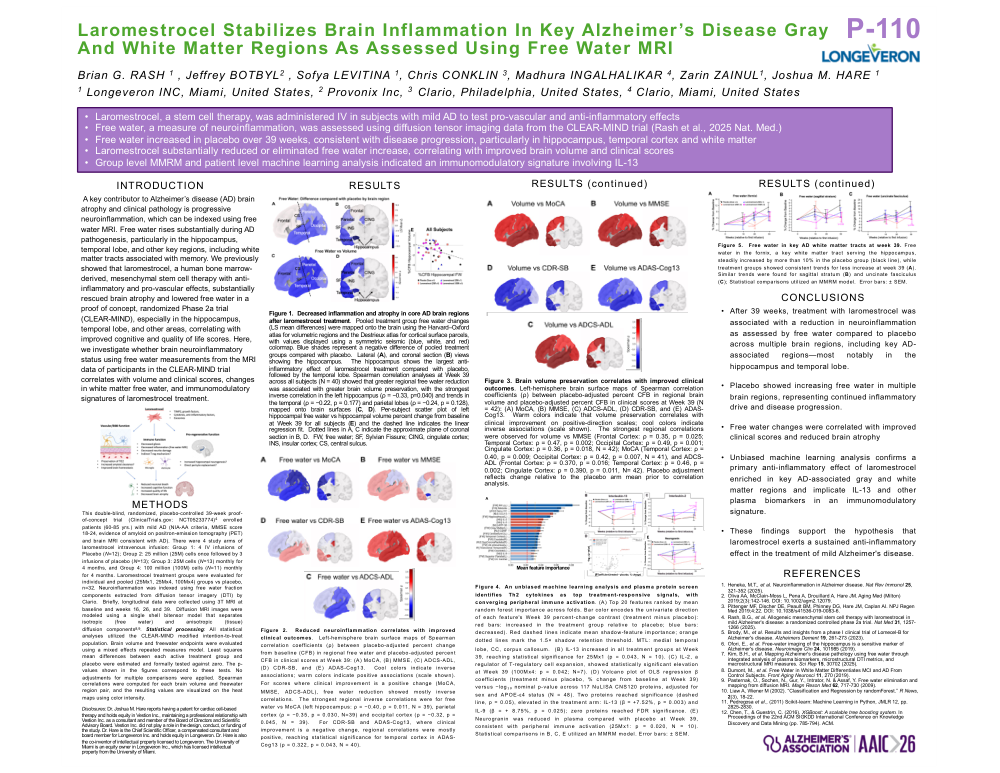
Laromestrocel Stabilizes Brain Inflammation In Key Alzheimer’s Disease Gray And White Matter Regions As Assessed Using Free Water MRI
Poster Presenter
Part of Topic
Abstract:
Background: A contributor to Alzheimer’s disease (AD) brain atrophy and clinical pathology isprogressive neuroinflammation, which can be indexed using free water MRI. Free water rises substantially during AD pathogenesis, particularly in the hippocampus, temporal lobe, and other key regions, including white matter tracts associated with memory. We previously showed that laromestrocel, a human bone marrow-derived, mesenchymal stem cell therapy with anti-inflammatory and pro-vascular effects, substantially rescued brain atrophy and lowered freewater in a proof of concept, randomized Phase 2a trial (CLEAR-MIND), especially in the hippocampus, temporal lobe, and other areas, correlating with improved cognitive and quality of life scores.
Methods: In a post-hoc exploratory analysis of CLEAR-MIND results, we investigated whether laromestrocel exerts anti-inflammatory effects in the brain using single shell free water MRI. Blood plasma samples from the trial were assessed using NuLISA. Laromestrocel infusion groups: 1) placebo, 2) 25 million (25M) cells, single dose, 3) 25M or 4) 100M cells in 4 monthly doses, vs placebo. Data were statistically modeled using MMRM.
Results: In the placebo population (N=10), free water rose over 39 weeks in the fornix, sagittal stratum, uncinate fasciculus, and other key AD white matter tracts. However, free water was numerically reduced compared with placebo in all groups receiving laromestrocel (fornix at week 26: 25Mx4,N=11, p=0.058; sagittal stratum at week 39: pooled 25Mx4 and 100Mx4 treatment groups, N=21, p=0.063; uncinate fasciculus (left) at week 39: 100Mx4, N=10, p=0.064). This reduction trend in free water correlated (Spearman) with our recent findings showing significantly reduced free water compared with placebo at 39 weeks in key gray matter regions: hippocampus, thetemporal, parietal, and occipital lobes, and medulla, and with improvements in clinical scores. Plasma NuLISA indicated a reduction compared with placebo (N=11) at 39 weeks in neurogranin, a marker of neuronal degradation (25Mx4, N=12, p=0.023), and an increase in IL13, an anti-inflammatory cytokine that regulates microglia activation (25Mx1, N=12, p=0.043).
Conclusion: These results provide support for a clinically relevant and long-lasting anti-inflammatory mechanism of action of laromestrocel in gray and white matter, indicate potential blood biomarker correlates, and support continued clinical development of laromestrocel for AD.
Comments
Email is required but is not shown publicly.
Loading comments...