4,068 posters, 219 videos, 101 topics, 69 sessions, 14,365 authors, 6,128 institutions
ePostersLive by SciGen Technologies S.A. All rights reserved.
Alzheimer's Association International Conference 2026
July 12-15, 2026 | London, United Kingdom, and Online

10726
Mri Correlates Of Pattern Separation: Insights From The A4 Study
Poster Presenter
Authors
Ghasem Farahmand, Katelynn M. Nguyen, Davis C. Woodworth, Joshua Cheung, Craig E. L. Stark, Seyed Ahmad Sajjadi
Affiliations
Department of Neurology, University of California, Irvine, Stritch School of Medicine, Loyola University Chicago, Department of Neurobiology & Behavior, University of California, Irvine
Part of Topic
Introduction:
Pattern separation — the ability to store highly similar experiences as distinct memories — is crucial for daily life and is among the earliest cognitive processes to decline in Alzheimer’s disease.
Inclusion of the Mnemonic Similarity Task (MST) in the Anti-Amyloid Treatment in Asymptomatic Alzheimer’s (A4) Study offers an opportunity to identify the neural correlates of pattern separation in a large, well-characterized group of older adults with amyloid biomarkers.
Methods:
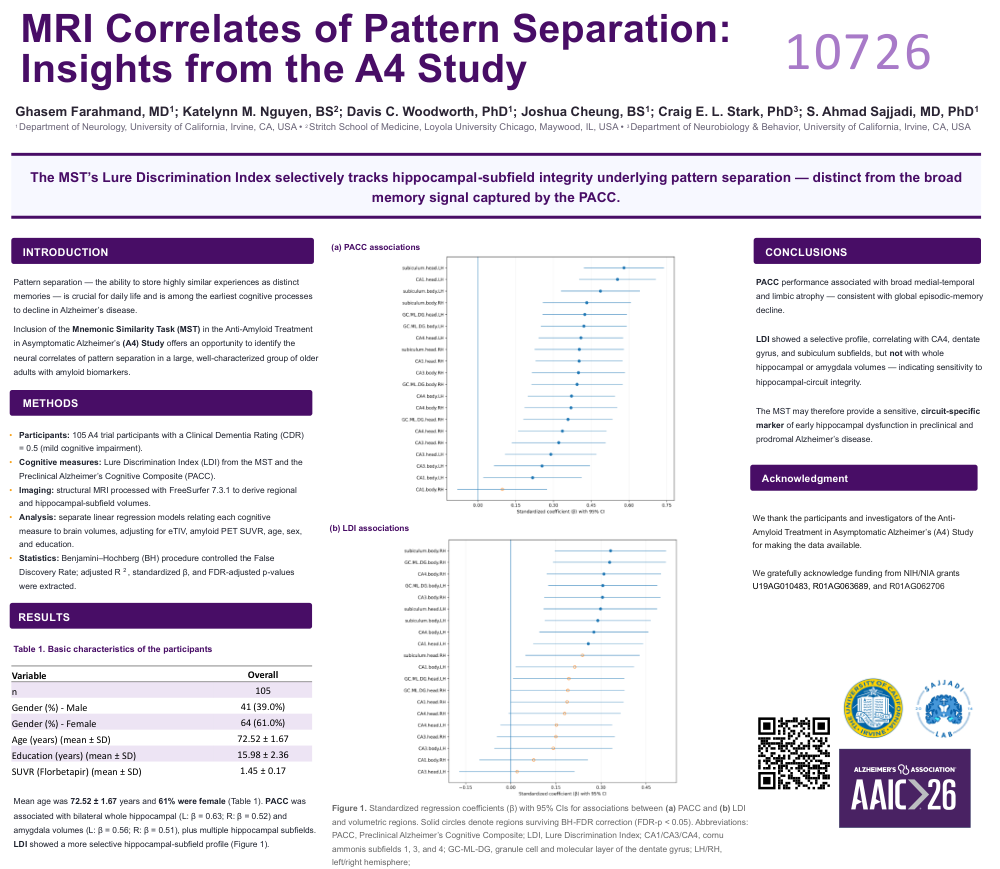
Mean age was 72.52 ± 1.67 years and 61% were female (Table 1). PACC was associated with bilateral whole hippocampal (L: β = 0.63; R: β = 0.52) and amygdala volumes (L: β = 0.56; R: β = 0.51), plus multiple hippocampal subfields. LDI showed a more selective hippocampal-subfield profile (Figure 1).
Conclusion:
PACC performance associated with broad medial-temporal and limbic atrophy — consistent with global episodic-memory decline.
LDI showed a selective profile, correlating with CA4, dentate gyrus, and subiculum subfields, but not with whole hippocampal or amygdala volumes — indicating sensitivity to hippocampal-circuit integrity.
The MST may therefore provide a sensitive, circuit-specific marker of early hippocampal dysfunction in preclinical and prodromal Alzheimer’s disease.
Acknowledgment:
We thank the participants and investigators of the Anti-Amyloid Treatment in Asymptomatic Alzheimer’s (A4) Study for making the data available.
We gratefully acknowledge funding from NIH/NIA grants U19AG010483, R01AG063689, and R01AG062706
Comments
Email is required but is not shown publicly.
Loading comments...