4,068 posters, 219 videos, 101 topics, 69 sessions, 14,365 authors, 6,128 institutions
ePostersLive by SciGen Technologies S.A. All rights reserved.
Alzheimer's Association International Conference 2026
July 12-15, 2026 | London, United Kingdom, and Online

3724
Utilizing Biological Noise To Optimize Outcomes, And Its Relevance As A Disease-modifying Intervention, For Alzheimer's Disease (AD)
Poster Presenter
Authors
Affiliations
Part of Topic
Utilizing Biological Noise to Optimize Outcomes: A Novel Method for Improving Disease-modifying Intervention for Alzheimer's Disease (AD)
Agus S., Furest O., Ilan Y.
Background:
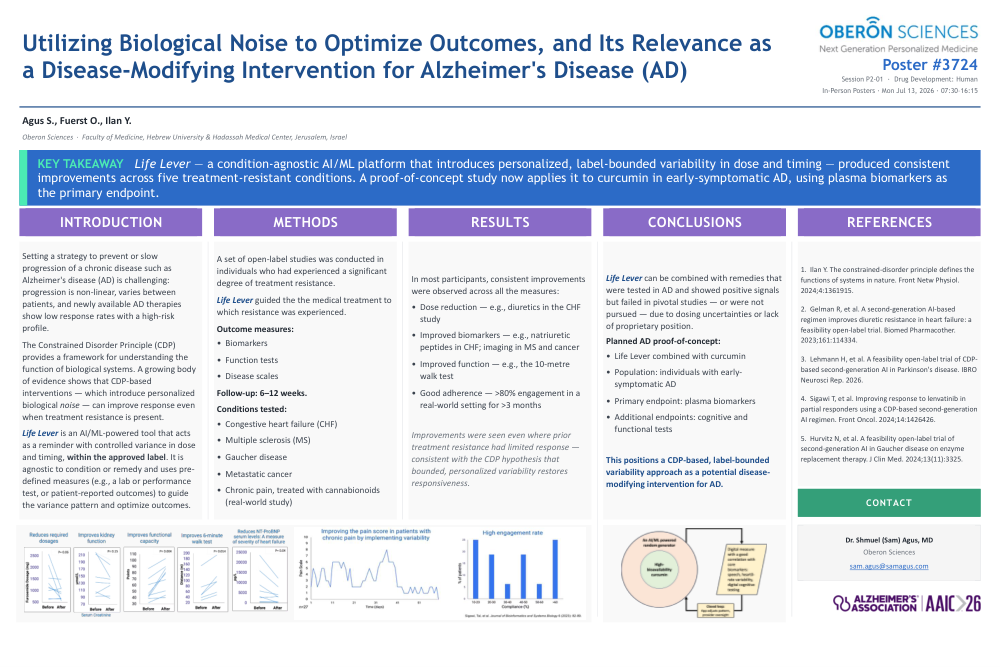
Setting a treatment strategy to prevent or slow the progression of a chronic disease, such as Alzheimer’s Disease (AD) is challenging. Disease progression is non-linear, variable among patients, and there is a low response rate with a high-risk profile of newly available treatments for AD. The Constrained-Disorder-Principle (CDP) provides a platform for understanding the function of biological systems. A growing body of evidence shows that CDP-based interventions which comprise personalized biological noise, could improve response, even when treatment resistance is experienced.
Life Lever is an AI/ML powered tool, which serves as a reminder with variance in dose and time, within the approved label. It is agnostic to condition or remedy and is using pre-defined measures (e.g., a lab or performance test, or patient-reported), to guide the variance pattern, in order to optimize the outcome.
Methods:
A set of open-label POC studies, with individuals, who have experienced a significant degree of treatment resistance, was conducted. Life lever was used to guide the pattern of the medical treatment, to which resistance was experienced. Outcome measures included biomarkers, function and disease scales. The follow up was between 6 and 12 weeks. The platform was tested in patients with congestive heart failure (CHF), multiple sclerosis (MS), Gaucher’s Disease, metastatic cancer, and chronic pain.
Results:
In most participants, consistent improvements were seen in majority of measures, including reduction of dose (e.g., diuretics in the CHF study), improved biomarkers (e.g., natriuretic peptides in CHF, imaging for MS and cancer), improvement on function (e.g., measured by the 10m walk test), and with good adherence (>80% engagement in a real-world setting, for >3 months).
Conclusion:
Life Lever can be combined with remedies that were tested in AD, showed some positive signals, but failed in pivotal studies, or was not pursued, due to dosing uncertainties, or even due to lack of proprietary. A POC study is being planned, whereby Life Lever will be combined with curcumin, in individuals with early-symptomatic AD. The primary endpoint will be based on plasma biomarkers. Additional endpoints will include cognitive and functional tests.
Comments
Email is required but is not shown publicly.
Loading comments...