4,068 posters, 219 videos, 101 topics, 69 sessions, 14,365 authors, 6,128 institutions
ePostersLive by SciGen Technologies S.A. All rights reserved.
Alzheimer's Association International Conference 2026
July 12-15, 2026 | London, United Kingdom, and Online

3095
ALN-5288, An Investigational RNA Interference Therapeutic Targeting MAPT In Phase 1 Development For Alzheimer’s Disease
Poster Presenter
Part of Topic
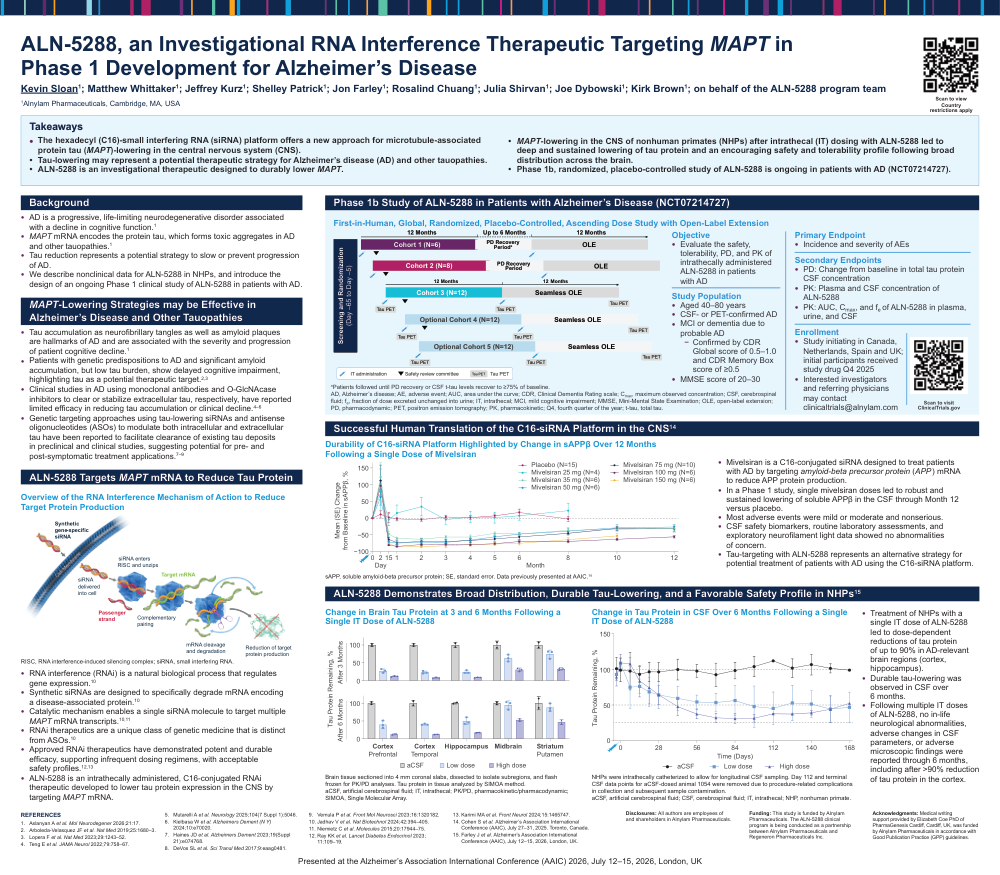
ALN-5288, an Investigational RNA Interference Therapeutic Targeting MAPT in Phase 1 Development for Alzheimer’s Disease
Kevin Sloan1; Matthew Whittaker1; Jeffrey Kurz1; Shelley Patrick1; Jon Farley1; Rosalind Chuang1; Julia Shirvan1; Joe Dybowski1; Kirk Brown1; on behalf of the ALN-5288 program team
1Alnylam Pharmaceuticals, Cambridge, MA, USA
Takeaways
• The hexadecyl (C16)-small interfering RNA (siRNA) platform offers a new approach for microtubule-associated protein tau (MAPT)-lowering in the central nervous system (CNS).
• Tau-lowering may represent a potential therapeutic strategy for Alzheimer’s disease (AD) and other tauopathies.
• ALN-5288 is an investigational therapeutic designed to durably lower MAPT.
• MAPT-lowering in the CNS of nonhuman primates (NHPs) after intrathecal (IT) dosing with ALN-5288 led to deep and sustained lowering of tau protein and an encouraging safety and tolerability profile following broad distribution across the brain.
• Phase 1b, randomized, placebo-controlled study of ALN-5288 is ongoing in patients with AD (NCT07214727).
Background
• AD is a progressive, life-limiting neurodegenerative disorder associated with a decline in cognitive function.1
• MAPT mRNA encodes the protein tau, which forms toxic aggregates in AD and other tauopathies.1
• Tau reduction represents a potential strategy to slow or prevent progression of AD.
• We describe nonclinical data for ALN-5288 in NHPs, and introduce the design of an ongoing Phase 1 clinical study of ALN-5288 in patients with AD.
MAPT-Lowering Strategies may be Effective in Alzheimer’s Disease and Other Tauopathies
• Tau accumulation as neurofibrillary tangles as well as amyloid plaques are hallmarks of AD and are associated with the severity and progression
of patient cognitive decline.1
• Patients with genetic predispositions to AD and significant amyloid accumulation, but low tau burden, show delayed cognitive impairment, highlighting tau as a potential therapeutic target.2,3
• Clinical studies in AD using monoclonal antibodies and O-GlcNAcase inhibitors to clear or stabilize extracellular tau, respectively, have reported limited efficacy in reducing tau accumulation or clinical decline.4–6
• Genetic targeting approaches using tau-lowering siRNAs and antisense oligonucleotides (ASOs) to modulate both intracellular and extracellular tau have been reported to facilitate clearance of existing tau deposits in preclinical and clinical studies, suggesting potential for pre- and post‑symptomatic treatment applications.7–9
ALN-5288 Targets MAPT mRNA to Reduce Tau Protein
Overview of the RNA Interference Mechanism of Action to Reduce Target Protein Production
• RNA interference (RNAi) is a natural biological process that regulates gene expression.10
• Synthetic siRNAs are designed to specifically degrade mRNA encoding a disease-associated protein.10
• Catalytic mechanism enables a single siRNA molecule to target multiple MAPT mRNA transcripts.10,11
• RNAi therapeutics are a unique class of genetic medicine that is distinct from ASOs.10
• Approved RNAi therapeutics have demonstrated potent and durable efficacy, supporting infrequent dosing regimens, with acceptable safety profiles.12,13
• ALN-5288 is an intrathecally administered, C16-conjugated RNAi therapeutic developed to lower tau protein expression in the CNS by targeting MAPT mRNA.
Phase 1b Study of ALN-5288 in Patients with Alzheimer’s Disease (NCT07214727)
First-in-Human, Global, Randomized, Placebo-Controlled, Ascending Dose Study with Open-Label Extension
Objective
• Evaluate the safety, tolerability, PD, and PK of intrathecally administered ALN-5288 in patients with AD
Study Population
• Aged 40–80 years
• CSF- or PET-confirmed AD
• MCI or dementia due to probable AD − Confirmed by CDR Global score of 0.5–1.0 and CDR Memory Box score of ≥0.5
• MMSE score of 20–30
Primary Endpoint
• Incidence and severity of AEs
Secondary Endpoints
• PD: Change from baseline in total tau protein CSF concentration
• PK: Plasma and CSF concentration of ALN‑5288
• PK: AUC, Cmax, and fe of ALN-5288 in plasma, urine, and CSF
Enrollment
• Study initiating in Canada, Netherlands, Spain and UK; initial participants received study drug Q4 2025
• Interested investigators and referring physicians may contact clinicaltrials@alnylam.com
Successful Human Translation of the C16-siRNA Platform in the CNS14
• Mivelsiran is a C16-conjugated siRNA designed to treat patients with AD by targeting amyloid-beta precursor protein (APP) mRNA to reduce APP protein production.
• In a Phase 1 study, single mivelsiran doses led to robust and sustained lowering of soluble APPβ in the CSF through Month 12 versus placebo.
• Most adverse events were mild or moderate and nonserious.
• CSF safety biomarkers, routine laboratory assessments, and exploratory neurofilament light data showed no abnormalities of concern.
• Tau-targeting with ALN-5288 represents an alternative strategy for potential treatment of patients with AD using the C16-siRNA platform.
ALN-5288 Demonstrates Broad Distribution, Durable Tau-Lowering, and a Favorable Safety Profile in NHPs15
• Treatment of NHPs with a single IT dose of ALN‑5288 led to dose-dependent reductions of tau protein of up to 90% in AD-relevant brain regions (cortex, hippocampus).
• Durable tau-lowering was observed in CSF over 6 months.
• Following multiple IT doses of ALN-5288, no in-life neurological abnormalities, adverse changes in CSF parameters, or adverse microscopic findings were reported through 6 months, including after >90% reduction of tau protein in the cortex.
REFERENCES
1. Aslanyan A et al. Mol Neurodegener 2026;21:17.
2. Arboleda-Velasquez JF et al. Nat Med 2019;25:1680–3.
3. Lopera F et al. Nat Med 2023;29:1243–52.
4. Teng E et al. JAMA Neurol 2022;79:758–67.
5. Mutarelli A et al. Neurology 2025;104(7 Suppl 1):5046.
6. Kielbasa W et al. Alzheimers Dement (N Y) 2024;10:e70020.
7. Haines JD et al. Alzheimers Dement 2023;19(Suppl 21):e074768.
8. DeVos SL et al. Sci Transl Med 2017;9:eaag0481.
9. Vemula P et al. Front Mol Neurosci 2023;16:1320182.
10. Jadhav V et al. Nat Biotechnol 2024;42:394–405.
11. Niemietz C et al. Molecules 2015;20:17944–75.
12. Ray KK et al. Lancet Diabetes Endocrinol 2023; 11:109–19.
13. Karimi MA et al. Front Neurol 2024;15:1465747.
14. Cohen S et al. Alzheimer’s Association International Conference (AAIC), July 27–31, 2025. Toronto, Canada.
15. Farley J et al. Alzheimer’s Association International Conference (AAIC), July 12–15, 2026, London, UK.
Disclosures: All authors are employees of and shareholders in Alnylam Pharmaceuticals.
Funding: This study is funded by Alnylam Pharmaceuticals. The ALN-5288 clinical program is being conducted as a partnership between Alnylam Pharmaceuticals and Regeneron Pharmaceuticals Inc.
Acknowledgments: Medical writing support provided by Elizabeth Coe PhD of PharmaGenesis Cardiff, Cardiff, UK, was funded by Alnylam Pharmaceuticals in accordance with Good Publication Practice (GPP) guidelines.
Presented at the Alzheimer’s Association International Conference (AAIC) 2026, July 12–15, 2026, London, UK
Comments
Email is required but is not shown publicly.
Loading comments...