4,068 posters, 219 videos, 101 topics, 69 sessions, 14,365 authors, 6,128 institutions
ePostersLive by SciGen Technologies S.A. All rights reserved.
Alzheimer's Association International Conference 2026
July 12-15, 2026 | London, United Kingdom, and Online

1712
Treatment Withbeta-amyloidtargeting Monoclonal Antibodies Improves Cognitive Function In A Patient With Alzheimer's Disease
Poster Presenter
Authors
Part of Topic
Treatment with Beta-Amyloid Targeting Monoclonal Antibodies Improves Cognitive Function in a Patient with Alzheimer's Disease
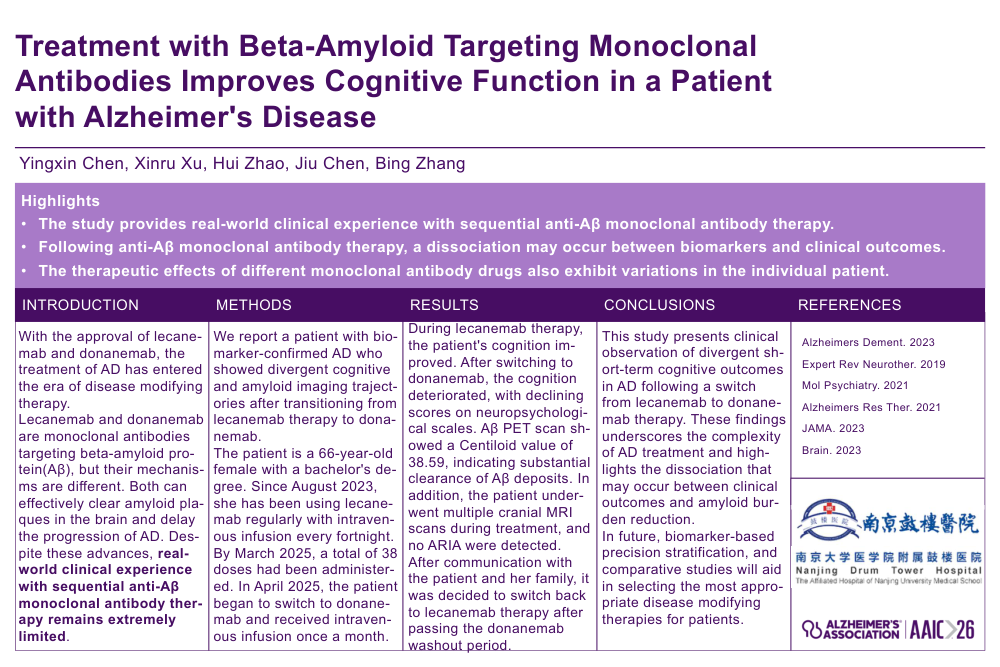
Background: Alzheimer's disease(AD) is a neurodegenerative disorder primarily characterized by the aggregation of beta-amyloid protein(Aβ). With the successive approval of lecanemab and donanemab, the treatment of AD has entered the era of disease modifying therapy. Lecanemab and donanemab are monoclonal antibodies targeting Aβ, but their mechanisms of action are different. Lecanemab targets soluble Aβ oligomers and fibrils, whereas donanemab targets insoluble Aβ plaques. Both can effectively clear amyloid plaques in the brain and delay the progression of AD. Despite these advances, real-world clinical experience with sequential anti-Aβ monoclonal antibody therapy remains extremely limited.
Methods: In this report, we describe a patient with biomarker-confirmed AD who experienced divergent cognitive and amyloid imaging trajectories after transitioning from prolonged lecanemab therapy to donanemab. The patient is a 66-year-old female with a bachelor's degree. Since August 2023, she has been using lecanemab regularly with intravenous infusion every fortnight. By March 2025, a total of 38 doses had been administered. In April 2025, the patient began to switch to donanemab and received intravenous infusion once a month.
Results: During lecanemab therapy, the patient's cognition improved. After switching to donanemab therapy, the patient's cognition deteriorated, with declining scores on neuropsychological scales. An Aβ PET scan revealed a Centiloid value of 38.59, indicating substantial clearance of amyloid deposits. Additionlly, the patient underwent multiple cranial magnetic resonance imaging scans during treatment, and no amyloid-related imaging abnormalities (ARIA) were detected. After thorough communication with the patient and her family, it was decided to switch back to lecanemab therapy after passing the donanemab washout period.
Conclusion: This study presents the first clinical observation of divergent short-term cognitive outcomes in AD following a switch from lecanemab to donanemab therapy. These findings underscores the complexity of AD treatment and highlights the dissociation that may occur between amyloid burden reduction and clinical outcomes. In the future, biomarker-based precision stratification, such as tau PET and neuroinflammation markers, and comparative studies will aid in selecting the most appropriate disease modifying therapies for patients.
Comments
Email is required but is not shown publicly.
Loading comments...