4,068 posters, 219 videos, 101 topics, 69 sessions, 14,365 authors, 6,128 institutions
ePostersLive by SciGen Technologies S.A. All rights reserved.
Alzheimer's Association International Conference 2026
July 12-15, 2026 | London, United Kingdom, and Online

1091
Promoting Innate Phagocytosis: Novel Treatment Strategies For Alzheimer’S Disease
Part of Topic
Promoting Innate Phagocytosis: Novel Treatment Strategies for Alzheimer’s Disease
Xin Huang1,2, Feng He3, Feng Chen1,2, Colin L. Masters1, Jianzhi Wang3, Ben J. Gu1,2,4,5,6*
1 The Florey Institute, The University of Melbourne, Parkville, VIC 3052, Australia;
2 The Innate Phagocytosis Lab, Melbourne, VIC 3000, Australia
3 Topgene Biotechnology, Wuhan, Hubei, China
4 Qankorey Biotechnology, Changsha, Hunan, China
5 Changsha InnatePhago Pharmaceutics, Changsha, Hunan, China
6 National Clinical Research Center for Aging and Medicine, Huashan Hospital of Fudan University, Shanghai, China.
*Presenting author, email: ben.gu@innatephagolab.com.au
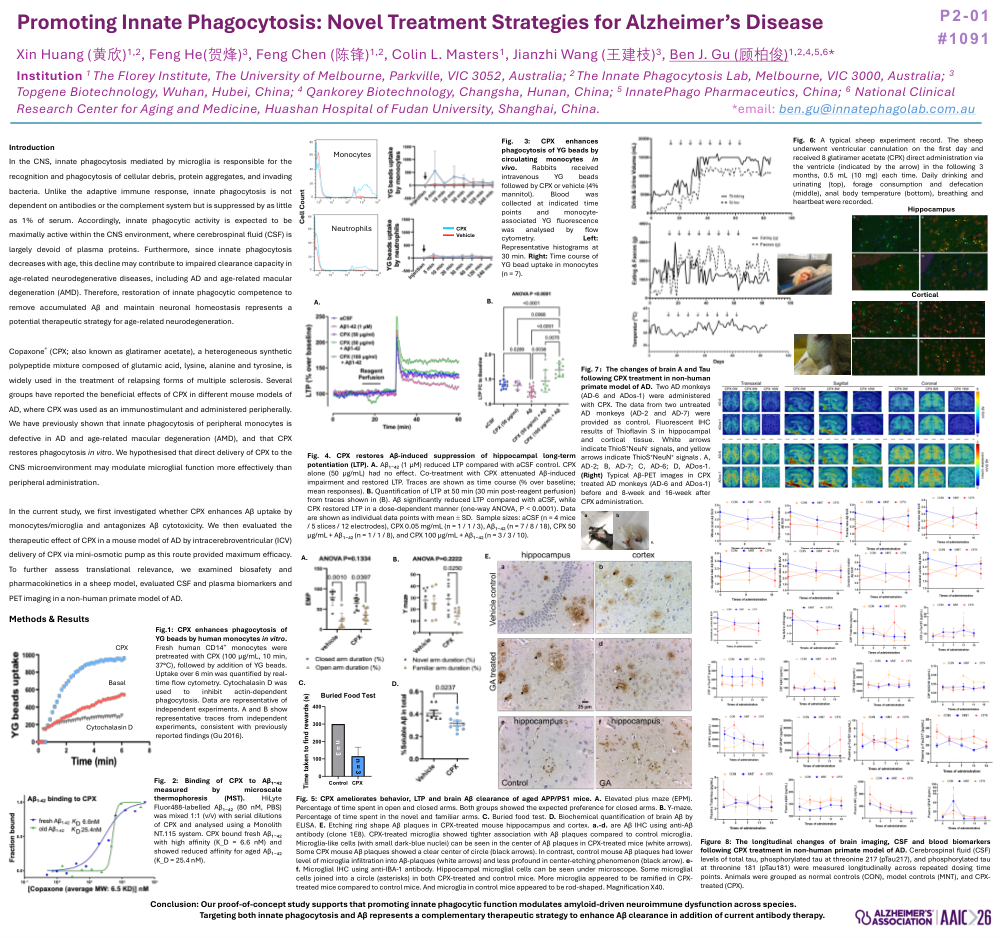
There have been many different opinions on the deep pathogenesis of Alzheimer's disease (AD). More and more research findings have made people realize that although the accumulation of Aβ plaques and Tau in the brain is closely related to cognitive decline, it may only be the manifestation of Alzheimer's disease, not the root cause of Alzheimer's disease. Innate phagocytosis is the first line of immune defence of the human body and an important physiological function for the body to remove denatured proteins, pathogens and apoptotic cells. In the process of perfecting the "innate phagocytosis" theory, we discovered a series of compounds that can enhance the innate phagocytic ability of the human body, including some small molecule peptides and Chinese medicine extracts. We found that some phagocytosis-promoting peptides (PPP) have a strong affinity with Aβ, so we tried to evaluate their efficacy and safety in AD treatment by direct intracerebroventricular administration. APP/PS1 mice showed behavioural improvements four weeks after administration, and the baseline level of long-term potentiation (LTP) in brain slices increased significantly, showing the recovery and improvement of the learning and memory function of the mouse brain. The levels of soluble and insoluble Aβ in the brain decreased by half, and the original Aβ plaques began to show signs of ablation from the centre. During the administration of the drug to healthy adult Australian sheep, we found that the sheep's food intake, water intake and excretion were greatly enhanced, indicating that the drug promoted brain energy metabolism. In the AD model induced by Aβ polymers and Tau in cynomolgus monkeys, we administered the drug once a week by implanting an Ommaya shunt in the head. After two and four months, Aβ-PET and Tau-PET scans were used to observe significantly reduced Aβ and Tau accumulation in the brain, which corresponded to laboratory indicators Aβ40/42, Tau, p-Tau and NFL in CSF and blood. Our proof-of-concept study revealed that innate phagocytosis plays a major role in the development of AD, and therapies targeting innate phagocytosis may open a new avenue for the complete treatment of AD.
Comments
Email is required but is not shown publicly.
Loading comments...