4,068 posters, 219 videos, 101 topics, 69 sessions, 14,365 authors, 6,128 institutions
ePostersLive by SciGen Technologies S.A. All rights reserved.
Alzheimer's Association International Conference 2026
July 12-15, 2026 | London, United Kingdom, and Online

6464
Design Of Applauds, A Phase 2 Study Of Mivelsiran In People With Down Syndrome And Early-stage Alzheimer’S Disease
Poster Presenter
Authors
Michael Rafii, Beau Ances, Johannes Levin, Sigan L Hartley, Bradley T Christian, Alexandre Sostelly, Sasikiran Goteti, Lan T Dang, Kirk Brown, Robert Deering, Julia Shirvan, Juan Fortea
Affiliations
Alzheimer’s Therapeutic Research Institute, Keck School of Medicine, University of Southern California, San Diego, CA, Department of Neurology, Washington University School of Medicine, St Louis, MO, USA, Department of Neurology, LMU University Hospital, Munich, Germany, Waisman Center, University of Wisconsin-Madison, Madison, WI, USA, Alnylam Pharmaceuticals, Cambridge, MA, USA, Sant Pau Memory Unit, IR SANT PAU, Hospital de la Santa Creu i Sant Pau, Barcelona, Spain; Barcelona Down Medical Center, Fundació Catalana Síndrome de Down, Barcelona, Spain
Part of Topic
Design of APPlauDS, a Phase 2 Study of Mivelsiran in People with Down Syndrome and Early-Stage Alzheimer’s Disease
Michael S Rafii1; Beau Ances2; Johannes Levin3; Sigan L Hartley4; Bradley T Christian4; Alexandre Sostelly5; Sasikiran Goteti5,a; Lan T Dang5,a; Kirk Brown5; Robert Deering5; Julia Shirvan5; Juan Fortea6,7
1Alzheimer’s Therapeutic Research Institute, Keck School of Medicine, University of Southern California, San Diego, CA, USA; 2Department of Neurology, Washington University School of Medicine, St Louis, MO, USA; 3Department of Neurology, LMU University Hospital, Munich, Germany; 4Waisman Center, University of Wisconsin-Madison, Madison, WI, USA; 5Alnylam Pharmaceuticals, Cambridge, MA, USA; 6Sant Pau Memory Unit, IR SANT PAU, Hospital de la Santa Creu i Sant Pau, Barcelona, Spain; 7Barcelona Down Medical Center, Fundació Catalana Síndrome de Down, Barcelona, Spain
aAffiliation at time of abstract submission
Takeaways
• Triplication of chromosome 21, the locus of the amyloid-beta precursor protein (APP) gene, and resulting overproduction of APP causes a near-complete risk of Alzheimer’s disease (AD) in people with Down syndrome (DS).
• APPlauDS will investigate the disease-modifying potential of APP reduction with the investigational RNA interference (RNAi) therapeutic mivelsiran in people with early-stage Down syndrome-associated Alzheimer’s disease (DS-AD), and evaluate whether mivelsiran can slow, halt, or reverse AD progression in people with DS who are not yet experiencing cognitive decline.
Background
Down Syndrome-Associated Alzheimer’s Disease (DS-AD)
• People with DS have a near-complete risk of developing symptomatic AD in late adulthood (>50 years); AD has become the leading cause of death in adults with DS.1,2
• DS-AD follows the same biomarker cascade as sporadic AD but is clinically distinct with earlier onset and more rapid progression.2–4
Rationale for Mivelsiran in DS-AD
DS-AD is Caused by Overexpression of APP Due to Trisomy 21
• People with DS have an additional copy of chromosome 21, the locus of the APP gene; this results in overexpression of APP and increases the production of amyloid-beta (Aβ) peptides implicated in AD pathogenesis.5–7
• Two rare case studies of people with DS with partial trisomy 21, in whom the APP locus had not been triplicated, showed no dementia and no signs of AD neuropathology at their time of death in their 70s.8,9
Mivelsiran is an RNAi Therapeutic that Targets APP
• Mivelsiran contains a small interfering RNA (siRNA) that binds and cleaves APP mRNA, reducing APP expression and Aβ production to reduce downstream intracellular and extracellular drivers of AD progression (Figure 1).10,11
• APP reduction has been shown to reduce amyloid plaques, reduce glial fibrillary acidic protein and neurofilament light chain, and correct behavior in a five times familial AD (5xFAD) mouse model.12
• Preclinical studies in induced pluripotent stem cell-derived neurons of people with DS have shown that APP-lowering siRNA can lower β-C-terminal fragment, improve lysosomal activity, and increase cell viability (Figure 2).
Mivelsiran Phase 1: Rapid, Robust APP-Lowering with Encouraging Safety11
• The Phase 1 study investigated the safety and tolerability of single and multiple ascending doses of mivelsiran in patients with early-onset AD.
• Mivelsiran was generally well tolerated across dose levels with single and multiple doses, with no immune responses or evidence of drug-related amyloid-related imaging abnormalities observed.
• Marked reductions in cerebrospinal fluid soluble APPβ and Aβ peptides (Aβ42 and Aβ40) were observed with single and multiple doses of mivelsiran above 25 mg versus placebo.
Methods
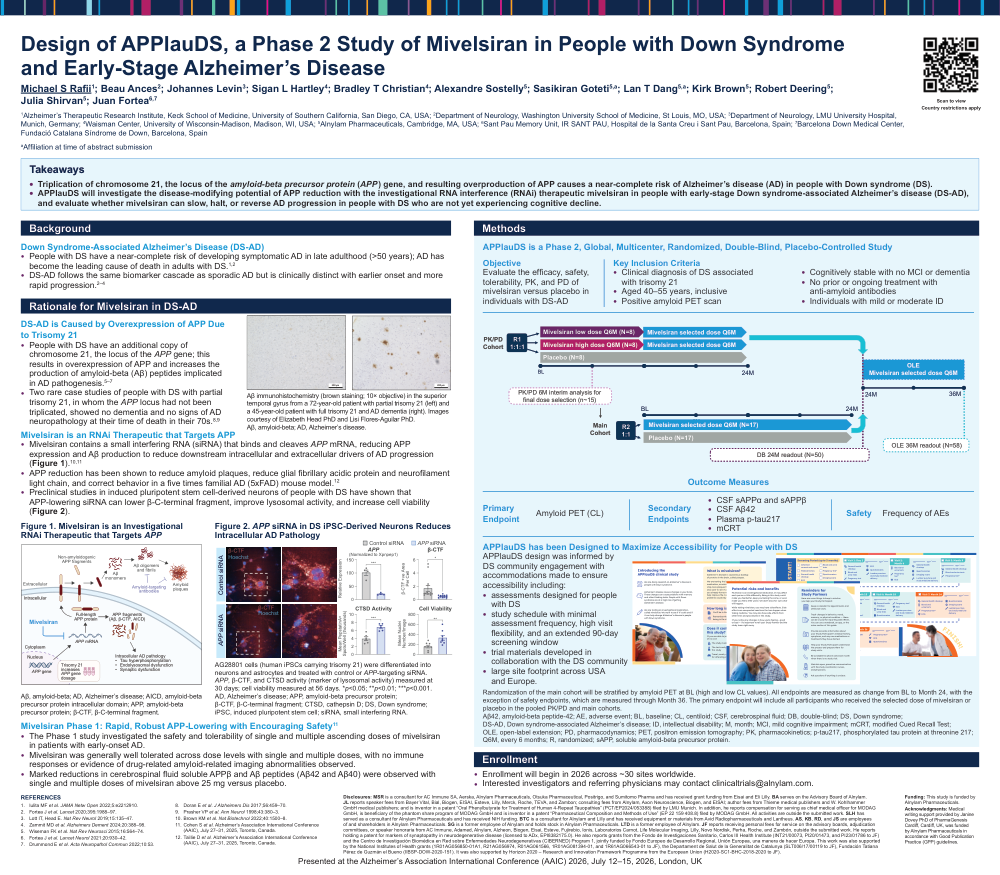
APPlauDS is a Phase 2, Global, Multicenter, Randomized, Double-Blind, Placebo-Controlled Study
Objective:
Evaluate the efficacy, safety, tolerability, PK, and PD of mivelsiran versus placebo in individuals with DS-AD
Key Inclusion Criteria:
• Clinical diagnosis of DS associated with trisomy 21
• Aged 40–55 years, inclusive
• Positive amyloid PET scan
• Cognitively stable with no MCI or dementia
• No prior or ongoing treatment with anti‑amyloid antibodies
• Individuals with mild or moderate ID
Outcome measures
Primary Endpoint:
Amyloid PET (CL)
Secondary Endpoints:
• CSF sAPPα and sAPPβ
• CSF Aβ42
• Plasma p-tau217
• mCRT
Safety:
Frequency of AEs
APPlauDS has been Designed to Maximize Accessibility for People with DS
APPlauDS design was informed by DS community engagement with accommodations made to ensure accessibility including:
• assessments designed for people with DS
• study schedule with minimal assessment frequency, high visit flexibility, and an extended 90-day screening window
• trial materials developed in collaboration with the DS community
• large site footprint across USA and Europe.
Randomization of the main cohort will be stratified by amyloid PET at BL (high and low CL values). All endpoints are measured as change from BL to Month 24, with the exception of safety endpoints, which are measured through Month 36. The primary endpoint will include all participants who received the selected dose of mivelsiran or placebo in the pooled PK/PD and main cohorts.
Aβ42, amyloid-beta peptide-42; AE, adverse event; BL, baseline; CL, centiloid; CSF, cerebrospinal fluid; DB, double-blind; DS, Down syndrome; DS‑AD, Down syndrome-associated Alzheimer’s disease; ID, intellectual disability; M, month; MCI, mild cognitive impairment; mCRT, modified Cued Recall Test; OLE, open-label extension; PD, pharmacodynamics; PET, positron emission tomography; PK, pharmacokinetics; p-tau217, phosphorylated tau protein at threonine 217; Q6M, every 6 months; R, randomized; sAPP, soluble amyloid-beta precursor protein.
Enrollment
• Enrollment will begin in 2026 across ~30 sites worldwide.
• Interested investigators and referring physicians may contact clinicaltrials@alnylam.com.
REFERENCES
1. Iulita MF et al. JAMA Netw Open 2022;5:e2212910.
2. Fortea J et al. Lancet 2020;395:1988–97.
3. Lott IT, Head E. Nat Rev Neurol 2019;15:135–47.
4. Zammit MD et al. Alzheimers Dement 2024;20:388–98.
5. Wiseman FK et al. Nat Rev Neurosci 2015;16:564–74.
6. Fortea J et al. Lancet Neurol 2021;20:930–42.
7. Drummond E et al. Acta Neuropathol Commun 2022;10:53.
8. Doran E et al. J Alzheimers Dis 2017;56:459–70.
9. Prasher VP et al. Ann Neurol 1998;43:380–3.
10. Brown KM et al. Nat Biotechnol 2022;40:1500–8.
11. Cohen S et al. Alzheimer’s Association International Conference (AAIC), July 27–31, 2025, Toronto, Canada.
12. Taillie D et al. Alzheimer’s Association International Conference (AAIC), July 27–31, 2025, Toronto, Canada.
Disclosures: MSR is a consultant for AC Immune SA, Aerska, Alnylam Pharmaceuticals, Otsuka Pharmaceutical, Positrigo, and Sumitomo Pharma and has received grant funding from Eisai and Eli Lilly. BA serves on the Advisory Board of Alnylam. JL reports speaker fees from Bayer Vital, Bial, Biogen, EISAI, Esteve, Lilly, Merck, Roche, TEVA, and Zambon; consulting fees from Alnylam, Axon Neuroscience, Biogen, and EISAI; author fees from Thieme medical publishers and W. Kohlhammer GmbH medical publishers; and is inventor in a patent “Oral Phenylbutyrate for Treatment of Human 4-Repeat Tauopathies” (PCT/EP2024/053388) filed by LMU Munich. In addition, he reports compensation for serving as chief medical officer for MODAG GmbH, is beneficiary of the phantom share program of MODAG GmbH and is inventor in a patent “Pharmaceutical Composition and Methods of Use” (EP 22 159 408.8) filed by MODAG GmbH. All activities are outside the submitted work. SLH has served as a consultant for Alnylam Pharmaceuticals and has received NIH funding. BTC is a consultant for Alnylam and Lilly and has received equipment or materials from Avid Radiopharmaceuticals and Lantheus. AS, KB, RD, and JS are employees of and shareholders in Alnylam Pharmaceuticals. SG is a former employee of Alnylam and holds stock in Alnylam Pharmaceuticals. LTD is a former employee of Alnylam. JF reports receiving personal fees for service on the advisory boards, adjudication committees, or speaker honoraria from AC Immune, Adamed, Alnylam, Alzheon, Biogen, Eisai, Esteve, Fujirebio, Ionis, Laboratorios Carnot, Life Molecular Imaging, Lilly, Novo Nordisk, Perha, Roche, and Zambón, outside the submitted work. He reports holding a patent for markers of synaptopathy in neurodegenerative disease (licensed to ADx, EPI8382175.0). He also reports grants from the Fondo de Investigaciones Sanitario, Carlos III Health Institute (INT21/00073, PI20/01473, and PI23/01786 to JF) and the Centro de Investigación Biomédica en Red sobre Enfermedades Neurodegenerativas (CIBERNED) Program 1, jointly funded by Fondo Europeo de Desarrollo Regional, Unión Europea, una manera de hacer Europa. This work was also supported by the National Institutes of Health grants (1R01AG056850-01A1, R21AG056974, R01AG061566, 1R01AG081394-01, and 1R61AG066543-01 to JF), the Departament de Salut de la Generalitat de Catalunya (SLT006/17/00119 to JF), Fundación Tatiana Pérez de Guzmán el Bueno (IIBSP-DOW-2020-151). It was also supported by Horizon 2020 – Research and Innovation Framework Programme from the European Union (H2020-SC1-BHC-2018-2020 to JF).
Funding: This study is funded by Alnylam Pharmaceuticals.
Acknowledgments: Medical writing support provided by Janine Dovey PhD of PharmaGenesis Cardiff, Cardiff, UK, was funded by Alnylam Pharmaceuticals in accordance with Good Publication Practice (GPP) guidelines.
Presented at the Alzheimer’s Association International Conference (AAIC) 2026, July 12–15, 2026, London, UK
Comments
Email is required but is not shown publicly.
Loading comments...