4,068 posters, 219 videos, 101 topics, 69 sessions, 14,365 authors, 6,128 institutions
ePostersLive by SciGen Technologies S.A. All rights reserved.
Alzheimer's Association International Conference 2026
July 12-15, 2026 | London, United Kingdom, and Online

6006
The Moderation Effect Of Cognitive Reserve On The Association Between Eye-tracking And Cognition: Data From The Predictom Study
Poster Presenter
Authors
Alice Valcarenghi, Martin Pszeida, Lucas Paletta, Dag Aarsland
Affiliations
Department of Psychology, University “G. d’Annunzio” of Chieti-Pescara, Chieti, Italy, Joanneum Research FgesmbH, Graz, Austria, Institute of Psychiatry, Psychology and Neuroscience, King's College London, London, United Kingdom; Centre for Age Related Medicine, Stavanger University Hospital, Stavanger, Norway
Part of Topic
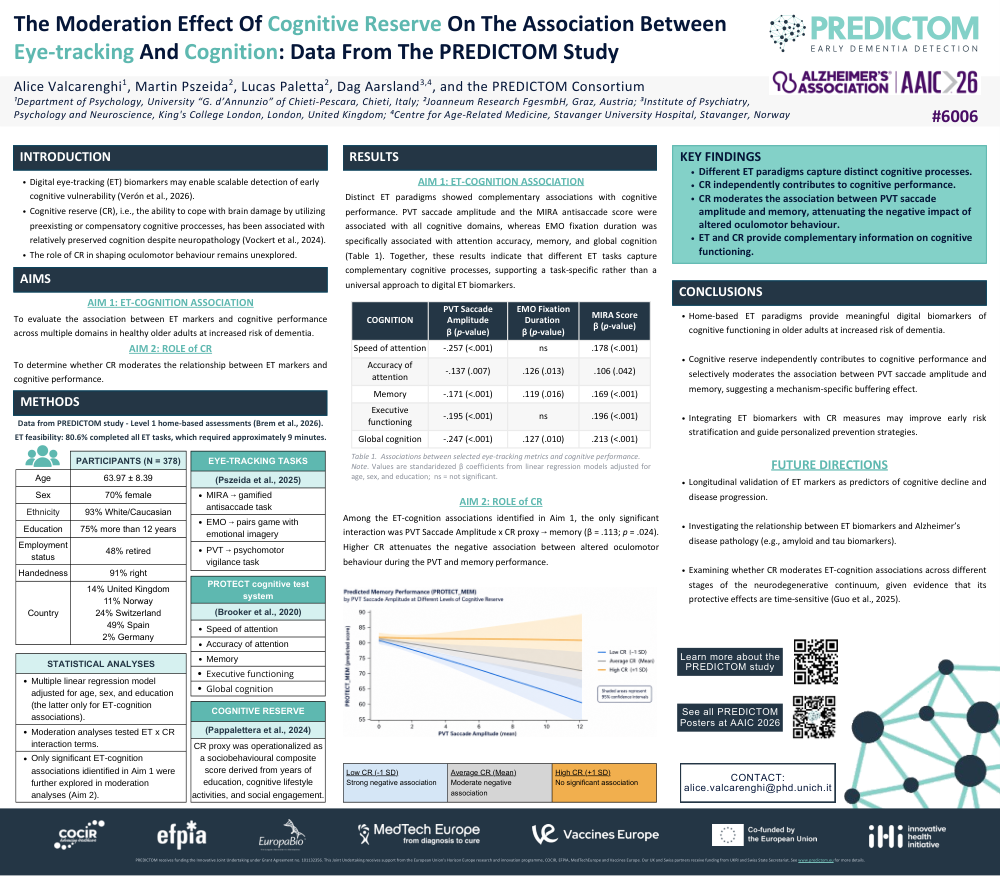
Background: Eye-tracking (ET) is increasingly recognized as a non-invasive biomarker of neurodegeneration, capturing alterations in oculomotor control and visual search in healthy ageing and preclinical cognitive decline (Crawford et al., 2005). However, preserved oculomotor performance in some older adults may reflect compensatory strategies, influenced by individual differences in attentional control and executive functioning. In parallel, cognitive reserve (CR), defined as the ability to cope with brain damage by utilizing preexisting or compensatory cognitive processes, has been associated with delayed clinical expression of Alzheimer's disease (AD) and relatively preserved cognition despite neuropathology (Vockert et al., 2024). Nevertheless, the role of CR in shaping oculomotor behaviour remains unexplored, and ET has not yet been integrated into CR frameworks. This study investigates the moderating effect of CR on the association between ET and cognition in older adults at risk of cognitive decline and dementia.
Methods: Within the PREDICTOM study (Brem et al., 2026, submitted), we will analyse cross-sectional data from Level 1 home-based assessments of 4000 non-demented individuals aged ≥ 50 years with increased risk of dementia. Digital assessments included ET tasks, cognitive tests, and questionnaires. CR will be operationalized using sociobehavioural proxies (e.g., education, physical, and social activities) (Pappalettera et al., 2024). ET was assessed using the game-based Mobile Instrumental Review of Attention (MIRA; Paletta et al., 2020), and cognition using the FLAME cognitive test battery (Brooker et al., 2020). Primary and secondary analyses will use regression-based moderation models to test whether CR moderates the relationship between cognition and ET performance by including CR × cognition interaction terms. Exploratory analyses will be conducted to identify which specific ET parameters (e.g., antisaccade errors) are linked to CR.
Results: Data collection on the first 832 participants has been completed, and analyses of ET and other tests are ongoing. Table 1 summarises the demographic characteristics of the sub-group. Complete results from a larger cohort will be presented at the conference.
Conclusion: Integrating CR into the interpretation of ET metrics may improve early risk stratification and clarify the diagnostic meaning of oculomotor markers in preclinical populations, supporting their use in scalable monitoring and intervention frameworks.
PREDICTOMisSupportedByTheInnovativeHealthInitiativeJointUndertaking(IHIJU),underGrantAgreementNo101132356.JUreceivesSupportFromTheEuropeanUnion’sHorizonEuropeResearchAndInnovationProgramme,COCIR,EFPIA,EuropaBio,MedTechEuropeAndVaccinesEurope.TheUKparticipantsAreSupportedByUKRIGrantNo10083467(NationalInstituteForHealthAndCareExcellence),GrantNo10083181(King'sCollegeLondon),andGrantNo10091560(UniversityOfExeter).UniversityOfGenevaIsSupportedByTheSwissStateSecretariatForEducation,ResearchAndInnovationRefNo113152304.
Comments
Email is required but is not shown publicly.
Loading comments...