4,068 posters, 219 videos, 101 topics, 69 sessions, 14,365 authors, 6,128 institutions
ePostersLive by SciGen Technologies S.A. All rights reserved.
Alzheimer's Association International Conference 2026
July 12-15, 2026 | London, United Kingdom, and Online

6618
Real-World Anti-Amyloid Therapy Is Associated With Lower All-Cause Mortality
Poster Presenter
Authors
Sephora Sabrina Candido de Almeida, Ana Carolina Gomes, Andre Luiz Rodrigues Palmeira, Eduardo Zimmer, Pedro Rosa-Neto, Diogo Haddad Santos, Wyllians Borelli
Affiliations
Hospital Alemão Oswaldo Cruz, São Paulo, Brazil, Centro de Cognição Paulista (CECOP), Santa Casa de Misericórdia de São Paulo, São Paulo, Brazil, Memory Center, Hospital Moinhos de Vento, Porto Alegre, Brazil, McGill University, Montreal, QC, Canada, 3Memory Center, Hospital Moinhos de Vento, Porto Alegre, Brazil
Part of Topic
TITLE
Real-World Anti-Amyloid Therapy Is Associated With Lower All-Cause Mortality
AUTHORS
Sephora Almeida, M.D.¹·², Ana Carolina Gomes¹·², André Luiz Rodrigues Palmeira³, Eduardo Zimmer³·⁴, Pedro Rosa-Neto⁵·⁶, Diogo Haddad Santos¹·², Wyllians Borelli³·⁴
AFFILIATIONS
¹Department of Neurology, Hospital Alemão Oswaldo Cruz, São Paulo, Brazil
²Paulista Cognition Center (CECOP), Santa Casa de Misericórdia de São Paulo, São Paulo, Brazil
³Memory Center, Hospital Moinhos de Vento, Porto Alegre, Brazil
⁴Universidade Federal do Rio Grande do Sul, Porto Alegre, Brazil
⁵McGill University, Montreal, QC, Canada
⁶University of Texas, Austin, TX, USA
INTRODUCTION
Amyloid-targeting therapies (ATT) with monoclonal antibodies (lecanemab and donanemab) have demonstrated efficacy in slowing cognitive decline in early Alzheimer's disease (AD). Despite this, concerns regarding safety in routine clinical practice, including potential effects on mortality, have limited broader adoption. Real-world evidence addressing this concern remains scarce, and most available data derive from controlled trial settings that may not reflect the complexity of clinical practice populations.
METHODS
Retrospective, propensity score-matched cohort study using the TriNetX Global Collaborative Network. Patients with a diagnosis of Alzheimer's disease treated with ATT (lecanemab or donanemab) were matched 1:1 to untreated AD controls on demographic and clinical characteristics. Patients with prior conditions that could confound mortality ascertainment were excluded. The primary outcome was all-cause mortality. Survival analyses were conducted using unrestricted follow-up and restricted to one year; hazard ratios were calculated using Cox regression.
RESULTS
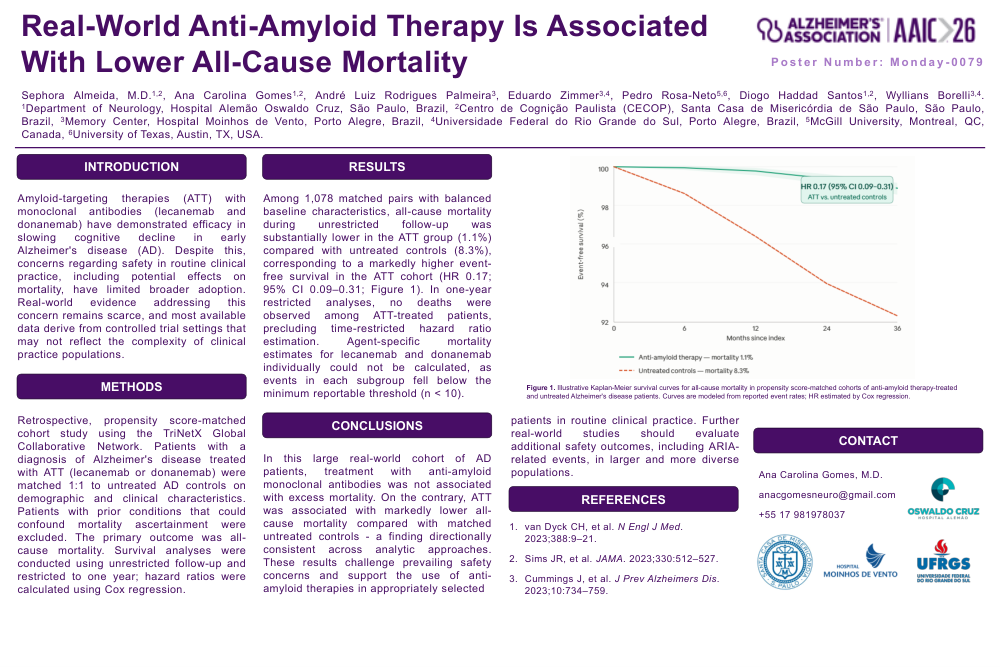
Among 1,078 matched pairs with balanced baseline characteristics, all-cause mortality during unrestricted follow-up was substantially lower in the ATT group (1.1%) compared with untreated controls (8.3%), corresponding to a markedly higher event-free survival in the ATT cohort (HR 0.17; 95% CI 0.09–0.31; Figure 1). In one-year restricted analyses, no deaths were observed among ATT-treated patients, precluding time-restricted hazard ratio estimation. Agent-specific mortality estimates for lecanemab and donanemab individually could not be calculated, as events in each subgroup fell below the minimum reportable threshold (n < 10).
CONCLUSIONS
In this large real-world cohort of AD patients, treatment with anti-amyloid monoclonal antibodies was not associated with excess mortality. On the contrary, ATT was associated with markedly lower all-cause mortality compared with matched untreated controls — a finding directionally consistent across analytic approaches. These results challenge prevailing safety concerns and support the use of anti-amyloid therapies in appropriately selected patients in routine clinical practice. Further real-world studies should evaluate additional safety outcomes, including ARIA-related events, in larger and more diverse populations.
REFERENCES
- van Dyck CH, et al. N Engl J Med. 2023;388:9–21.
- Sims JR, et al. JAMA. 2023;330:512–527.
- Cummings J, et al. J Prev Alzheimers Dis. 2023;10:734–759.
Comments
Email is required but is not shown publicly.
Loading comments...