4,068 posters, 219 videos, 101 topics, 69 sessions, 14,365 authors, 6,128 institutions
ePostersLive by SciGen Technologies S.A. All rights reserved.
Alzheimer's Association International Conference 2026
July 12-15, 2026 | London, United Kingdom, and Online

10084
Modeling Systemic Therapeutics Delivery: Coupling Human In Vitro BBB Models With Brain Organoids For Preclinical Screening Of RNA Delivery
Poster Presenter
Authors
Part of Topic
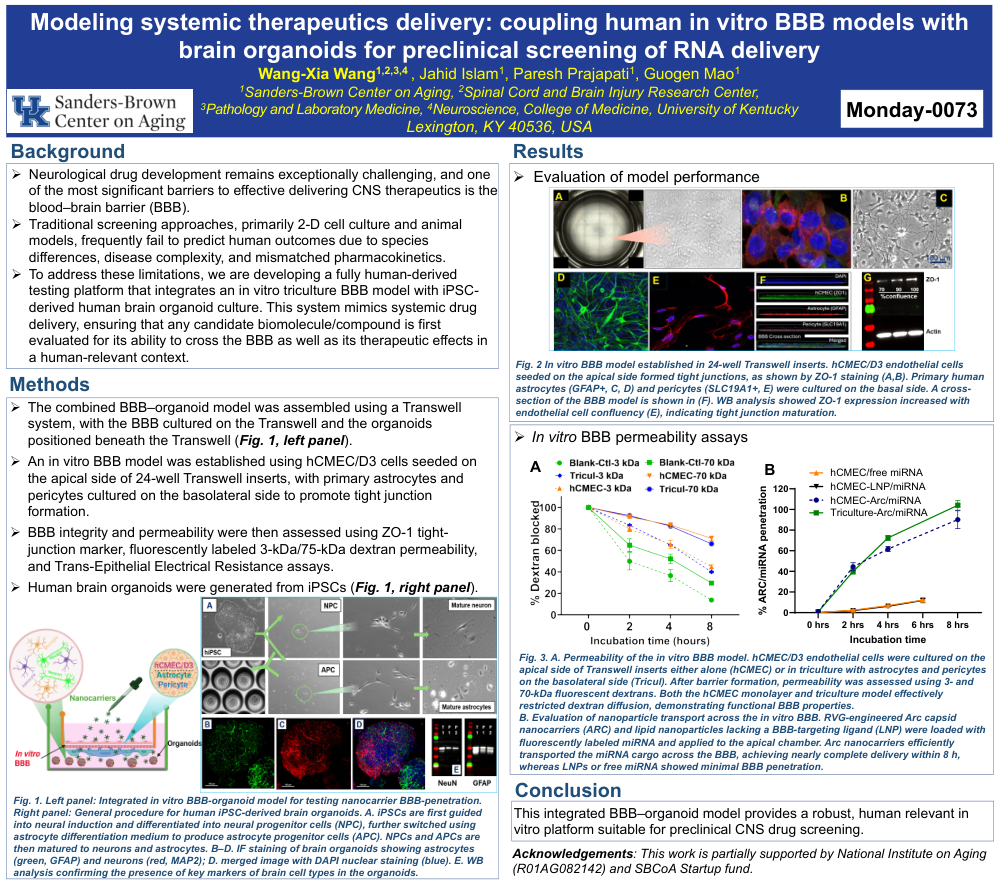
Background: Neurological drug development remains exceptionally challenging, and one of the most significant barriers to effective delivering CNS therapeutics is the blood–brain barrier (BBB). Traditional screening approaches, primarily 2‑D cell culture and animal models, frequently fail to predict human outcomes due to species differences, disease complexity, and mismatched pharmacokinetics. To address these limitations, we are developing a fully human‑derived testing platform that integrates an in vitro triculture BBB model with iPSC-derived human brain organoid culture. This system mimics systemic drug delivery, ensuring that any candidate biomolecule/compound is first evaluated for its ability to cross the BBB as well as its therapeutic effects in a human‑relevant context. It represents a significant advancement in preclinical CNS‑targeted drug screening.
Methods: In vitro BBB model was constructed using human immortalized cerebral microvascular endothelia cells co-cultured with human primary pericytes and astrocytes to establish tight junctions mimicking human BBB. BBB integrity and permeability were then assessed using ZO-1 tight-junction marker, fluorescently labeled 3‑kDa/75-kDa dextran permeability, and Trans‑Epithelial Electrical Resistance (TEER) assays. Human brain organoids were generated from iPSCs. Briefly, iPSCs were cultured in a neural progenitor induction medium to form neural embryoid bodies, which subsequently differentiated into the human brain organoids containing neurons, astrocytes, and microglia under maturation media conditions.
The combined BBB–organoid model was assembled using a transwell system, with the BBB cultured on the transwell and the organoids positioned beneath the transwell. Model performance was evaluated by applying various miRNA‑LNP nanoparticles and controls to the upper compartment and barrier integrity and organoid uptake were examined using patch‑clamp electrophysiology, immunofluorescence imaging, RT-qPCR, and Western blot analysis.
Results: The in vitro BBB model effectively blocked 3‑kDa/75-kDa dextran diffusion, confirming BBB integrity, and tight junction formation was verified by ZO‑1 expression, and TEER assays. IF-staining, patch-clam recording, and Western blot analysis revealed the viability and maintenance of neurons, astrocytes, and microglia, as well as electrical properties in the brain organoids. BBB penetration assays demonstrated substantial blockage of both free miRNA and LNP‑mediated miRNA penetration across the barrier.
Conclusions: This integrated BBB–organoid model provides a robust, human‑relevant in vitro platform suitable for preclinical CNS drug screening.
Comments
Email is required but is not shown publicly.
Loading comments...