4,068 posters, 219 videos, 101 topics, 69 sessions, 14,365 authors, 6,128 institutions
ePostersLive by SciGen Technologies S.A. All rights reserved.
Alzheimer's Association International Conference 2026
July 12-15, 2026 | London, United Kingdom, and Online

654
Broad Parietal Repetitive Transcranial Magnetic Stimulation (rTMS): Updated Open-label Results in Alzheimer’s Disease
Poster Presenter
Authors
Part of Topic
INTRODUCTION:
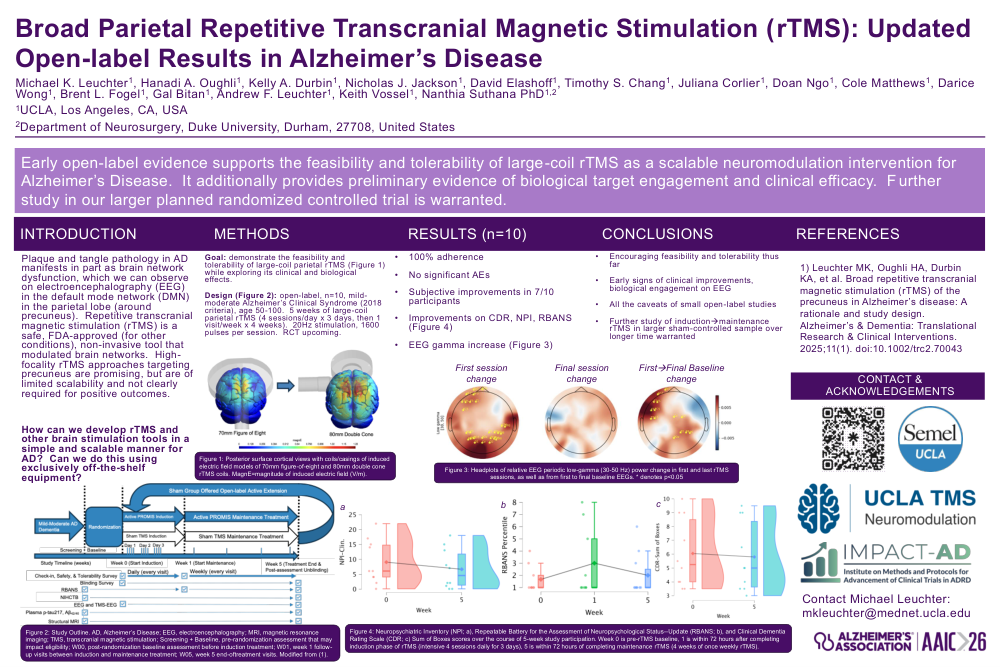
Plaque and tangle pathology in AD manifests in part as brain network dysfunction, which we can observe on electroencephalography (EEG) in the default mode network (DMN) in the parietal lobe (around precuneus). Repetitive transcranial magnetic stimulation (rTMS) is a safe, FDA-approved (for other conditions), non-invasive tool that modulated brain networks. High-focality rTMS approaches targeting precuneus are promising, but are of limited scalability and not clearly required for positive outcomes.
How can we develop rTMS and other brain stimulation tools in a simple and scalable manner for AD? Can we do this using exclusively off-the-shelf equipment?
METHODS:
Goal: demonstrate the feasibility and tolerability of large-coil parietal rTMS (Figure 1) while exploring its clinical and biological effects.
Design (Figure 2): open-label, n=10, mild-moderate Alzheimer’s Clinical Syndrome (2018 criteria), age 50-100. 5 weeks of large-coil parietal rTMS (4 sessions/day x 3 days, then 1 visit/week x 4 weeks). 20Hz stimulation, 1600 pulses per session. RCT upcoming.
RESULTS:
Figure 1: Posterior surface cortical views with coils/casings of induced electric field models of 70mm figure-of-eight and 80mm double cone rTMS coils. MagnE=magnitude of induced electric field (V/m).
Figure 2: Study Outline. AD, Alzheimer’s Disease; EEG, electroencephalography; MRI, magnetic resonance imaging; TMS, transcranial magnetic stimulation; Screening + Baseline, pre-randomization assessment that may impact eligibility; W00, post-randomization baseline assessment before induction treatment; W01, week 1 follow-up visits between induction and maintenance treatment; W05, week 5 end-oftreatment visits. Modified from (1).
Figure 3: Headplots of relative EEG periodic low-gamma (30-50 Hz) power change in first and last rTMS sessions, as well as from first to final baseline EEGs. * denotes p<0.05
Figure 4: Neuropsychiatric Inventory (NPI; a), Repeatable Battery for the Assessment of Neuropsychological Status--Update (RBANS; b), and Clinical Dementia Rating Scale (CDR; c) Sum of Boxes scores over the course of 5-week study participation. Week 0 is pre-rTMS baseline, 1 is within 72 hours after completing induction phase of rTMS (intensive 4 sessions daily for 3 days), 5 is within 72 hours of completing maintenance rTMS (4 weeks of once weekly rTMS).
Comments
Email is required but is not shown publicly.
Loading comments...