4,068 posters, 219 videos, 101 topics, 69 sessions, 14,365 authors, 6,128 institutions
ePostersLive by SciGen Technologies S.A. All rights reserved.
Alzheimer's Association International Conference 2026
July 12-15, 2026 | London, United Kingdom, and Online

9109
Misleading Quantiles: Invalid Methods Inflate Amyloid Effects In Alzheimer Disease Trials
Poster Presenter
Authors
Michael Flanders, Michelle Caunca, Renaud La Joie, Lon Schneider, Sarah Ackley
Affiliations
Part of Topic
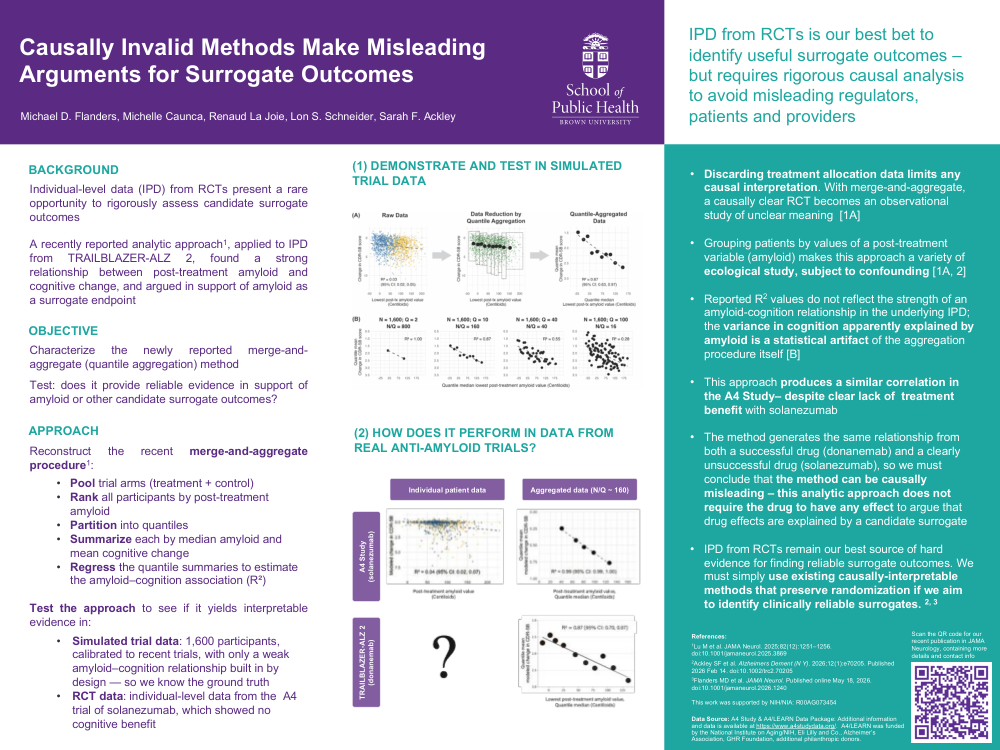
Causally Invalid Methods Make Misleading Arguments for Surrogate Outcomes
Michael D. Flanders, Michelle Caunca, Renaud La Joie, Lon S. Schneider, Sarah F. Ackley
Background
Individual participant data (IPD) from randomized controlled trials provide a rare opportunity to rigorously evaluate candidate surrogate outcomes.
A recently reported analytic approach—merge-and-aggregate, also called quantile aggregation—was applied to IPD from TRAILBLAZER-ALZ 2 and found a strong relationship between post-treatment amyloid and cognitive change. The analysis was interpreted as supporting amyloid as a surrogate endpoint.
However, IPD from randomized trials can only provide reliable evidence about surrogate outcomes when analyses preserve the causal information created by randomization.
Objective
To characterize and test the recently reported merge-and-aggregate method:
-
Does it provide reliable evidence in support of amyloid or other candidate surrogate outcomes?
-
Does it produce interpretable estimates of the amyloid–cognition relationship?
Approach
Reconstructing the Merge-and-Aggregate Procedure
-
Pool treatment and control arms.
-
Rank all participants by post-treatment amyloid.
-
Partition participants into quantiles.
-
Summarize each quantile using:
-
Median amyloid
-
Mean cognitive change
-
-
Regress the quantile-level summaries to estimate the amyloid–cognition association, reported as R².
Testing the Method
We evaluated the approach in two settings:
1. Simulated trial data
-
1,600 participants
-
Calibrated to recent anti-amyloid trials
-
Included only a weak amyloid–cognition relationship by design
-
Ground truth was known
2. Randomized clinical trial data
-
Individual-level data from the A4 trial of solanezumab
-
Solanezumab showed no cognitive benefit in A4
Why the Method Is Causally Problematic
-
Pooling trial arms discards treatment-allocation information, transforming a causally interpretable randomized trial into an observational analysis of unclear meaning.
-
Grouping participants by a post-treatment variable—amyloid—creates an ecological analysis vulnerable to confounding.
-
The reported R² values do not measure the strength of the amyloid–cognition relationship in the underlying individual-level data.
-
Apparent variance in cognition “explained” by amyloid can arise as a statistical artifact of the aggregation procedure itself.
Findings
1. Simulated Trial Data
Even when the true amyloid–cognition relationship was intentionally weak, merge-and-aggregate produced a strong apparent association.
Interpretation: The method can generate persuasive-looking relationships that do not reflect the known underlying causal structure.
2. Real Anti-Amyloid Trial Data
The method produced a similar apparent amyloid–cognition relationship in:
-
TRAILBLAZER-ALZ 2, a successful donanemab trial
-
A4, a solanezumab trial with no demonstrated cognitive benefit
Interpretation: Because the method generates similar findings from both a successful and an unsuccessful drug, it cannot reliably show that drug effects on cognition are explained by effects on amyloid.
Conclusions
-
Merge-and-aggregate does not preserve the causal information provided by randomization.
-
A causally interpretable randomized trial can become an observational, ecologically aggregated analysis after participants are grouped by post-treatment amyloid.
-
Strong R² values from the aggregated analysis can be artifacts of the method rather than evidence that amyloid is a valid surrogate outcome.
-
Reliable surrogate evaluation requires individual-level analyses that preserve randomization and use established causal methods.
Individual participant data from randomized trials remain among the strongest sources of evidence for identifying clinically reliable surrogate outcomes—but only when analyzed with causally valid methods.
Scan the QR code for our recent JAMA Neurology publication, including additional details and contact information.
References
-
Lu M, et al. JAMA Neurology. 2025;82(12):1251–1256. doi:10.1001/jamaneurol.2025.3869
-
Ackley SF, et al. Alzheimer’s & Dementia: Translational Research & Clinical Interventions. 2026;12(1):e70205. Published February 14, 2026. doi:10.1002/trc2.70205
-
Flanders MD, et al. JAMA Neurology. Published online May 18, 2026. doi:10.1001/jamaneurol.2026.1240
Funding and Data Source
Funding: NIH/NIA R00AG073454.
Data Source: A4 Study and A4/LEARN Data Package. Additional information and data are available at a4studydata.org.
A4/LEARN was funded by the National Institute on Aging/NIH, Eli Lilly and Co., the Alzheimer’s Association, GHR Foundation, and additional philanthropic donors.
Comments
Email is required but is not shown publicly.
Loading comments...