4,068 posters, 219 videos, 101 topics, 69 sessions, 14,365 authors, 6,128 institutions
ePostersLive by SciGen Technologies S.A. All rights reserved.
Alzheimer's Association International Conference 2026
July 12-15, 2026 | London, United Kingdom, and Online

2183
A Patient-centred Sedation-based Anaesthesia Approach For Deep Cervical Lymphaticovenous Bypass In Alzheimer’s Disease: A Case Series
Poster Presenter
Authors
Wei Shyan Siow, Xin Yan Zhang, Chou Liang Mah, Jeremy Ming Fa Sun, Kok Pin Ng, Si Ching Lim, Sumeet Kumar, Wan Ying Xie, Chin Kong Goh, Vincent Khwee Soon Tay
Affiliations
Department of Anaesthesia, Pain, Perioperative and Critical Care Medicine (Changi General Hospital), Plastic Reconstructive and Aesthetic Surgery (Changi General Hospital), Neurology (National Neuroscience Institute), Geriatric Medicine (Changi General Hospital), Department of Neuroradiology (National Neuroscience Institute), Department of Nuclear Medicine and Molecular Imaging (Singapore General Hospital), Diagnostic Radiology (Changi General Hospital)
Part of Topic
Title:
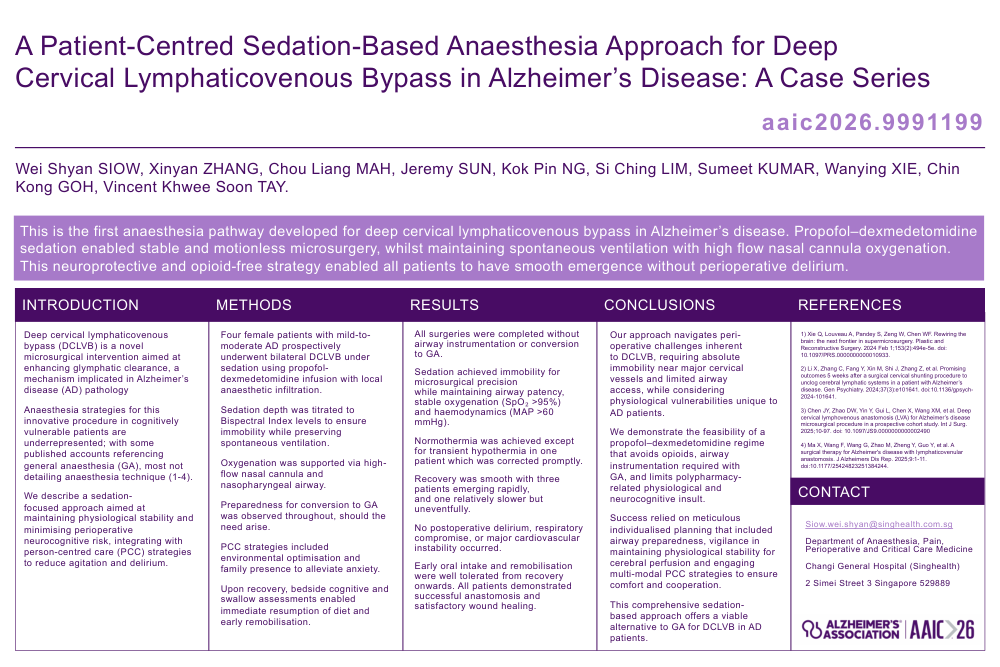
A Patient-Centred Sedation-Based Anaesthesia Approach for Deep Cervical Lymphaticovenous Bypass in Alzheimer’s Disease: A Case Series
Authors:
Wei Shyan SIOW, Xinyan ZHANG, Chou Liang MAH, Jeremy SUN, Kok Pin NG, Si Ching LIM, Sumeet KUMAR, Wanying XIE, Chin Kong GOH, Vincent Khwee Soon TAY.
Introduction:
Deep cervical lymphaticovenous bypass (DCLVB) is a novel microsurgical intervention aimed at enhancing glymphatic clearance, a mechanism implicated in Alzheimer’s disease (AD) pathology
Anaesthesia strategies for this innovative procedure in cognitively vulnerable patients are underrepresented; with some published accounts referencing general anaesthesia (GA), most not detailing anaesthesia technique (1-4).
We describe a sedation- focused approach aimed at maintaining physiological stability and minimising perioperative neurocognitive risk, integrating with person-centred care (PCC) strategies to reduce agitation and delirium.
Methods:
Four female patients with mild-to-moderate AD prospectively underwent bilateral DCLVB under sedation using propofol- dexmedetomidine infusion with local anaesthetic infiltration.
Sedation depth was titrated to Bispectral Index levels to ensure immobility while preserving spontaneous ventilation.
Oxygenation was supported via high-flow nasal cannula and nasopharyngeal airway.
Preparedness for conversion to GA was observed throughout, should the need arise.
PCC strategies included environmental optimisation and family presence to alleviate anxiety.
Upon recovery, bedside cognitive and swallow assessments enabled immediate resumption of diet and early remobilisation.
Results:
All surgeries were completed without airway instrumentation or conversion to GA.
Sedation achieved immobility for microsurgical precision while maintaining airway patency, stable oxygenation (SpO₂ >95%) and haemodynamics (MAP >60 mmHg).
Normothermia was achieved except for transient hypothermia in one patient which was corrected promptly.
Recovery was smooth with three patients emerging rapidly, and one relatively slower but uneventfully.
No postoperative delirium, respiratory compromise, or major cardiovascular instability occurred.
Early oral intake and remobilisation were well tolerated from recovery onwards. All patients demonstrated successful anastomosis and satisfactory wound healing.
Conclusions:
Our approach navigates peri-operative challenges inherent to DCLVB, requiring absolute immobility near major cervical vessels and limited airway access, while considering physiological vulnerabilities unique to AD patients.
We demonstrate the feasibility of a propofol–dexmedetomidine regime that avoids opioids, airway instrumentation required with GA, and limits polypharmacy-related physiological and neurocognitive insult.
Success relied on meticulous individualised planning that included airway preparedness, vigilance in maintaining physiological stability for cerebral perfusion and engaging multi-modal PCC strategies to ensure comfort and cooperation.
This comprehensive sedation-based approach offers a viable alternative to GA for DCLVB in AD patients.
References:
1) Xie Q, Louveau A, Pandey S, Zeng W, Chen WF. Rewiring the brain: the next frontier in supermicrosurgery. Plastic and Reconstructive Surgery. 2024 Feb 1;153(2):494e-5e. doi: 10.1097/PRS.0000000000010933.
2) Li X, Zhang C, Fang Y, Xin M, Shi J, Zhang Z, et al. Promising outcomes 5 weeks after a surgical cervical shunting procedure to unclog cerebral lymphatic systems in a patient with Alzheimer’s disease. Gen Psychiatry. 2024;37(3):e101641. doi:10.1136/gpsych-2024-101641.
3) Chen JY, Zhao DW, Yin Y, Gui L, Chen X, Wang XM, et al. Deep cervical lymphovenous anastomosis (LVA) for Alzheimer’s disease microsurgical procedure in a prospective cohort study. Int J Surg. 2025;10-97. doi: 10.1097/JS9.0000000000002490
4) Ma X, Wang F, Wang G, Zhao M, Zheng Y, Guo Y, et al. A surgical therapy for Alzheimer's disease with lymphaticovenular anastomosis. J Alzheimers Dis Rep. 2025;9:1-11. doi:10.1177/25424823251384244.
Comments
Email is required but is not shown publicly.
Loading comments...