4,068 posters, 219 videos, 101 topics, 69 sessions, 14,365 authors, 6,128 institutions
ePostersLive by SciGen Technologies S.A. All rights reserved.
Alzheimer's Association International Conference 2026
July 12-15, 2026 | London, United Kingdom, and Online

4934
Six-month Real-world Amyloid PET Outcomes After Lecanemab Treatment: Greater Amyloid Reduction In The MCI Stage Of Alzheimer’s Disease
Poster Presenter
Authors
Geon Ha Kim, Hai-Jeon Yoon, Eun Hee Kim, Ji-Young Kim, Seo Young Kang, Boeun Lee, Jee Hyang Jeong
Affiliations
Department of Neurology, Ewha Womans University College of Medicine, Department of Nuclear Medicine, Ewha Womans University College of Medicine, Department of Radiology, Ewha Womans University College of Medicine
Part of Topic
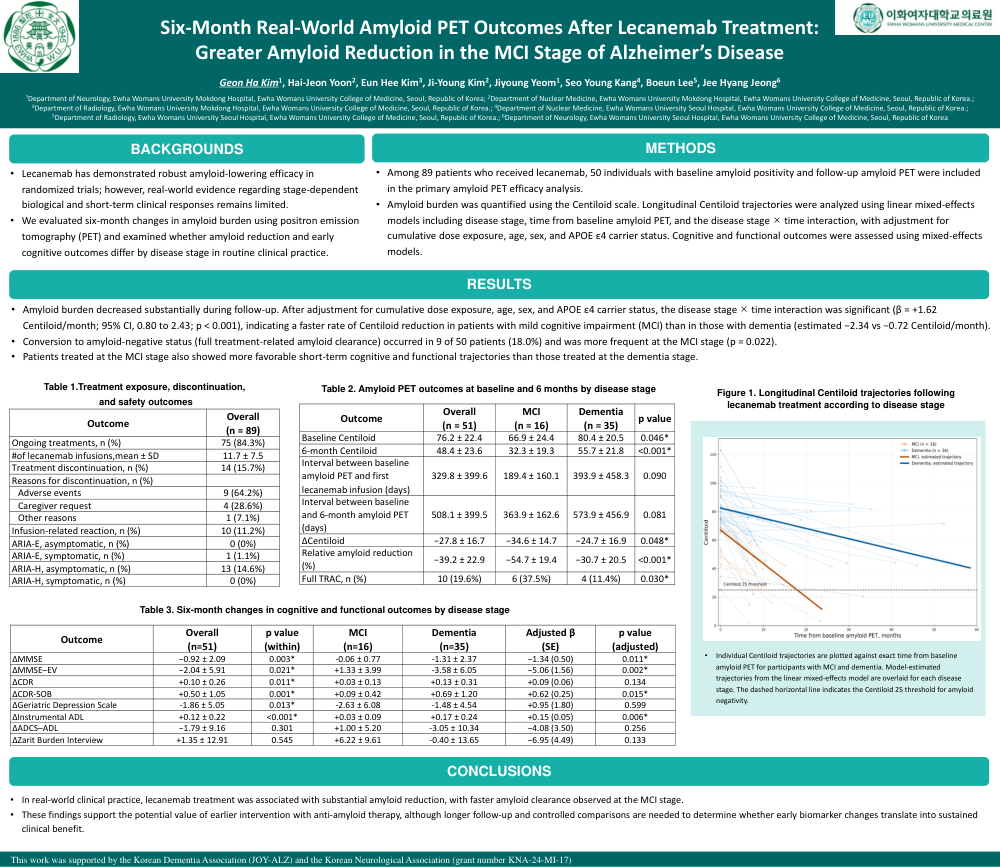
INTRODUCTION: Evidence from routine clinical practice regarding stage-dependent responses to lecanemab remains limited. We examined early amyloid positron emission tomography (PET) and clinical trajectories according to disease stage in a real-world cohort.
METHODS: Among 89 patients who received lecanemab, 50 individuals with baseline amyloid positivity and follow-up amyloid PET were included in the primary amyloid PET efficacy analysis. Amyloid burden was quantified using the Centiloid scale. Longitudinal Centiloid trajectories were analyzed using linear mixed-effects models including disease stage, time from baseline amyloid PET, and the disease stage × time interaction, with adjustment for cumulative dose exposure, age, sex, and APOE ε4 carrier status. Cognitive and functional outcomes were assessed using mixed-effects models.
RESULTS: Amyloid burden decreased substantially during follow-up. After adjustment for cumulative dose exposure, age, sex, and APOE ε4 carrier status, the disease stage × time interaction was significant (β = +1.62 Centiloid/month; 95% CI, 0.80 to 2.43; p < 0.001), indicating a faster rate of Centiloid reduction in patients with mild cognitive impairment (MCI) than in those with dementia (estimated −2.34 vs −0.72 Centiloid/month). Conversion to amyloid-negative status (full treatment-related amyloid clearance) occurred in 9 of 50 patients (18.0%) and was more frequent at the MCI stage (p = 0.022). Patients treated at the MCI stage also showed more favorable short-term cognitive and functional trajectories than those treated at the dementia stage.
DISCUSSION: In real-world clinical practice, lecanemab treatment was associated with substantial amyloid reduction, with faster amyloid clearance observed at the MCI stage. These findings support the potential value of earlier intervention with anti-amyloid therapy, although longer follow-up and controlled comparisons are needed to determine whether early biomarker changes translate into sustained clinical benefit.
Comments
Email is required but is not shown publicly.
Loading comments...