4,068 posters, 219 videos, 101 topics, 69 sessions, 14,365 authors, 6,128 institutions
ePostersLive by SciGen Technologies S.A. All rights reserved.
Alzheimer's Association International Conference 2026
July 12-15, 2026 | London, United Kingdom, and Online

9185
The WAT-R As A Stable Estimator Of Premorbid Intelligence: A Longitudinal Comparison With Global And Executive Cognitive Decline
Poster Presenter
Authors
Affiliations
Part of Topic
The WAT-R As A Stable EstimatorOf Premorbid Intelligence for Spanish-speaking populations: A Longitudinal Comparison With Global And Executive Cognitive Decline
González, Tobías, MSc.; Roman, Sol. MSc.; Sierra Sanjurjo, Natalia PhD
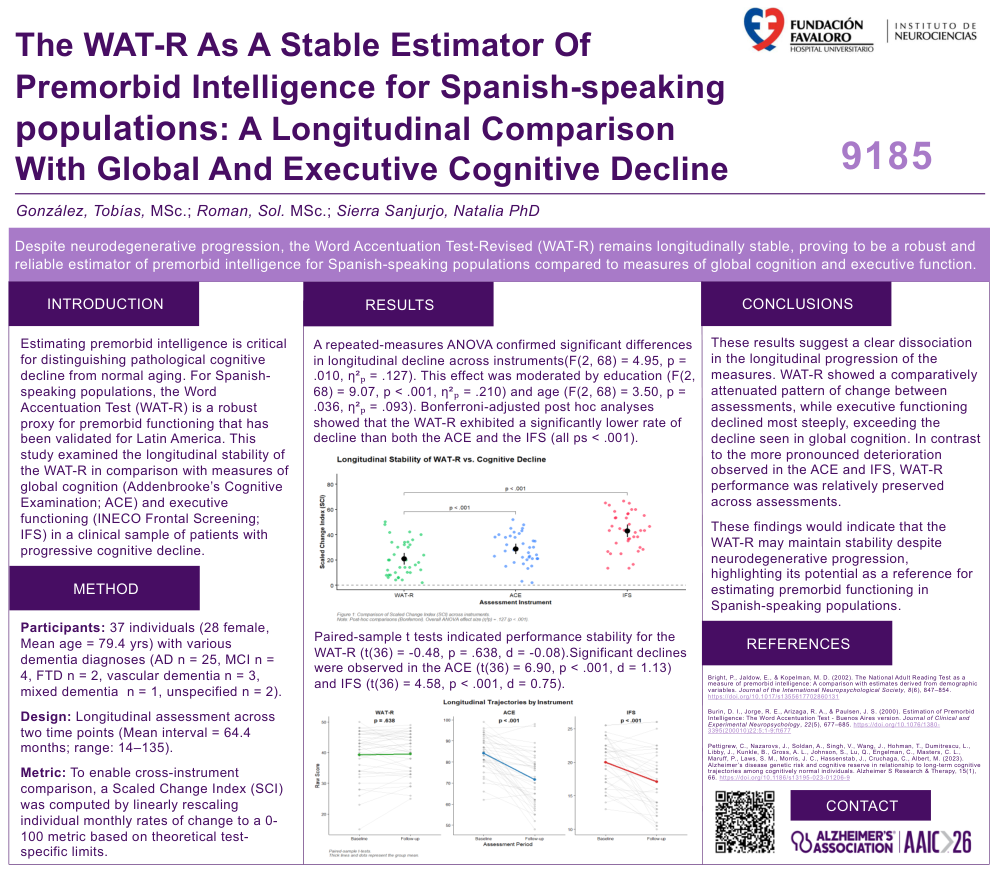
Despite neurodegenerative progression, the Word Accentuation Test-Revised (WAT-R) remains longitudinally stable, proving to be a robust and reliable estimator of premorbid intelligence for Spanish-speaking populations compared to measures of global cognition and executive function.
INTRODUCTION
Estimating premorbid intelligence is critical for distinguishing pathological cognitive decline from normal aging. For Spanish-speaking populations, the Word Accentuation Test (WAT-R) is a robust proxy for premorbid functioning that has been validated for Latin America. This study examined the longitudinal stability of the WAT-R in comparison with measures of global cognition (Addenbrooke’s Cognitive Examination; ACE) and executive functioning (INECO Frontal Screening; IFS) in a clinical sample of patients with progressive cognitive decline.
METHOD
Participants: 37 individuals (28 female, Mean age = 79.4 yrs) with various dementia diagnoses (AD n = 25, MCI n = 4, FTD n = 2, vascular dementia n = 3, mixed dementia n = 1, unspecified n = 2).
Design: Longitudinal assessment across two time points (Mean interval = 64.4 months; range: 14–135).
Metric: To enable cross-instrument comparison, a Scaled Change Index (SCI) was computed by linearly rescaling individual monthly rates of change to a 0-100 metric based on theoretical test-specific limits.
RESULTS
A repeated-measures ANOVA confirmed significant differences in longitudinal decline across instruments(F(2, 68) = 4.95, p = .010, η²ₚ = .127). This effect was moderated by education (F(2, 68) = 9.07, p < .001, η²ₚ = .210) and age (F(2, 68) = 3.50, p = .036, η²ₚ = .093). Bonferroni-adjusted post hoc analyses showed that the WAT-R exhibited a significantly lower rate of decline than both the ACE and the IFS (all ps < .001).
Paired-sample t tests indicated performance stability for the WAT-R (t(36) = -0.48, p = .638, d = -0.08).Significant declines were observed in the ACE (t(36) = 6.90, p < .001, d = 1.13) and IFS (t(36) = 4.58, p < .001, d = 0.75).
CONCLUSIONS
These results suggest a clear dissociation in the longitudinal progression of the measures. WAT-R showed a comparatively attenuated pattern of change between assessments, while executive functioning declined most steeply, exceeding the decline seen in global cognition. In contrast to the more pronounced deterioration observed in the ACE and IFS, WAT-R performance was relatively preserved across assessments.
These findings would indicate that the WAT-R may maintain stability despite neurodegenerative progression, highlighting its potential as a reference for estimating premorbid functioning in Spanish-speaking populations.
Comments
Email is required but is not shown publicly.
Loading comments...