4,068 posters, 219 videos, 101 topics, 69 sessions, 14,365 authors, 6,128 institutions
ePostersLive by SciGen Technologies S.A. All rights reserved.
Alzheimer's Association International Conference 2026
July 12-15, 2026 | London, United Kingdom, and Online

5523
Inheriting A Legacy
Poster Presenter
Authors
Part of Topic
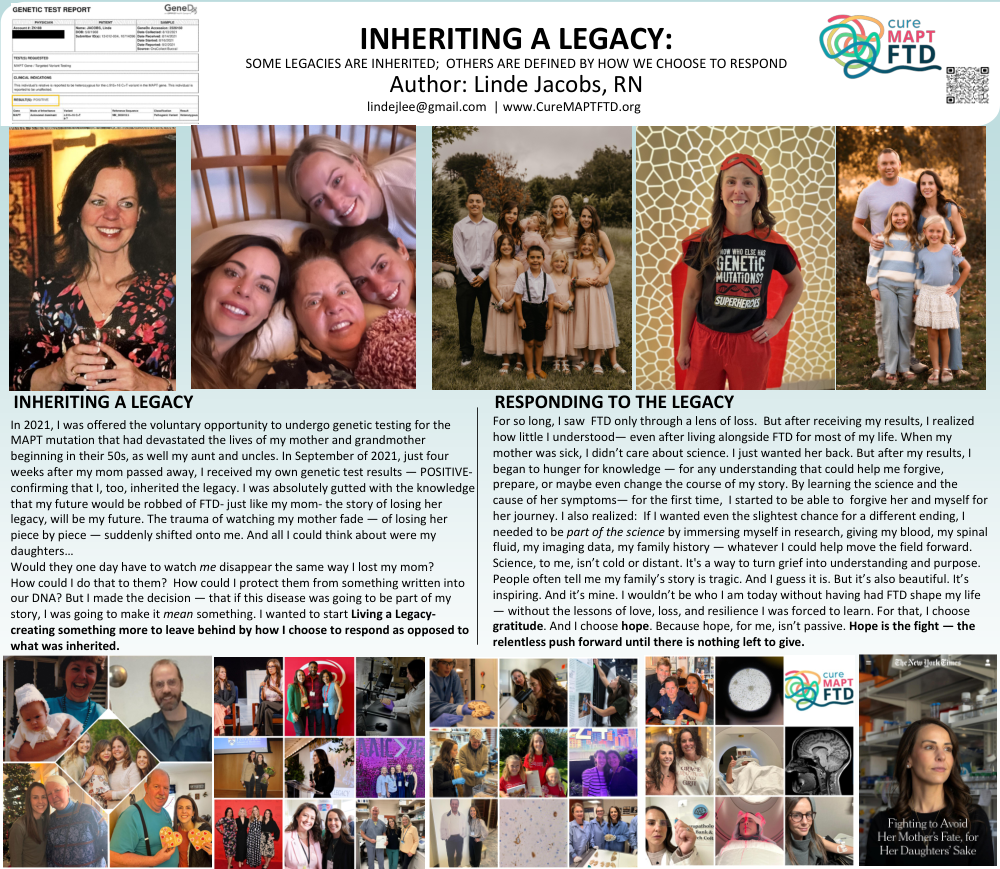
In 2021, I was offered the voluntary opportunity to undergo genetic testing for the MAPT mutation that had devastated the lives of my mother and grandmother beginning in their 50s, as well my aunt and uncles. In September of 2021, just four weeks after my mom passed away, I received my own genetic test results — POSITIVE- confirming that I, too, inherited the legacy. I was absolutely gutted with the knowledge that my future would be robbed of FTD- just like my mom- the story of losing her legacy, will be my future. The trauma of watching my mother fade — of losing her piece by piece — suddenly shifted onto me. And all I could think about were my daughters…
Would they one day have to watch me disappear the same way I lost my mom?
How could I do that to them? How could I protect them from something written into our DNA? But I made the decision — that if this disease was going to be part of my story, I was going to make it mean something. I wanted to start Living a Legacy- creating something more to leave behind by how I choose to respond as opposed to what was inherited.
For so long, I saw FTD only through a lens of loss. But after receiving my results, I realized how little I understood— even after living alongside FTD for most of my life. When my mother was sick, I didn’t care about science. I just wanted her back. But after my results, I began to hunger for knowledge — for any understanding that could help me forgive, prepare, or maybe even change the course of my story. By learning the science and the cause of her symptoms— for the first time, I started to be able to forgive her and myself for her journey. I also realized: If I wanted even the slightest chance for a different ending, I needed to be part of the science by immersing myself in research, giving my blood, my spinal fluid, my imaging data, my family history — whatever I could help move the field forward. Science, to me, isn’t cold or distant. It's a way to turn grief into understanding and purpose. People often tell me my family’s story is tragic. And I guess it is. But it’s also beautiful. It’s inspiring. And it’s mine. I wouldn’t be who I am today without having had FTD shape my life — without the lessons of love, loss, and resilience I was forced to learn. For that, I choose gratitude. And I choose hope. Because hope, for me, isn’t passive. Hope is the fight — the relentless push forward until there is nothing left to give.
Comments
Email is required but is not shown publicly.
Loading comments...