4,068 posters, 219 videos, 101 topics, 69 sessions, 14,365 authors, 6,128 institutions
ePostersLive by SciGen Technologies S.A. All rights reserved.
Alzheimer's Association International Conference 2026
July 12-15, 2026 | London, United Kingdom, and Online

3406
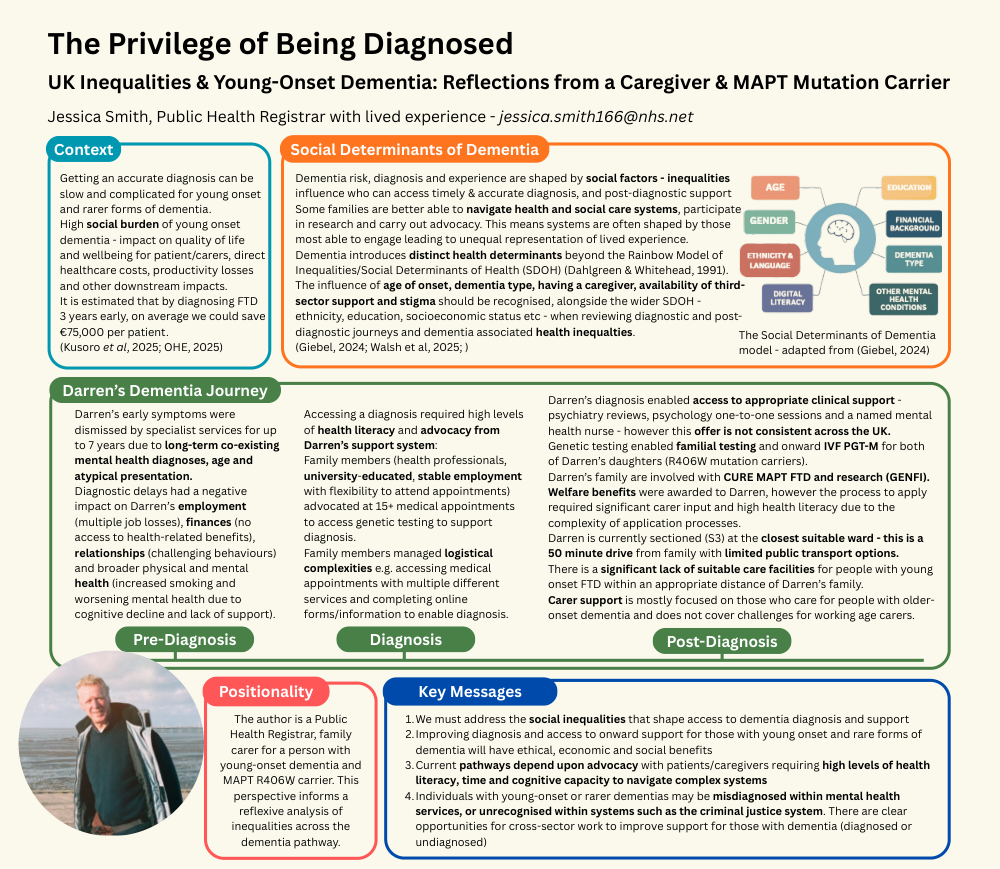
The Privilege Of Being Diagnosed - Reflections On Genetic Dementia From A Caregiver And MAPT R406w Mutation Carrier
Poster Presenter
Authors
Part of Topic
The Privilege of Being Diagnosed
UK Inequalities & Young-Onset Dementia: Reflections from a Caregiver & MAPT Mutation Carrier
Jessica Smith, Public Health Registrar with lived experience - jessica.smith166@nhs.net
Context
Getting an accurate diagnosis can be slow and complicated for young onset and rarer forms of dementia. High social burden of young onset dementia - impact on quality of life and wellbeing for patient/carers, direct healthcare costs, productivity losses and other downstream impacts. It is estimated that by diagnosing FTD 3 years early, on average we could save €75,000 per patient. (Kusoro et al, 2025; OHE, 2025)
Social Determinants of Dementia
Dementia risk, diagnosis and experience are shaped by social factors - inequalities influence who can access timely & accurate diagnosis, and post-diagnostic support Some families are better able to navigate health and social care systems, participate in research and carry out advocacy. This means systems are often shaped by those most able to engage leading to unequal representation of lived experience. Dementia introduces distinct health determinants beyond the Rainbow Model of Inequalities/Social Determinants of Health (SDOH) (Dahlgreen & Whitehead, 1991). The influence of age of onset, dementia type, having a caregiver, availability of third sector support and stigma should be recognised, alongside the wider SDOH ethnicity, education, socioeconomic status etc - when reviewing diagnostic and post diagnostic journeys and dementia associated health inequalties. (Giebel, 2024; Walsh et al, 2025)
Darren's Dementia Journey
Pre-Diagnosis
Darren’s early symptoms were dismissed by specialist services for up to 7 years due to long-term co-existing mental health diagnoses, age and atypical presentation.
Diagnostic delays had a negative impact on Darren’s employment (multiple job losses), finances (no access to health-related benefits), relationships (challenging behaviours) and broader physical and mental health (increased smoking and worsening mental health due to cognitive decline and lack of support).
Diagnosis
Accessing a diagnosis required high levels of health literacy and advocacy from Darren’s support system:
Family members (health professionals, university-educated, stable employment with flexibility to attend appointments) advocated at 15+ medical appointments to access genetic testing to support diagnosis.
Family members managed logistical complexities e.g. accessing medical appointments with multiple different services and completing online forms/information to enable diagnosis.
Post-Diagnosis
Darren’s diagnosis enabled access to appropriate clinical support psychiatry reviews, psychology one-to-one sessions and a named mental health nurse - however this offer is not consistent across the UK.
Genetic testing enabled familial testing and onward IVF PGT-M for both of Darren’s daughters (R406W mutation carriers). Darren’s family are involved with CURE MAPT FTD and research (GENFI).
Welfare benefits were awarded to Darren, however the process to apply required significant carer input and high health literacy due to the complexity of application processes.
Darren is currently sectioned (S3) at the closest suitable ward - this is a 50 minute drive from family with limited public transport options.
There is a significant lack of suitable care facilities for people with young onset FTD within an appropriate distance of Darren’s family.
Carer support is mostly focused on those who care for people with older onset dementia and does not cover challenges for working age carers.
Key Messages
1.We must address the social inequalities that shape access to dementia diagnosis and support
2.Improving diagnosis and access to onward support for those with young onset and rare forms of dementia will have ethical, economic and social benefits
3.Current pathways depend upon advocacy with patients/caregivers requiring high levels of health literacy, time and cognitive capacity to navigate complex systems
4.Individuals with young-onset or rarer dementias may be misdiagnosed within mental health services, or unrecognised within systems such as the criminal justice system. There are clear opportunities for cross-sector work to improve support for those with dementia (diagnosed or undiagnosed)
Positionality
The author is a Public Health Registrar, family carer for a person with young-onset dementia and MAPT R406W carrier. This perspective informs a reflexive analysis of inequalities across the dementia pathway.
Comments
Email is required but is not shown publicly.
Loading comments...