4,068 posters, 219 videos, 101 topics, 69 sessions, 14,365 authors, 6,128 institutions
ePostersLive by SciGen Technologies S.A. All rights reserved.
Alzheimer's Association International Conference 2026
July 12-15, 2026 | London, United Kingdom, and Online

4338
Always Listening, Always Learning: The Experience Of Two Student Researchers Interviewing People Living With Dementia
Part of Topic
Always Listening, Always Learning: The Experience of Two Student Researchers Interviewing People Living With Dementia
Mina Aghaei¹², Marlee Carter¹
¹ Western Sydney University (The MARCS Institute for Brain, Behaviour and Development)
² University of Hertfordshire (CRIPACC)
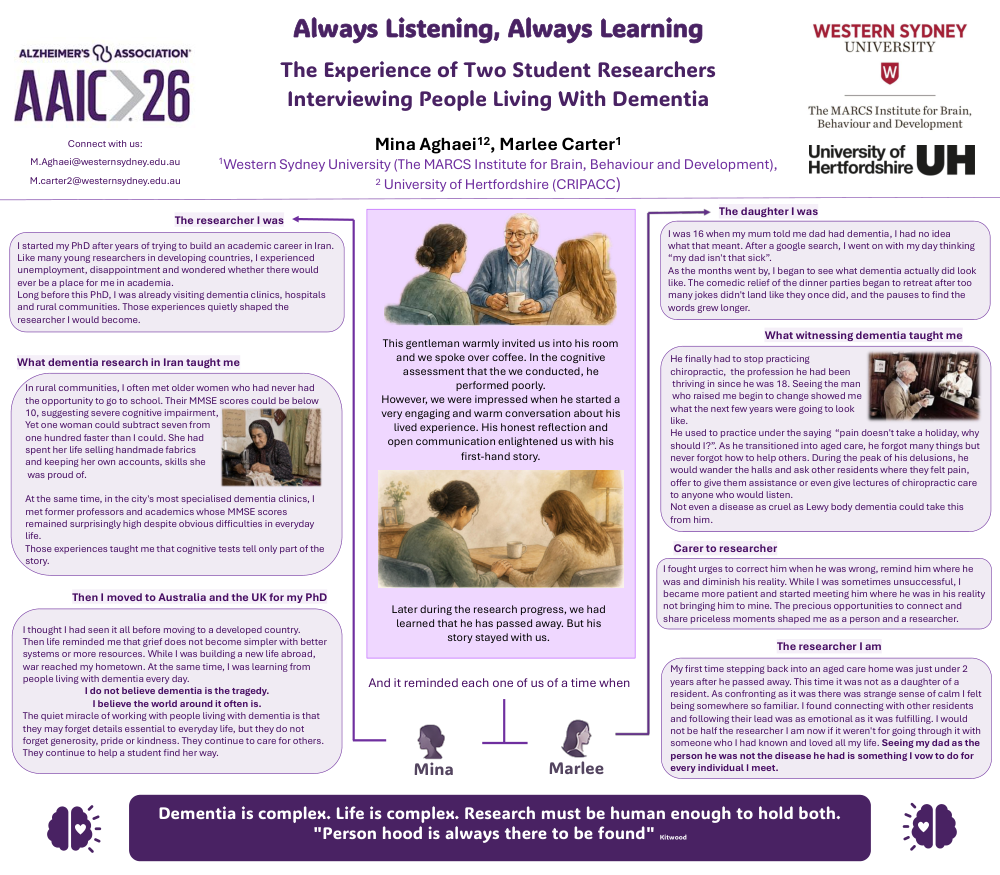
This gentleman warmly invited us into his room and we spoke over coffee. In the cognitive assessment that we conducted, he performed poorly.
However, we were impressed when he started a very engaging and warm conversation about his lived experience. His honest reflection and open communication enlightened us with his first-hand story.
Later during the research progress, we had learned that he has passed away. But his story stayed with us.
And it reminded each one of us of a time when
Mina:
“The researcher I was
I started my PhD after years of trying to build an academic career in Iran. Like many young researchers in developing countries, I experienced unemployment, disappointment and wondered whether there would ever be a place for me in academia.
Long before this PhD, I was already visiting dementia clinics, hospitals and rural communities. Those experiences quietly shaped the researcher I would become.
What dementia research in Iran taught me
In rural communities, I often met older women who had never had the opportunity to go to school. Their MMSE scores could be below 10, suggesting severe cognitive impairment,
Yet one woman could subtract seven from one hundred faster than I could. She had spent her life selling handmade fabrics and keeping her own accounts, skills she was proud of.
At the same time, in the city's most specialised dementia clinics, I met former professors and academics whose MMSE scores remained surprisingly high despite obvious difficulties in everyday life.
Those experiences taught me that cognitive tests tell only part of the story.
Then I moved to Australia and the UK for my PhD
I thought I had seen it all before moving to a developed country.
Then life reminded me that grief does not become simpler with better systems or more resources. While I was building a new life abroad, war reached my hometown. At the same time, I was learning from people living with dementia every day.
I do not believe dementia is the tragedy.
I believe the world around it often is.
The quiet miracle of working with people living with dementia is that they may forget details essential to everyday life, but they do not forget generosity, pride or kindness. They continue to care for others. They continue to help a student find her way.”
Marlee:
“The daughter I was
I was 16 when my mum told me dad had dementia, I had no idea what that meant. After a Google search, I went on with my day thinking "my dad isn't that sick".
As the months went by, I began to see what dementia actually did look like. The comedic relief of the dinner parties began to retreat after too many jokes didn't land like they once did, and the pauses to find the words grew longer.
What witnessing dementia taught me
He finally had to stop practicing chiropractic, the profession he had been thriving in since he was 18. Seeing the man who raised me begin to change showed me what the next few years were going to look like.
He used to practice under the saying "pain doesn't take a holiday, why should I?". As he transitioned into aged care, he forgot many things but never forgot how to help others. During the peak of his delusions, he would wander the halls and ask other residents where they felt pain, offer to give them assistance or even give lectures of chiropractic care to anyone who would listen.
Not even a disease as cruel as Lewy body dementia could take this from him.
Carer to researcher
I fought urges to correct him when he was wrong, remind him where he was and diminish his reality. While I was sometimes unsuccessful, I became more patient and started meeting him where he was in his reality, not bringing him to mine. The precious opportunities to connect and share priceless moments shaped me as a person and a researcher.
The researcher I am
My first time stepping back into an aged care home was just under 2 years after he passed away. This time it was not as a daughter of a resident. As confronting as it was there was a strange sense of calm I felt being somewhere so familiar. I found connecting with other residents and following their lead was as emotional as it was fulfilling. I would not be half the researcher I am now if it weren't for going through it with someone who I had known and loved all my life.
Seeing my dad as the person he was, not the disease he had, is something I vow to do for every individual I meet.”
Dementia is complex. Life is complex. Research must be human enough to hold both.
"Person hood is always there to be found" — Kitwood
Connect with us
Comments
Email is required but is not shown publicly.
Loading comments...