4,068 posters, 219 videos, 101 topics, 69 sessions, 14,365 authors, 6,128 institutions
ePostersLive by SciGen Technologies S.A. All rights reserved.
Alzheimer's Association International Conference 2026
July 12-15, 2026 | London, United Kingdom, and Online

10881
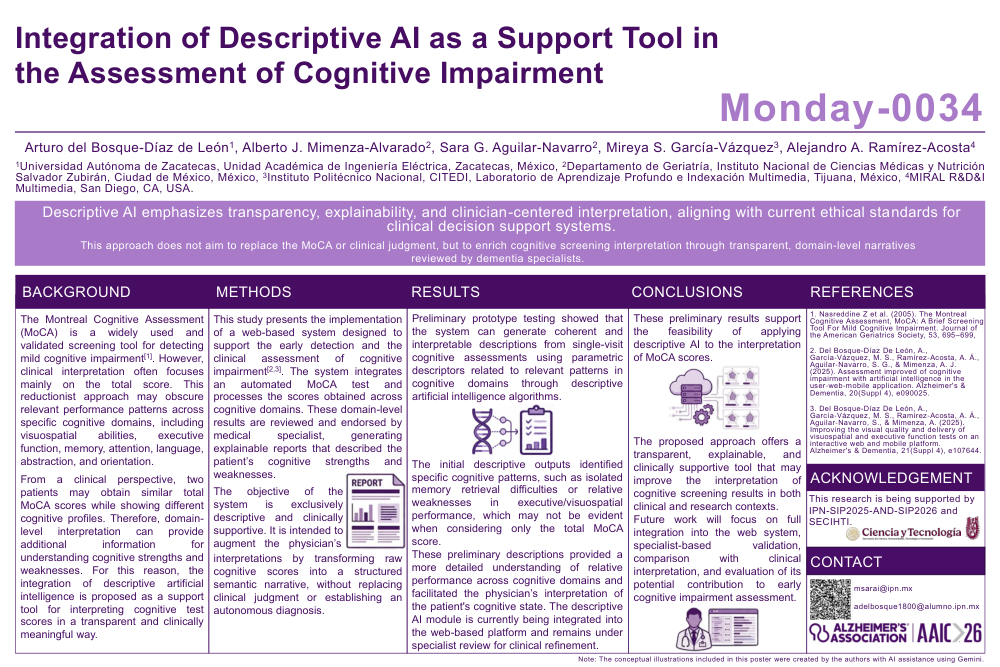
Integration Of Descriptive Ai As A Support Tool In The Assessment Of Cognitive Impairment
Poster Presenter
Authors
Arturo Del Bosque Díaz De León, Alberto José Mimenza Alvarado, Sara Gloria Aguilar Navarro, Mireya Saraí García Vázquez, Alejandro Alvaro Ramírez Acosta
Affiliations
Universidad Autónoma de Zacatecas, Unidad Académica de Ingeniería Eléctrica, Zacatecas, México, Departamento de Geriatría, Instituto Nacional de Ciencias Médicas y Nutrición Salvador Zubirán, Ciudad de México, México, Instituto Politécnico Nacional, CITEDI, Laboratorio de Aprendizaje Profundo e Indexación Multimedia, Tijuana, México, MIRAL R&D&I Multimedia, San Diego, CA, USA
Part of Topic
Keywords: Montreal Cognitive Assessment, Artificial Intelligence, Dementia.
Background
Cognitive screening tests are widely used to assess cognitive impairment. One such test is the Montreal Cognitive Assessment (MoCA), widely regarded as a great standard for detecting mild cognitive impairment. However, clinical interpretation often focuses on the total score. This reductionist approach can obscure critical performance patterns in specific cognitive domains, such as visuospatial abilities, executive function, memory and others cognitive domains, leading to potential misdiagnosis or overlooked specific deficits. Furthermore, patients with similar total scores may exhibit markedly different cognitive profiles, which are not adequately captured by aggregate scoring alone.
Therefore, there is a pressing need to implement tools that provide a qualitative, detailed, rather than solely numerical interpretation. For this reason, the integration of descriptive artificial intelligence for interpreting cognitive test scores is proposed. Descriptive AI emphasizes transparency and explainability, aligning with current ethical standards for clinical decision support systems.
Method
This study presents the implementation of a web-based system to support the early detection of dementia. The system integrates a digitized and automated MoCA test, processing the scores obtained during the test for each cognitive domain; these are endorsed by the specialist, generating explainable reports that detail the cognitive strengths and weaknesses of the patient. In addition, demographic variables such as age and educational level are incorporated to contextualize performance across cognitive domains.
The system's objective is exclusively descriptive and clinically supportive, aiming to augment the physician's capabilities without replacing clinical judgment.
Results
The system successfully generated coherent and interpretable reports from single-visit cognitive assessments. The automated descriptions identified specific deficit patterns such as isolated memory retrieval failures that were not evident when considering only the total score. The generated descriptions allowed for a detailed understanding of relative performance across domains, effectively translating raw data into a semantic narrative that facilitated the physician's understanding of the patient's cognitive state.
Conclusion
The results demonstrate the feasibility and utility of applying descriptive AI for the interpretation of MocA scores.
The proposal offers an ethical, transparent and clinically useful tool that improves the interpretation of results in clinical and research contexts.
Comments
Email is required but is not shown publicly.
Loading comments...