4,068 posters, 219 videos, 101 topics, 69 sessions, 14,365 authors, 6,128 institutions
ePostersLive by SciGen Technologies S.A. All rights reserved.
Alzheimer's Association International Conference 2026
July 12-15, 2026 | London, United Kingdom, and Online

9628
Sailing Towards Cognitive Resilience
Poster Presenter
Authors
Part of Topic
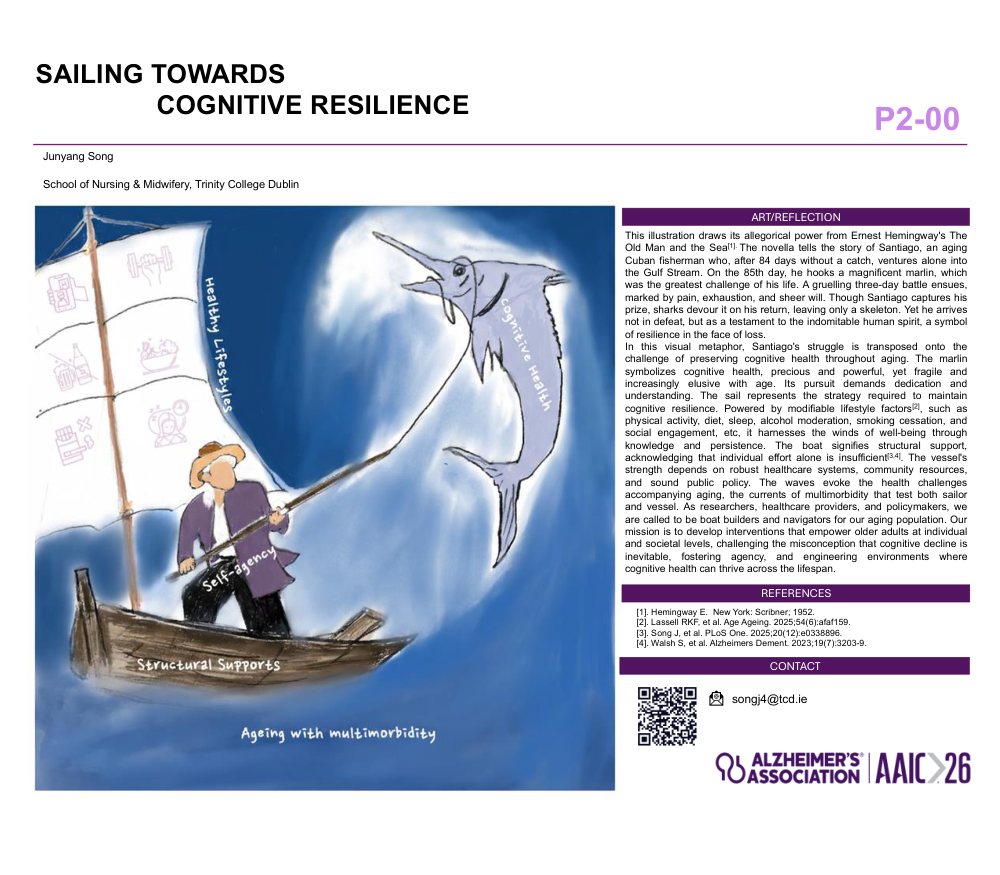
This illustration draws its allegorical power from Ernest Hemingway's The Old Man and the Sea[1]. The novella tells the story of Santiago, an aging Cuban fisherman who, after 84 days without a catch, ventures alone into the Gulf Stream. On the 85th day, he hooks a magnificent marlin, which was the greatest challenge of his life. A gruelling three-day battle ensues, marked by pain, exhaustion, and sheer will. Though Santiago captures his prize, sharks devour it on his return, leaving only a skeleton. Yet he arrives not in defeat, but as a testament to the indomitable human spirit, a symbol of resilience in the face of loss.
In this visual metaphor, Santiago's struggle is transposed onto the challenge of preserving cognitive health throughout aging. The marlin symbolizes cognitive health, precious and powerful, yet fragile and increasingly elusive with age. Its pursuit demands dedication and understanding. The sail represents the strategy required to maintain cognitive resilience. Powered by modifiable lifestyle factors[2], such as physical activity, diet, sleep, alcohol moderation, smoking cessation, and social engagement, etc, it harnesses the winds of well-being through knowledge and persistence. The boat signifies structural support, acknowledging that individual effort alone is insufficient[3,4]. The vessel's strength depends on robust healthcare systems, community resources, and sound public policy. The waves evoke the health challenges accompanying aging, the currents of multimorbidity that test both sailor and vessel. As researchers, healthcare providers, and policymakers, we are called to be boat builders and navigators for our aging population. Our mission is to develop interventions that empower older adults at individual and societal levels, challenging the misconception that cognitive decline is inevitable, fostering agency, and engineering environments where cognitive health can thrive across the lifespan.
Comments
Email is required but is not shown publicly.
Loading comments...