4,068 posters, 219 videos, 101 topics, 69 sessions, 14,365 authors, 6,128 institutions
ePostersLive by SciGen Technologies S.A. All rights reserved.
Alzheimer's Association International Conference 2026
July 12-15, 2026 | London, United Kingdom, and Online

8772
Cutoff Identification For Centiloid, WMH, And MoCa In Cognitive Syndromes: A Clinically Driven Decision Tree Analysis
Poster Presenter
Part of Topic
Cutoff Identification For Centiloid, WMH, And MoCa In Cognitive Syndromes: A Clinically Driven Decision Tree
Abstract
Background:
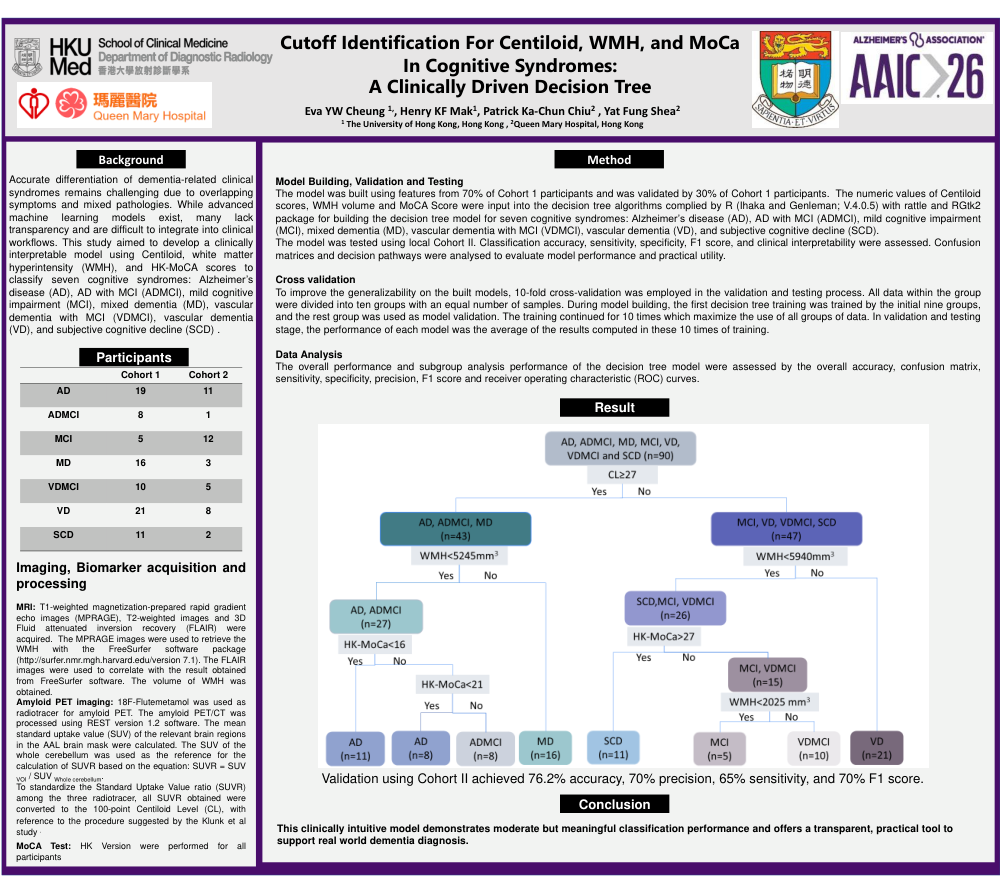
Accurate differentiation of dementia-related clinical syndromes remains challenging due to overlapping symptoms and mixed pathologies. While advanced machine learning models exist, many lack transparency and are difficult to integrate into clinical workflows. This study aimed to develop a clinically interpretable model using Centiloid, white matter hyperintensity (WMH), and HK-MoCA scores to classify seven cognitive syndromes: Alzheimer’s disease (AD), AD with MCI (ADMCI), mild cognitive impairment (MCI), mixed dementia (MD), vascular dementia with MCI (VDMCI), vascular dementia (VD), and subjective cognitive decline (SCD).
Methods:
This retrospective observational study included two independent cohorts. Cohort I consisted of participants assessed at the Queen Mary Hospital memory clinic (July 2017–June 2019). Cohort II included participants assessed at the Hong Kong West Cluster (January 2024–June 2025). All participants underwent standardized neuroimaging and cognitive assessments. A decision tree incorporating Centiloid, WMH volume, and HK-MoCA scores was developed using 10‑fold cross‑validation.
Results:
Decision Tree model first stratified participants by Centiloid level (CL). When CL ≥ 27, the model followed an AD‑related path, further separating cases using WMH at 5245 mm³ and HK-MoCA thresholds at 16 and 21 to classify AD, ADMCI, or MD. When CL < 27, the model followed a non‑AD pathway, splitting by WMH at 5940 mm³ and using HK‑MoCA (cutoff = 27) and WMH (2025 mm³) to classify SCD, MCI, VDMCI, or VD. Validation using Cohort II achieved 76.2% accuracy, 70% precision, 65% sensitivity, and 70% F1‑score.
Conclusion:
This clinically intuitive model demonstrates moderate but meaningful classification performance and offers a transparent, practical tool to support real‑world dementia diagnosis.
Comments
Email is required but is not shown publicly.
Loading comments...