4,068 posters, 219 videos, 101 topics, 69 sessions, 14,365 authors, 6,128 institutions
ePostersLive by SciGen Technologies S.A. All rights reserved.
Alzheimer's Association International Conference 2026
July 12-15, 2026 | London, United Kingdom, and Online

9541
Cognitive And Motor Behavior Impairments Across Neurodegenerative Diseases During A 3d Virtual Reality Task
Poster Presenter
Authors
Part of Topic
Cognitive and Motor Behavior Impairments Across Neurodegenerative Diseases During a 3D Virtual Reality Task
Gerardo Fernández1, Luis Mendez2, David Aguillon2, Valentin Barco3, Mario A Parra4
1) Chief Scientific Officer, ViewMind Inc., New York, USA
2) Grupo de Neurociencias, Universidad de Antioquia, Medellín, Colombia
3) Senior Data ScientiVist, ViewMind Inc., New York, USA
4) Department of Psychological Sciences and Health, University of Strathclyde, Glasgow, UK
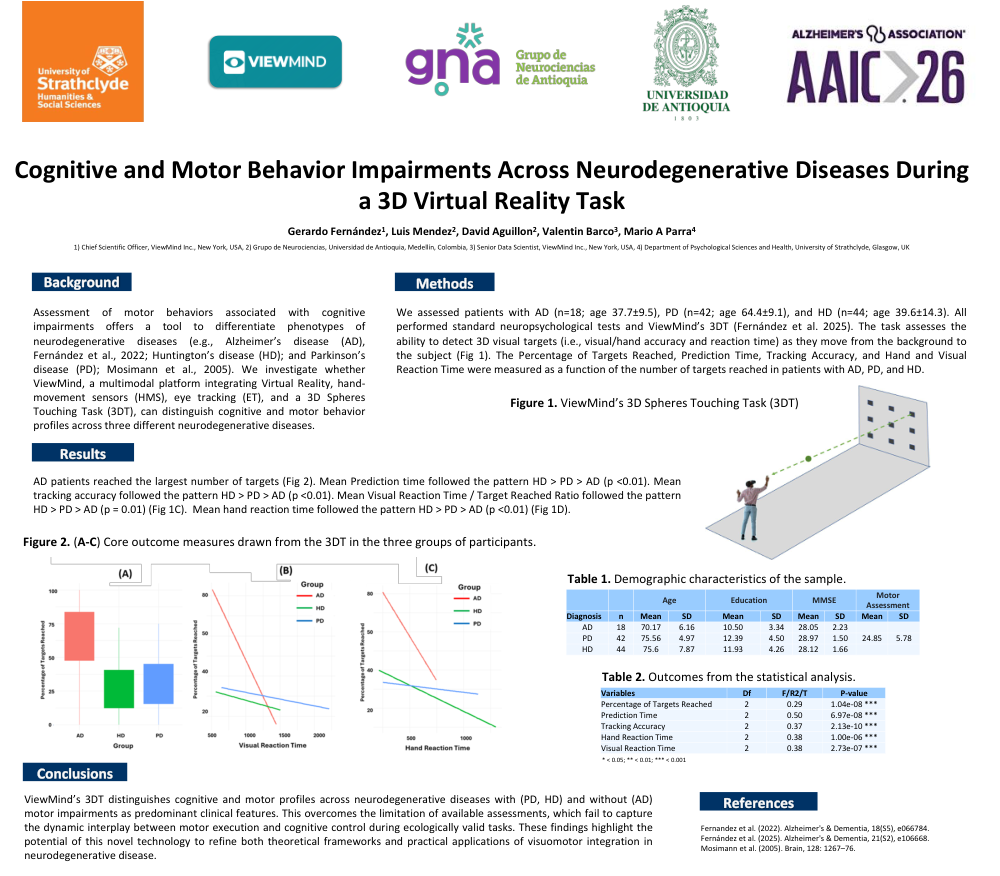
Background: Assessment of motor behaviors associated with cognitive impairments offers a tool to differentiate phenotypes of neurodegenerative diseases (e.g., Alzheimer’s disease (AD), Fernández et al., 2022; Huntington’s disease (HD); and Parkinson’s disease (PD); Mosimann et al., 2005). We investigate whether ViewMind, a multimodal platform integrating Virtual Reality, hand-movement sensors (HMS), eye tracking (ET), and a 3D Spheres Touching Task (3DT), can distinguish cognitive and motor behavior profiles across three different neurodegenerative diseases.
Methods: We assessed patients with AD (n=18; age 37.7±9.5), PD (n=42; age 64.4±9.1), and HD (n=44; age 39.6±14.3). All performed standard neuropsychological tests and ViewMind’s 3DT. The task assesses the ability to detect 3D visual targets (i.e., visual/hand accuracy and reaction time) as they move from the background to the subject (Fig 1A). The Percentage of Targets Reached, Prediction Time, Tracking Accuracy, and Hand and Visual Reaction Time were measured as a function of the number of targets reached in patients with AD, PD, and HD.
Results: AD patients reached the largest number of targets (Fig 1B). Mean Prediction time followed the pattern HD > PD > AD (p <0.01). Mean tracking accuracy followed the pattern HD > PD > AD (p <0.01). Mean Visual Reaction Time / Target Reached Ratio followed the pattern HD > PD > AD (p = 0.01) (Fig 1C). Mean hand reaction time followed the pattern HD > PD > AD (p <0.01) (Fig 1D).
Conclusion: ViewMind’s 3DT distinguishes cognitive and motor profiles across neurodegenerative diseases with (PD, HD) and without (AD) motor impairments as predominant clinical features. This overcomes the limitation of available assessments, which fail to capture the dynamic interplay between motor execution and cognitive control during ecologically valid tasks. These findings highlight the potential of this novel technology to refine both theoretical frameworks and practical applications of visuomotor integration in neurodegenerative disease.
References
Fernandez et al. (2022). Alzheimer's & Dementia, 18(S5), e066784.
Mosimann et al. (2005). Brain, 128: 1267–76.
Comments
Email is required but is not shown publicly.
Loading comments...