4,068 posters, 219 videos, 101 topics, 69 sessions, 14,365 authors, 6,128 institutions
ePostersLive by SciGen Technologies S.A. All rights reserved.
Alzheimer's Association International Conference 2026
July 12-15, 2026 | London, United Kingdom, and Online

9523
Integrity Of Memory Networks In The Alzheimer’S Disease Continuum
Poster Presenter
Authors
Part of Topic
Integrity of Memory Networks in the Alzheimer’s Disease Continuum
Mario A Parra1, Victor Shiramizu1, Fabio Luis de Souza Duran2, Andrea Slachevsky3,4,5, Gonzalo Forno3,4, Daniela Thumala3, Yaakov Stern6, Geraldo Busatto2,7
1) Department of Psychological Sciences and Health, University of Strathclyde, Glasgow, UK.
2) Laboratory of Psychiatric Neuroimaging (LIM-21), Departamento e Instituto de Psiquiatria, Hospital das Clínicas, School of Medicine, University of São Paulo, SãoPaulo, Brazil.
3) Gerosciences Centre for Brain Health and Metabolism (GERO), Santiago, Chile. b. Memory and Neuropsychiatric Centre (CMYN) Neurology Department, Hospital del Salvador & Faculty of Medicine, University of Chile, Chile.
4) Neuropsychology and Clinical Neuroscience Laboratory (LANNEC), Interdisciplinary Nucleus for Physiology, Biophysics and Pathophysiology– Institute of Biomedical Science, Neuroscience and East Neuroscience Departments, Faculty of Medicine, University of Chile, Avenida Salvador 486, Providencia, Santiago, Chile. 7500922
5) Neurology and Psychiatry Department, Clínica Alemana-University Desarrollo, Santiago, Chile.
6) Cognitive Neuroscience Division, Department of Neurology, Columbia University Vagelos College of Physicians and Surgeons, New York, NY, USA.
7) Núcleo de Apoio a Pesquisa em Neurociência Aplicada (NAPNA), University of São Paulo, São Paulo, Brazil.
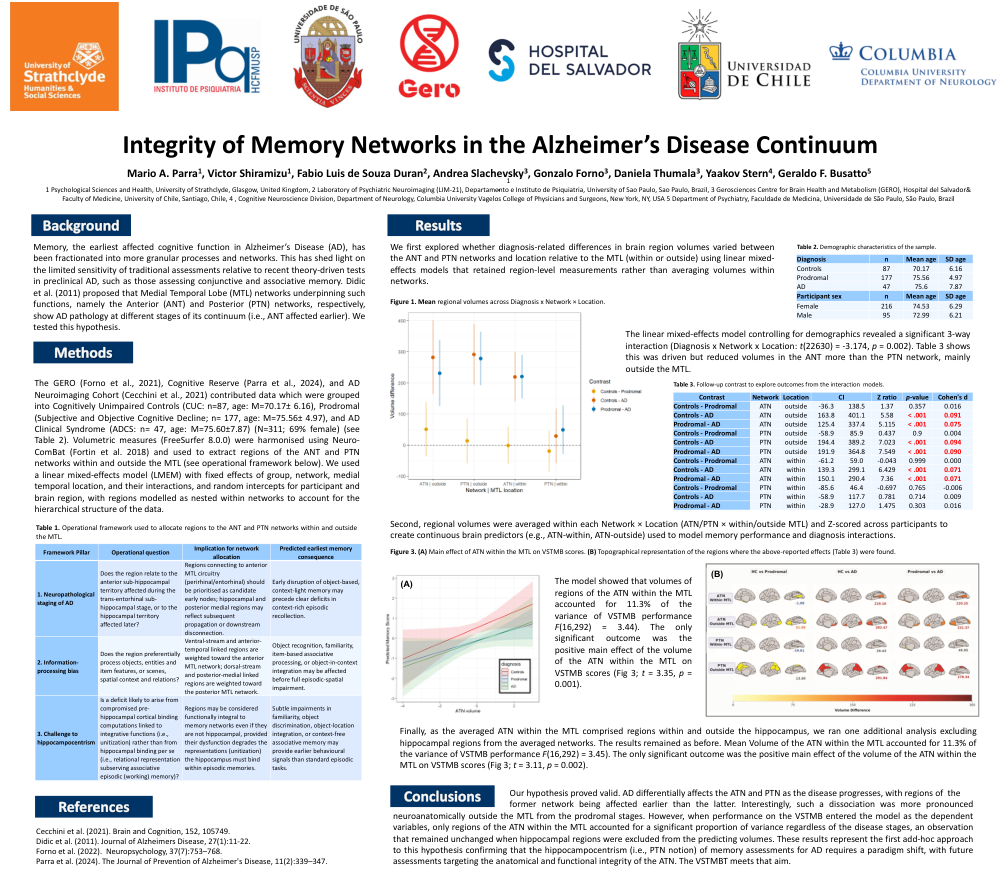
Background: Memory, the earliest affected cognitive function in Alzheimer’s Disease (AD), has been fractionated into more granular processes and networks. This has shed light on the limited sensitivity of traditional assessments relative to recent theory-driven tests in preclinical AD, such as those assessing conjunctive and associative memory. Didic et al. (2011) proposed that Medial Temporal Lobe (MTL) networks underpinning such functions, namely the Anterior (ANT) and Posterior (POST) networks, respectively, show AD pathology at different stages of its continuum (i.e., ANT affected earlier). We tested this hypothesis.
Methods: The GERO (Forno et al., 2021), Cognitive Reserve (Parra et al., 2024), and AD Neuroimaging Cohort (Cecchini et al., 2021) contributed data which were grouped into Cognitively Unimpaired Controls (CUC: n=87, age: M=70.17± 6.16), Prodromal (Subjective and Objective Cognitive Decline; n= 177, age: M=75.56± 4.97), and AD Clinical Syndrome (ADCS: n= 47, age: M=75.60±7.87) (N=311; 69% female). Volumetric measures (FreeSurfer 8.0.0) were harmonised using Neuro-ComBat (Fortin et al. 2018) and used to extract regions of the ANT and POST networks within and outside the MTL. We used a linear mixed-effects model (LMEM) with fixed effects of group, network, medial temporal location, and their interactions, and random intercepts for participant and brain region, with regions modelled as nested within networks to account for the hierarchical structure of the data.
Results: Z-ratios showed that network integrity in Prodromal cases < CUC with ANT (Z=2.7) more affected than (<) POST (1.9) (M=2.3). Prodromal > ADCS also with the ANT (Z=7.4) < POST (4.4) (M=5.9). Finally, CUC >> ADCS displaying a very similar pattern (ANT (Z=8.7) < POST (5.4) (M=7.0); all p<0.01; Fig 1).
Conclusions: In line with Didic et al.’s (2011) hypothesis, the ANT network is affected earlier than the POST. The pathology appears to spread outside the MTL earlier than within the MTL. Memory tests that tap into the integrity of the MTL, particularly its POST network, may not detect the earliest deficits in the AD clinical continuum.
References
Cecchini et al. (2021). https://doi.org/https://doi.org/10.1016/j.bandc.2021.105749
Didic et al. (2011). https://doi.org/10.3233/JAD-2011-110557
Forno et al. (2023). https://doi.org/10.1037/neu0000891
Fortin et al. (2018). https://doi.org/10.1016/j.neuroimage.2017.11.024
Parra et al. (2024). https://doi.org/10.14283/jpad.2024.11
Comments
Email is required but is not shown publicly.
Loading comments...