4,068 posters, 219 videos, 101 topics, 69 sessions, 14,365 authors, 6,128 institutions
ePostersLive by SciGen Technologies S.A. All rights reserved.
Alzheimer's Association International Conference 2026
July 12-15, 2026 | London, United Kingdom, and Online

8839
The Language That Does Not Yet Exist
Poster Presenter
Authors
Part of Topic
The Language That Does Not Yet Exist
Author: Rocío Mesa Martínez.
Neurology, Complejo Asistencial Universitario de León (CAULE), León, Spain.
Art/Reflection:
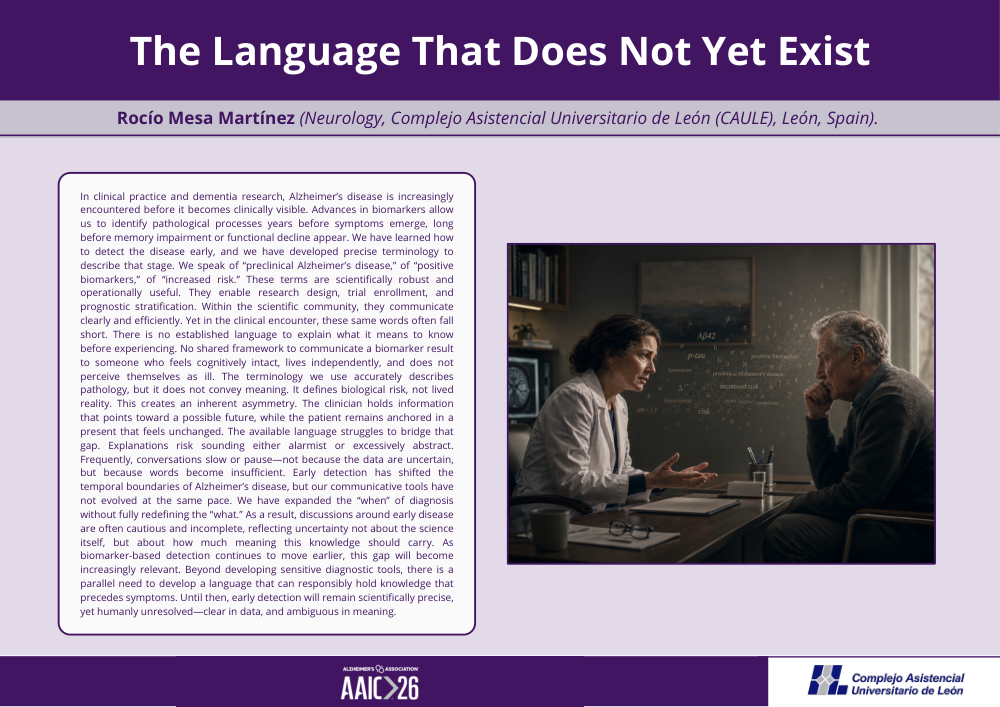
In clinical practice and dementia research, Alzheimer’s disease is increasingly encountered before it becomes clinically visible. Advances in biomarkers allow us toidentify pathological processes years before symptoms emerge, long before memory impairment or functional decline appear. We have learned how to detect thedisease early, and we have developed precise terminology to describe that stage. We speak of “preclinical Alzheimer’s disease,” of “positive biomarkers,” of “increasedrisk.” These terms are scientifically robust and operationally useful. They enable research design, trial enrollment, and prognostic stratification. Within the scientificcommunity, they communicate clearly and efficiently. Yet in the clinical encounter, these same words often fall short. There is no established language to explain whatit means to know before experiencing. No shared framework to communicate a biomarker result to someone who feels cognitively intact, lives independently, anddoes not perceive themselves as ill. The terminology we use accurately describes pathology, but it does not convey meaning. It defines biological risk, not lived reality.This creates an inherent asymmetry. The clinician holds information that points toward a possible future, while the patient remains anchored in a present that feelsunchanged. The available language struggles to bridge that gap. Explanations risk sounding either alarmist or excessively abstract. Frequently, conversations slow orpause—not because the data are uncertain, but because words become insufficient. Early detection has shifted the temporal boundaries of Alzheimer’s disease, butour communicative tools have not evolved at the same pace. We have expanded the “when” of diagnosis without fully redefining the “what.” As a result, discussionsaround early disease are often cautious and incomplete, reflecting uncertainty not about the science itself, but about how much meaning this knowledge should carry.As biomarker-based detection continues to move earlier, this gap will become increasingly relevant. Beyond developing sensitive diagnostic tools, there is a parallelneed to develop a language that can responsibly hold knowledge that precedes symptoms. Until then, early detection will remain scientifically precise, yet humanlyunresolved—clear in data, and ambiguous in meaning.
Comments
Email is required but is not shown publicly.
Loading comments...