4,068 posters, 219 videos, 101 topics, 69 sessions, 14,365 authors, 6,128 institutions
ePostersLive by SciGen Technologies S.A. All rights reserved.
Alzheimer's Association International Conference 2026
July 12-15, 2026 | London, United Kingdom, and Online

6530
The Doctor (in The Wearable Era)
Poster Presenter
Authors
Affiliations
Part of Topic
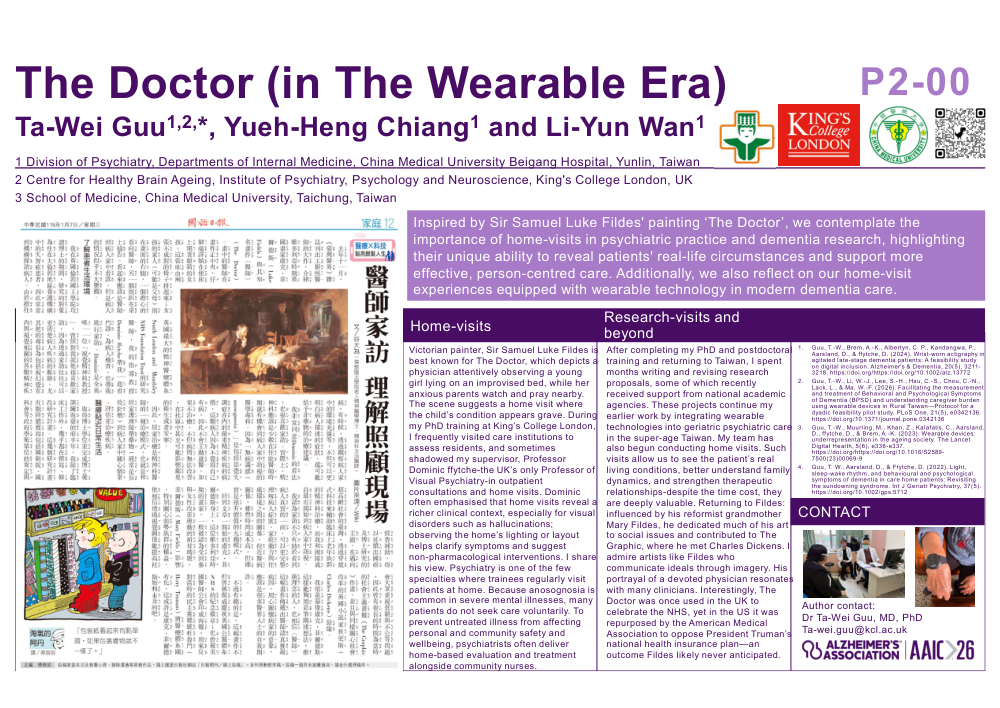
Victorian painter, Sir Samuel Luke Fildes is best known for The Doctor, which depicts a physician attentively observing a young girl lying on an improvised bed, while her anxious parents watch and pray nearby. The scene suggests a home visit where the child’s condition appears grave. During my PhD training at King’s College London, I frequently visited care institutions to assess residents, and sometimes shadowed my supervisor, Professor Dominic ffytche-the UK’s only Professor of Visual Psychiatry-in outpatient consultations and home visits. Dominic often emphasised that home visits reveal a richer clinical context, especially for visual disorders such as hallucinations; observing the home’s lighting or layout helps clarify symptoms and suggest non‑pharmacological interventions. I share his view. Psychiatry is one of the few specialties where trainees regularly visit patients at home. Because anosognosia is common in severe mental illnesses, many patients do not seek care voluntarily. To prevent untreated illness from affecting personal and community safety and wellbeing, psychiatrists often deliver home‑based evaluation and treatment alongside community nurses.
After completing my PhD and postdoctoral training and returning to Taiwan, I spent months writing and revising research proposals, some of which recently received support from national academic agencies. These projects continue my earlier work by integrating wearable technologies into geriatric psychiatric care in the super-age Taiwan. My team has also begun conducting home visits. Such visits allow us to see the patient’s real living conditions, better understand family dynamics, and strengthen therapeutic relationships-despite the time cost, they are deeply valuable. Returning to Fildes: influenced by his reformist grandmother Mary Fildes, he dedicated much of his art to social issues and contributed to The Graphic, where he met Charles Dickens. I admire artists like Fildes who communicate ideals through imagery. His portrayal of a devoted physician resonates with many clinicians. Interestingly, The Doctor was once used in the UK to celebrate the NHS, yet in the US it was repurposed by the American Medical Association to oppose President Truman’s national health insurance plan—an outcome Fildes likely never anticipated.
References:
Author contact: Dr Ta-Wei Guu, MD, PhD Ta-wei.guu@kcl.ac.uk
Comments
Email is required but is not shown publicly.
Loading comments...