4,068 posters, 219 videos, 101 topics, 69 sessions, 14,365 authors, 6,128 institutions
ePostersLive by SciGen Technologies S.A. All rights reserved.
Alzheimer's Association International Conference 2026
July 12-15, 2026 | London, United Kingdom, and Online

12997
Validation Of Automated Speech And Language Measures For Cognitive Classification And Detection Of Mild Behavioral Impairment
Poster Presenter
Part of Topic
Biomarkers -> Biomarkers (non-neuroimaging) -> Digital Health Technologies / Digital Biomarkers
Introduction
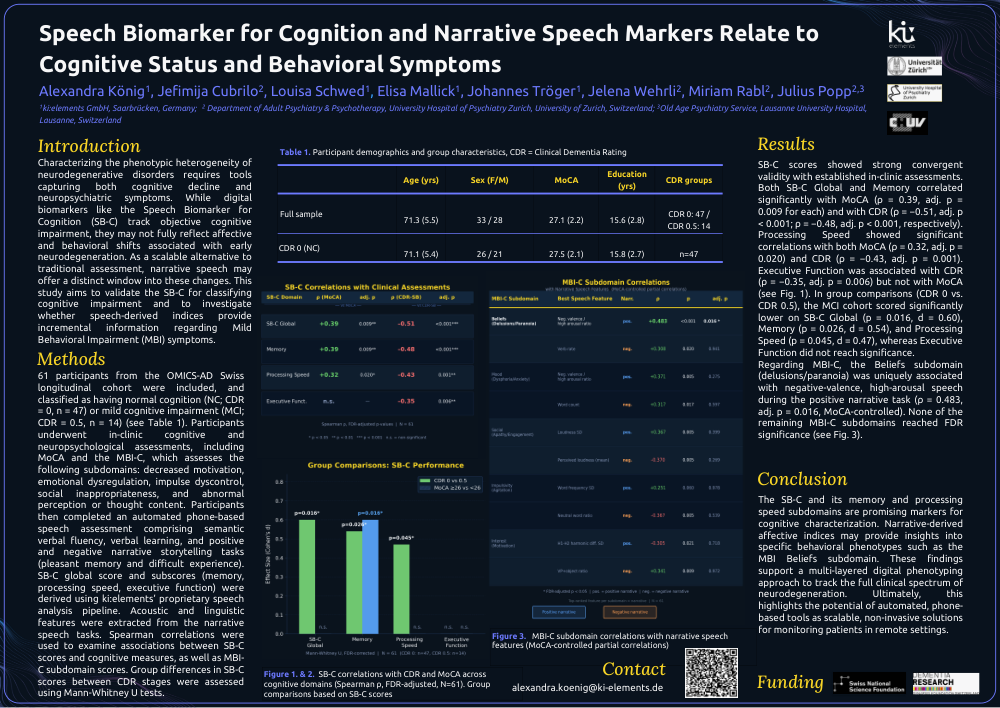
Characterizing the phenotypic heterogeneity of neurodegenerative disorders requires tools capturing both cognitive decline and neuropsychiatric symptoms. While digital biomarkers like the Speech Biomarker for Cognition (SB-C) track objective cognitive impairment, they may not fully reflect affective and behavioral shifts associated with early neurodegeneration. As a scalable alternative to traditional assessment, narrative speech may offer a distinct window into these changes. This study aims to validate the SB-C for classifying cognitive impairment and to investigate whether speech-derived indices provide incremental information regarding Mild Behavioral Impairment (MBI) symptoms.
Methods
61 participants from the OMICS-AD Swiss longitudinal cohort were included, and classified as having normal cognition (NC; CDR = 0, n = 47) or mild cognitive impairment (MCI; CDR = 0.5, n = 14) (see Table 1). Participants underwent in-clinic cognitive and neuropsychological assessments, including MoCA and the MBI-C, which assesses the following subdomains: decreased motivation, emotional dysregulation, impulse dyscontrol, social inappropriateness, and abnormal perception or thought content. Participants then completed an automated phone-based speech assessment comprising semantic verbal fluency, verbal learning, and positive and negative narrative storytelling tasks (pleasant memory and difficult experience). SB-C global score and subscores (memory, processing speed, executive function) were derived using ki:elements’ proprietary speech analysis pipeline. Acoustic and linguistic features were extracted from the narrative speech tasks. Spearman correlations were used to examine associations between SB-C scores and cognitive measures, as well as MBI-C subdomain scores. Group differences in SB-C scores between CDR stages were assessed using Mann-Whitney U tests.
Results
SB-C scores showed strong convergent validity with established in-clinic assessments. Both SB-C Global and Memory correlated significantly with MoCA (ρ = 0.39, adj. p = 0.009 for each) and with CDR (ρ = −0.51, adj. p < 0.001; ρ = −0.48, adj. p < 0.001, respectively). Processing Speed showed significant correlations with both MoCA (ρ = 0.32, adj. p = 0.020) and CDR (ρ = −0.43, adj. p = 0.001). Executive Function was associated with CDR (ρ = −0.35, adj. p = 0.006) but not with MoCA (see Fig. 1). In group comparisons (CDR 0 vs. CDR 0.5), the MCI cohort scored significantly lower on SB-C Global (p = 0.016, d = 0.60), Memory (p = 0.026, d = 0.54), and Processing Speed (p = 0.045, d = 0.47), whereas Executive Function did not reach significance.
Regarding MBI-C, the Beliefs subdomain (delusions/paranoia) was uniquely associated with negative-valence, high-arousal speech during the positive narrative task (ρ = 0.483, adj. p = 0.016, MoCA-controlled). None of the remaining MBI-C subdomains reached FDR significance (see Fig. 3).
Conclusion
The SB-C and its memory and processing speed subdomains are promising markers for cognitive characterization. Narrative-derived affective indices may provide insights into specific behavioral phenotypes such as the MBI Beliefs subdomain. These findings support a multi-layered digital phenotyping approach to track the full clinical spectrum of neurodegeneration. Ultimately, this highlights the potential of automated, phone-based tools as scalable, non-invasive solutions for monitoring patients in remote settings.
Comments
Email is required but is not shown publicly.
Loading comments...