4,068 posters, 219 videos, 101 topics, 69 sessions, 14,365 authors, 6,128 institutions
ePostersLive by SciGen Technologies S.A. All rights reserved.
Alzheimer's Association International Conference 2026
July 12-15, 2026 | London, United Kingdom, and Online

13247
The Impact Of Neuroimaging Markers Of Cerebrovascular Disease On Plasma Biomarker Levels In Alzheimer’S Disease Patients
Poster Presenter
Part of Topic
Biomarkers -> Biomarkers (non-neuroimaging) -> Fluid biomarkers
Background
Plasma biomarkers have emerged as important tools for diagnosing Alzheimer’s disease (AD) and for monitoring treatment response and disease progression. Cerebral vessel disease (CVD) frequently coexists with AD and may influence the interpretation of plasma AD biomarkers. However, the impact of neuroimaging markers of CVD on plasma AD biomarker levels remains unclear.
Methods
Patients with AD confirmed by CSF biomarkers or amyloid PET imaging were enrolled. 3.0 T MRI was performed to assess the Fazekas score and to quantify cerebral microbleeds using SWI. Plasma levels of Aβ40, Aβ42, p-tau181, p-tau217, GFAP, and NfL were measured using electrochemiluminescence assays. Spearman correlation analysis was conducted to evaluate the associations between imaging markers and plasma biomarkers. Multivariable linear regression models were further constructed to determine the independent effects of CVD-related imaging markers on plasma biomarker levels.
Results
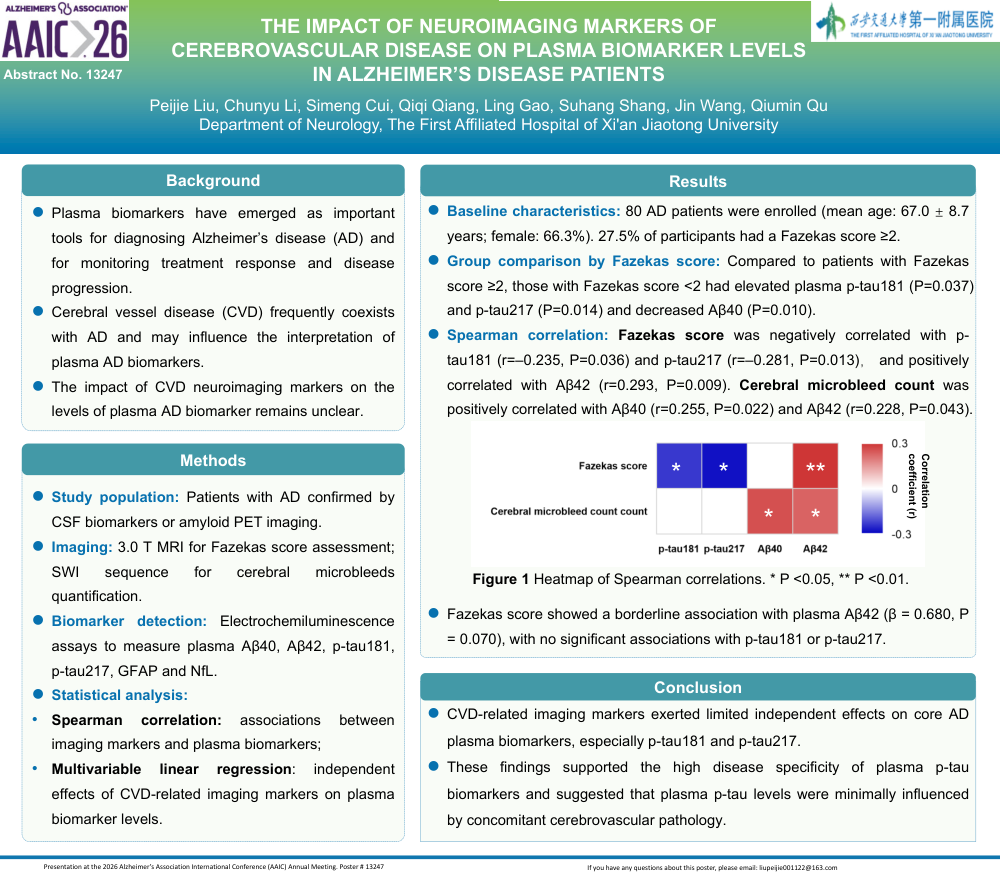
A total of 80 patients with AD (mean age 67.0 ± 8.7 years, 66.3% female, 27.5% had a Fazekas score≥2) were included. Plasma p-tau181 (P = 0.037) and p-tau217 (P = 0.014) levels were significantly higher in patients with Fazekas <2 compared to those with Fazekas ≥2. And Aβ40 (P = 0.010) was significantly lower in patients with Fazekas <2. Spearman correlation analysis showed that Fazekas score was negatively correlated with plasma p-tau181 (r = –0.235, P = 0.036) and p-tau217 (r = –0.281, P = 0.013), and positively correlated with Aβ42 levels (r = 0.293, P = 0.009). The number of cerebral microbleeds was also positively correlated with plasma Aβ40 (r = 0.255, P = 0.022) and Aβ42 (r = 0.228, P = 0.043). In multivariable linear regression analyses adjusting for age, sex, and comorbidities, Fazekas score showed a borderline association with plasma Aβ42 (β = 0.680, P = 0.070), but was not significantly associated with p-tau181 or p-tau217 levels.
Conclusions
This study found that CVD-related imaging markers show limited independent effects on core AD biomarkers, particularly p-tau181 and p-tau217. These findings support the relatively high disease specificity of plasma p-tau biomarkers and indicate that their levels are minimally influenced by concomitant cerebrovascular pathology.
Comments
Email is required but is not shown publicly.
Loading comments...