4,068 posters, 219 videos, 101 topics, 69 sessions, 14,365 authors, 6,128 institutions
ePostersLive by SciGen Technologies S.A. All rights reserved.
Alzheimer's Association International Conference 2026
July 12-15, 2026 | London, United Kingdom, and Online

13306
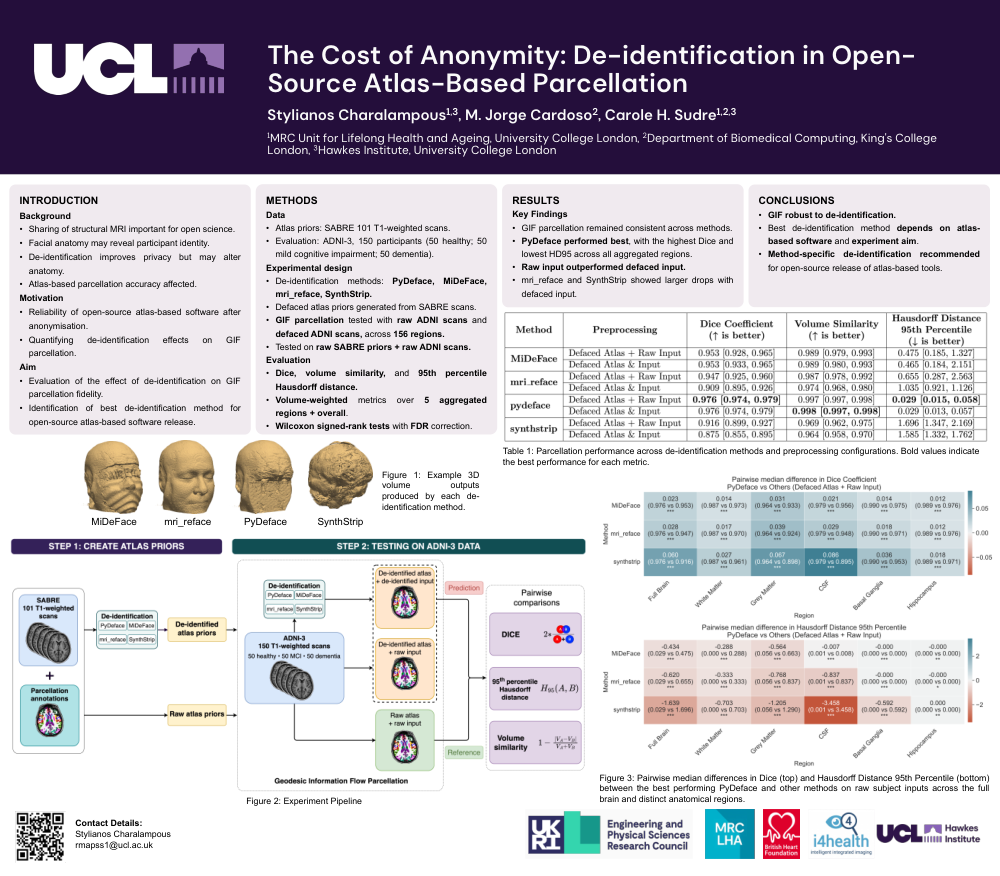
The Cost Of Anonymity: De-identification In Open-source Atlas-based Parcellation
Poster Presenter
Authors
Affiliations
1. MRC Unit for Lifelong Health and Ageing, University College London, 2.Hawkes Institute, University College London, Department of Biomedical Computing, King's College London, 1.MRC Unit for Lifelong Health and Ageing, University College London, 2.Department of Biomedical Computing, King's College London, 3.Hawkes Institute, University College London
Part of Topic
Biomarkers -> Neuroimaging -> Novel imaging methods
Background: Structural MRI data are essential for brain analysis, but sharing raises privacy concerns due to identifiable facial features. De-identification methods enhance privacy but may introduce geometric or intensity changes affecting downstream pipelines. This project evaluated de-identification effects on Geodesic Information Flow (GIF) parcellation accuracy to support open-source atlas-based software release, critical for ensuring anatomical fidelity and usability post-anonymisation.
Methods: Four de-identification techniques (PyDeface, MiDeFace, mri_reface, SynthStrip) were evaluated under two configurations. The first set defaced voxels to background, and the second set both defaced regions and an encompassing facial bounding box to NaN to preserve anonymity, with the best approach selected for reporting. Method-specific atlas priors were generated from 101 SABRE T1-weighted MRI scans.Testing involved 150 ADNI-3 participants (50 cognitively normal, 50 mild cognitive impairment, 50 dementia) parcellated against de-identified atlases using raw and preprocessed inputs. Parcellation fidelity was assessed against the original atlas via Dice coefficients, 95th-percentile Hausdorff distance (HD), and volumetric differences. Volume-weighted scores were computed for brain and anatomical regions, ensuring global accuracy was not skewed by region size.Statistical comparisons utilised Wilcoxon signed-rank tests with Benjamini-Hochberg (FDR) correction.
Results: Methods maintained high agreement with reference parcellations, showing minimal Dice coefficient deviations (Table 1). PyDeface achieved the highest fidelity, significantly reducing HD across all regions with superior anatomical boundary preservation (Figure 1). Bland-Altman analysis confirmed negligible preprocessing effects for MiDeFace and PyDeface (Figure 2), though mri_reface and SynthStrip performance degraded when symmetric de-identification was applied to both atlas and input.
Conclusion: Dice deviations were minor across the cohort, but PyDeface best preserved anatomical boundary integrity with sub-millimetre HD. Computational efficiency favours using raw inputs against de-identified atlases; however, for GIF-based pipelines, this is recommended primarily for facial-obscuration methods like PyDeface or MiDeFace. Performance drops with mri_reface and SynthStrip suggest that overly invasive de-identification limits accuracy, even if it increases the structural similarity between the input and atlas images.Ultimately, PyDeface offers the optimal balance between privacy and precision, supporting the use of raw inputs without compromising neuroanatomical fidelity. Releasing robust open-source atlas-based software requires de-identification and preprocessing strategies specifically tailored to the custom parcellation algorithm to maintain performance.
Comments
Email is required but is not shown publicly.
Loading comments...