4,068 posters, 219 videos, 101 topics, 69 sessions, 14,365 authors, 6,128 institutions
ePostersLive by SciGen Technologies S.A. All rights reserved.
Alzheimer's Association International Conference 2026
July 12-15, 2026 | London, United Kingdom, and Online

13376
Subjective Cognitive Decline Improves Prediction Of Incident MCI Beyond AD Blood Biomarkers And Cognitive Measures
Poster Presenter
Authors
Thomas Claessen, Jeremiah Aakre, Maria Vassilaki, Veronique Marcotte, Clifford Jack, Alicia Algeciras-Schimnich, Ronald Petersen, Argonde van Harten
Affiliations
Department of Neurology, Mayo Clinic, USA, Neurochemistry Laboratory, Department of Clinical Chemistry, Amsterdam UMC, the Netherlands, Alzheimer Center Amsterdam, Department of Neurology, Amsterdam UMC, The Netherlands, Department of Quantitative Health Sciences, Mayo Clinic, USA, Department of Radiology, Mayo Clinic, USA, Department of Laboratory Medicine and Pathology, Mayo Clinic, USA, Department of Neurology, Mayo Clinic, USA
Part of Topic
Biomarkers -> Biomarkers (non-neuroimaging) -> Prognostic utility
Background
Objective
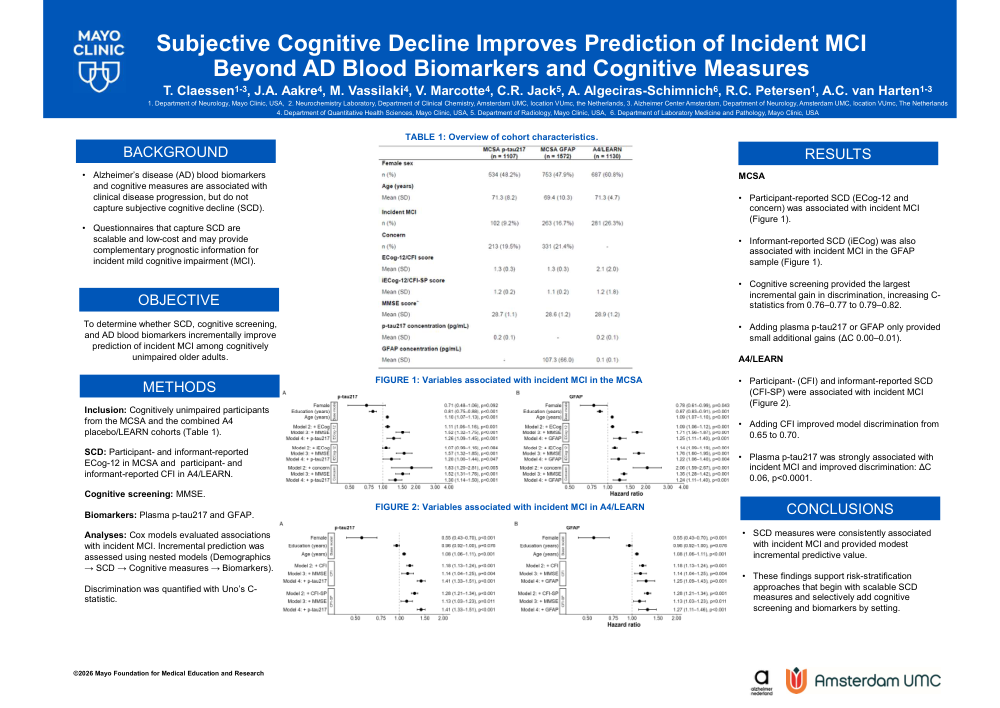
To determine whether SCD, cognitive screening, and AD blood biomarkers incrementally improve prediction of incident MCI among cognitively unimpaired older adults.
Methods
Inclusion: Cognitively unimpaired participants from the MCSA and the combined A4 placebo/LEARN cohorts (Table 1).
SCD: Participant- and informant-reported ECog-12 in MCSA and participant- and informant-reported CFI in A4/LEARN.
Cognitive screening: MMSE.
Biomarkers: Plasma p-tau217 and GFAP.
Analyses: Cox models evaluated associations with incident MCI. Incremental prediction was assessed using nested models (Demographics → SCD → Cognitive measures → Biomarkers).
Discrimination was quantified with Uno’s C-statistic.
Results
MCSA
A4/LEARN
Conclusions
Comments
Email is required but is not shown publicly.
Loading comments...